
3 Years or 12 Months? Australian First Aid Certificate Timeframe

In Australia, the standard guidance is that Provide First Aid (HLTAID011) is refreshed every three years, while CPR (HLTAID009) should be refreshed every 12 months. These aren’t hard legal expiry dates. They’re industry currency recommendations, and some workplaces or placements will ask for more recent proof than the standard timeframe allows.
TL;DR:
Most workplaces expect first aid certificates to be refreshed every three years and CPR annually, but industry updates may require more frequent refreshes.
The certification issue date is not an expiry; instead, your skills and knowledge must stay aligned with current Australian Resuscitation Council guidelines.
Different first aid units have varying refresh requirements, with HLTAID011 needing a three-year refresh and HLTAID009 requiring an annual CPR update.
Employers and regulators may enforce shorter renewal intervals based on workplace risk, especially in high-risk or vulnerable settings like childcare or remote sites.
Mobile and on-site training options help remote and FIFO teams maintain currency without long downtime or travel, with certificates issued promptly after completion.
Table of Contents
Why your first aid certificate timeframe isn’t a fixed expiry date
Your statement of attainment carries an issue date, not a use-by date. Nobody voids it the day it turns three years old. What changes is your “currency”, the industry’s word for whether your skills and knowledge still line up with current best practice.
That distinction matters because resuscitation science moves. The Australian Resuscitation Council periodically updates its guidelines on compression ratios, airway management and defibrillation, and those updates flow through into training content. A certificate issued five years ago might teach a technique that’s since been refined. Refreshing regularly keeps your skills matched to what the ARC actually recommends today, not what it recommended when you first sat the course.
Workplace safety law adds another layer. Safe Work Australia and the state Codes of Practice expect employers to actively manage first aid competence across their workforce, not just tick a box once every few years. Some employers set shorter intervals than the industry standard because their risk profile demands it.
The commonly cited pattern across Australian training providers is straightforward:
HLTAID011 Provide First Aid: refresh every few years, typically around three years
HLTAID009 Provide CPR: refresh annually
Pro Tip: If you’re not sure which certificate an employer actually wants refreshed, ask for the unit code, not just “first aid”. HLTAID011 and HLTAID009 have different clocks.
What are HLTAID011, HLTAID009, and related first aid units?
Not every “first aid certificate” is the same qualification, and the currency expectations shift depending on which unit you hold.
HLTAID011 Provide First Aid is the broad, nationally recognised unit most workplaces mean when they say “first aid certificate.” It covers CPR, wound management, shock, choking, and a range of medical emergencies, and the standard refresh window is three years.
HLTAID009 Provide CPR is narrower and sits inside HLTAID011 but is often treated as its own currency item. Because compressions and rescue breathing are perishable skills, most guidance recommends refreshing this annually, and it can be run as a standalone short course rather than the full first aid day. This is why you can legitimately hold a valid three-year first aid certificate while still needing a CPR top-up sooner.
A few related units carry their own expectations worth knowing:
HLTAID012 Provide First Aid in an Education and Care Setting, aimed at childcare workers, often reviewed alongside licensing requirements.
HLTAID013 Provide First Aid in Remote or Isolated Site, built for FIFO and remote crews with limited access to emergency services.
HLTAID014 Provide Advanced First Aid, for roles with a higher clinical scope.
Some providers, including international ones like the Red Cross, historically use different validity windows for equivalent courses, so always check the exact unit code and provider wording rather than assuming every “first aid” course follows the same three year clock.
When should you book your first aid renewal?
Working out your own first aid certificate timeframe is simple once you know your completion date. Here’s how to stay ahead of it rather than scrambling after it’s lapsed:
Find your completion date on your statement of attainment, not the date you printed or downloaded it.
Set two reminders, one at 12 months for CPR and one at three years for the full HLTAID011 refresh.
Book ahead of the deadline, ideally four to six weeks out, so a fully booked course or a rostering clash doesn’t push you past your currency window.
Choose your delivery mode: a full face-to-face day, a blended option combining online theory with a practical session, or on-site and mobile training that comes to remote or FIFO worksites.
Save your proof. Keep a digital copy of your certificate and check your USI transcript periodically, since it holds a historical record of everything you’ve completed.
Course length matters for planning shift coverage. HLTAID011 typically runs 7.5 to 9.5 hours, often delivered as a single day, and public course pages in Queensland list similar durations around 9.5 hours. A standalone HLTAID009 CPR refresher is considerably shorter, usually a few hours, which is exactly why it works as an annual top-up rather than a full retraining day.
Pro Tip: Mobile and on-site delivery is worth asking about if you manage a team spread across a remote site. Bringing the trainer to the crew avoids the downtime of sending workers offsite for a public course.
What do employers and regulators actually expect?
The Safe Work Australia Code of Practice requires employers to manage first aid competence across their workforce as an ongoing obligation, not a set-and-forget certificate. That’s where the “typical” three-year and 12-month timeframes can shift in practice.
Certain industries push for tighter cycles because the consequences of outdated skills are higher. Childcare and aged care often expect more frequent CPR currency given the vulnerability of the people in care. Health settings expect the same for similar reasons. Mining and other high-risk industrial sites, especially remote ones, often mandate stricter refresh schedules because emergency services response times are longer.
If your employer asks for evidence more recent than your certificate’s standard window, don’t assume they’ve made a mistake:
Ask exactly which unit code and currency period they’re enforcing.
Request an employer-funded refresher if the tighter timeframe is a condition of your role.
Book a standalone CPR update rather than a full first aid day if that’s all the gap requires.
An expired first aid certificate can stop you working in a role that requires it as a condition of employment, and in regulated settings it can affect compliance audits and insurance standing.
How specialised delivery keeps Australian workplaces current
Staying inside your first aid certificate timeframe gets harder the further you are from a training centre, which is exactly the gap Prime First Aid and Training was built to close. On-site and mobile delivery brings the trainer to remote sites, including mine operations in the Pilbara, so crews don’t lose a rostered day travelling for a public course.
Mobile and on-site courses reduce downtime for FIFO and remote teams facing tight rosters.
Blended delivery options cut the time staff spend off the tools.
Certificates and statements of attainment are issued promptly on completion, so there’s no gap in your evidence trail.
Course content is tailored to the actual hazards a workplace faces, not a generic template.
Our take on getting ahead of the renewal cycle
Most of the confusion around first aid certificate timeframe comes from treating “three years” as a legal deadline rather than a currency recommendation. It isn’t. The real risk isn’t a technicality, it’s turning up to an emergency with compression techniques or protocols that the Australian Resuscitation Council has since revised.
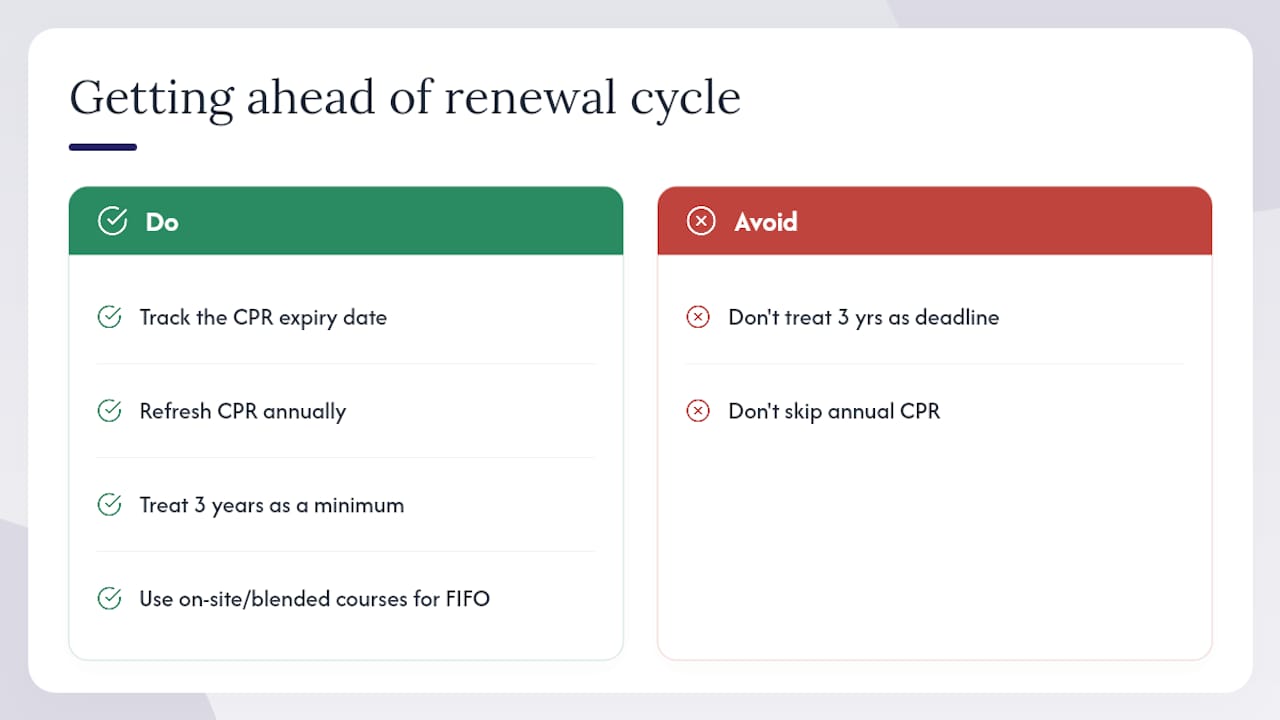
The conventional advice, “renew every three years,” undersells the CPR piece. Annual CPR refreshers matter more than the headline first aid figure because that skill decays faster and gets used under more pressure than most first aid content. If you’re only tracking one date, track the CPR one.
For remote and FIFO teams, the priority isn’t finding a course, it’s finding one that doesn’t cost a rostered swing. On-site and blended delivery through providers like Prime First Aid and Training solves the logistics problem, not just the compliance one. Get the CPR clock right, treat the three-year mark as a floor rather than a target, and check with your employer whenever a placement or a higher-risk role is involved.
— Vapour
Book your renewal before the clock runs out
Certificates are issued promptly on completion, and some providers offer on-site and mobile courses that bring training to your crew rather than requiring travel offsite. For remote and FIFO teams, on-site and mobile delivery can be scheduled around your roster, with blended options available where a full day off the tools isn’t realistic.
Whether you need a full HLTAID011 Provide First Aid course, an annual HLTAID009 CPR top-up, or a remote-site specific option like HLTAID013, course content is tailored to your actual worksite hazards rather than a generic slide deck. Certificates are issued promptly on completion, so there’s no gap between finishing the course and having proof in hand. Check upcoming dates and book online to lock in your renewal before your currency lapses.
Where to check the rules yourself
Safe Work Australia for the Code of Practice and employer obligations.
Training for official unit codes and provider records.
Queensland’s public course guidance for course length and delivery detail.
UMA College’s currency guide for a practical industry summary.
Sources
FAQ
How long does a first aid certificate last in Australia?
HLTAID011 Provide First Aid is commonly refreshed every few years, typically around three years, while HLTAID009 CPR should be refreshed annually to stay current.
How long does a first aid certificate take to complete?
HLTAID011 typically runs 7.5 to 9.5 hours, often as a single day or blended course, while a standalone CPR refresher takes considerably less time.
Is first aid certification valid for two or three years?
The standard Australian guidance for HLTAID011 is typically around three years, though some providers or older course variants have used shorter validity periods, so always confirm the exact unit code and provider terms.
How long is a first aid certificate valid before I need to renew?
Treat three years as the general benchmark for HLTAID011, but check with your employer or placement host, since some workplaces set shorter intervals for compliance reasons.
Can Prime First Aid and Training help with renewals for remote teams?
Yes. Prime First Aid and Training offers on-site and mobile delivery designed for FIFO and remote crews, reducing downtime while keeping certificates current.
Recommended
Comments