
Avoid Compliance Gaps: First Aid Refresher for Australian Workplaces

CPR skills need refreshing regularly each year, while a full first aid qualification like HLTAID011 is commonly renewed on a multi-year cycle. “Current” for workplace purposes means your training matches what your employer and industry expect, not just what the certificate date says. Prime First Aid and Training delivers both renewal pathways locally, and the rest of this guide walks through the rules, the proof you need, and how to book without leaving a compliance gap.
TL;DR:
CPR must be refreshed annually because it is a perishable skill, while full first aid qualifications like HLTAID011 typically renew every three years.
Employers are responsible for ensuring first aiders are currently capable, meaning they meet industry-specific renewal requirements beyond just certificate expiry dates.
Higher-risk industries such as construction and childcare often require more frequent or specialized refreshers, sometimes with internal policies tighter than national guidelines.
Digital certificates and USI transcripts are valid proof of training, but employers should verify completion and current competency through official records instead of relying solely on expiry dates.
On-site, blended, or mobile training options are recommended to maintain currency without disrupting operations and are tailored to the specific risk profile of each workplace.
Table of Contents
What are the first aid refresher requirements under Australian workplace law?
How to renew your first aid or CPR certification, step by step
What are employers responsible for when it comes to workforce currency?
Prime First Aid and Training: how our delivery options match refresher needs
Book your refresher with a provider built for how Australian workplaces actually operate
What are the first aid refresher requirements under Australian workplace law?
There’s no single federal law that states “renew every X years” in black and white. Instead, SafeWork NSW guidance sets the benchmark most Australian workplaces follow: first aiders should hold a nationally recognised qualification issued by a Registered Training Organisation (RTO), CPR should be refreshed annually, and first aid qualifications are typically renewed every three years. That guidance shapes how workplace safety plans are built across the country.
Here’s where a lot of businesses trip up. A certificate might say it’s valid for three years, but “valid” and “current” aren’t the same thing under work health and safety (WHS) duties. Your employer’s obligation is to make sure the person responding to an incident can actually perform the skill competently, right now, not just hold a piece of paper that hasn’t technically expired.
That’s the currency question, and it matters more in some settings than others:
Construction and mining sites often require CPR refreshers well inside the standard annual window because of higher injury risk and remote response times.
Childcare and education settings frequently mandate specific variants covering anaphylaxis and asthma management, on top of standard first aid.
Office-based workplaces may follow the standard three-year and annual pattern with less variation.
Check your own employer’s policy before assuming the general guidance is all you need. Higher-risk industries frequently set tighter internal timelines than the baseline.
CPR versus full first aid: why the timelines are different
CPR and first aid aren’t the same qualification, and they don’t run on the same clock. Confusing the two is one of the most common mistakes safety officers make when scheduling refreshers.
HLTAID009 Provide Cardiopulmonary Resuscitation covers CPR specifically, and it’s treated as a perishable skill. That’s not marketing language. Resuscitation technique, timing, and confidence under pressure degrade faster than most other first aid knowledge, which is why annual refreshing is the accepted industry standard rather than a three-year cycle.
HLTAID011 Provide First Aid is the broader qualification. It includes CPR but also covers wound management, fractures, burns, anaphylaxis response, and incident management more generally. Because it’s a wider skill set assessed less frequently, the common renewal pattern sits at three years.
In practice, this gives you a few pathways depending on what’s lapsed:
CPR-only refresher if your HLTAID011 is still current but your annual CPR component is due.
Full HLTAID011 renewal every three years, covering CPR and the broader first aid competencies together.
Blended learning with a short practical skills session, which many RTOs accept for renewal candidates who complete theory online first.
Which courses and units actually count toward compliance
Not every “first aid course” satisfies workplace requirements. What matters is the unit code and whether it’s delivered by an RTO issuing a nationally recognised qualification.
HLTAID009 (Provide Cardiopulmonary Resuscitation) covers CPR only and should be refreshed annually.
HLTAID011 (Provide First Aid) is the standard workplace qualification, commonly renewed every three years.
HLTAID012 (Provide First Aid in an Education and Care Setting) adds anaphylaxis and asthma modules required in childcare and education roles.
Sector-specific variants may be mandated by your employer depending on award conditions or site-specific risk assessments, so check before booking a generic course.
When it comes to proof, a digital certificate is the easiest option, but it isn’t the only acceptable evidence. Every RTO-issued qualification is recorded against your Unique Student Identifier (USI), and you can pull a full transcript of your training history if you’ve misplaced a certificate or an employer needs to verify completion. That transcript is treated as authoritative evidence when a printed certificate isn’t available.
If you work in education or childcare, confirm with your employer whether HLTAID011 alone satisfies the role or whether the education and care variant is specifically required. This trips people up more often than the timing rules themselves.
How to renew your first aid or CPR certification, step by step
Getting this right isn’t complicated, but skipping a step usually costs you time later.
Check your completion date and employer policy first. Some employers set stricter internal windows than the standard guidance, so don’t assume the printed expiry is your real deadline.
Book two to three months before expiry. This gives you flexibility around dates and avoids a gap where you’re technically not covered as a designated first aider.
Choose the right pathway. A CPR-only refresher suits someone whose HLTAID011 is still valid. Blended learning, with online theory plus a short in-person skills check, suits those renewing the full qualification. A lapsed certificate generally means a full course.
Bring the right evidence. Photo ID, your USI, and proof of your prior certificate (digital copy or USI transcript) if the trainer needs to confirm your eligibility for a shortened refresher rather than a full course.
Expect a practical skills assessment, even in a short refresher. Certificates are issued promptly on completion and recorded against your USI.
Pro Tip: If your certificate has already lapsed, don’t assume you’re locked into the full course everywhere. Some RTOs allow a short revalidation window past the expiry date, so it’s worth confirming eligibility with the provider directly before you book, rather than assuming the worst.
What are employers responsible for when it comes to workforce currency?
Under WHS duties, employers need to make a risk-based judgement about how many first aiders are needed on-site, how current their skills need to be, and how that maps against staffing patterns, shift work, and site risk. It’s not a set-and-forget obligation.
Practically, this comes down to a handful of controls that safety officers can put in place without much overhead:
A central training register tracking completion dates against each staff member’s role, not just their certificate expiry.
Calendar reminders set at the two to three month mark before renewal is due, giving enough lead time to book without a compliance gap.
Written confirmation of completed training filed against the register, ideally cross-checked against USI records rather than relying on staff to self-report.
A contingency plan for when a certificate lapses unexpectedly, such as temporarily reassigning first aid duties to another currently qualified staff member while the gap is filled.
Tracking currency, not just expiry dates, is the difference between a system that catches problems early and one that only notices a gap after an incident.
Prime First Aid and Training: how our delivery options match refresher needs
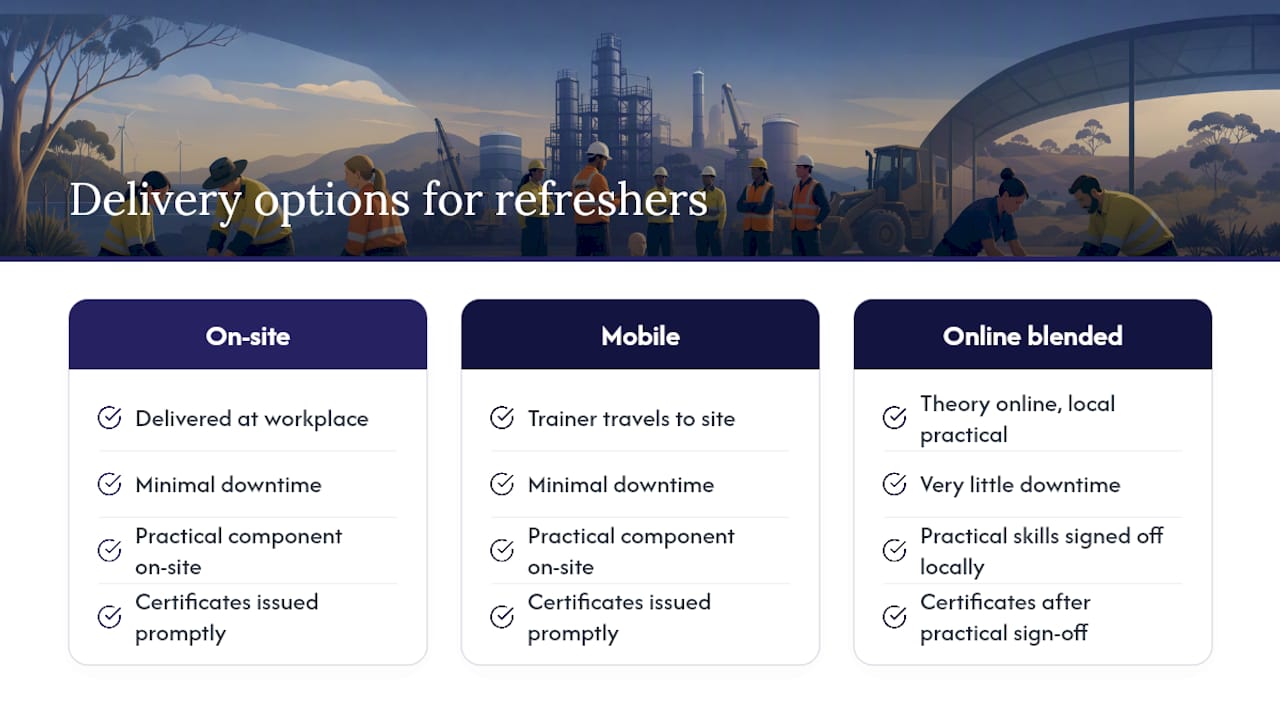
We built our course offering around a simple observation: the businesses that struggle most with refresher timing are usually the ones with the least flexibility to send staff off-site for a full day. That’s especially true for remote operations, including the mine sites we regularly work with across the Pilbara.
Our approach is to bring the training to the workforce rather than the other way around. On-site delivery, mobile training, and online blended options mean a refresher doesn’t have to mean a full day off the tools, and certificates are issued promptly once the practical skills component is signed off. We also customise course content to the actual risk profile of the business, so a construction crew and a childcare centre aren’t sitting through identical material. That’s how we see currency staying genuinely current, not just current on paper.
— Vapour
Book your refresher with a provider built for how Australian workplaces actually operate
Primetraining is the practical alternative to sending your whole team off-site for a day you don’t have to spare. Because we deliver on-site, mobile, and blended online courses, you can schedule a CPR-only refresher or a full HLTAID011 renewal around your roster instead of around a training calendar that doesn’t fit your site.
Before you book, check with your safety officer or HR contact on which unit your role actually requires. Standard HLTAID011, the education and care variant, or a CPR-only top-up all lead to different sessions. Once you know which one you need, browse our available courses to see formats and dates, or head straight to book online to lock in a session before your certificate lapses. If you’re coordinating training for a remote or Pilbara-based team, our Port Hedland page has details on mobile delivery to your site.
Sources
Recommended
Comments