
5–10 Minute Hearing Protector Fit Tests for Safety Managers

Hearing protector fit testing gives each worker a measurable personal attenuation rating (PAR), so you can verify and train to a real on-the-job level of protection rather than trusting a manufacturer’s laboratory figure. NIOSH, the NHCA, and OSHA all treat it as a best-practice pillar of any hearing conservation program. If you need to prove your workers are actually protected, not just issued earplugs, this is how you do it.
TL;DR:
Fit testing provides a worker-specific Personal Attenuation Rating that reflects actual noise reduction achieved during typical insertion and wearing, unlike laboratory-based NRR or SNR ratings.
The most reliable fit-testing systems are either subjective REAT tests, which are flexible but slower, or objective F-MIRE systems, which are faster but often restrict testable earplug types.
Testing should prioritize new workers, those issued different hearing protectors, high-exposure employees, and those showing hearing issues, with retesting frequency based on risk factors.
On-site fit testing involves pre-checks, baseline measurement, coaching, retesting, and recordkeeping, with mobile options allowing rapid testing of large groups during shift changeovers.
Choosing a provider requires confirming system validation, accreditation, compatibility with your PPE stock, training quality, and scalability to your worksite’s schedule.
Table of Contents
What does hearing protector fit testing actually measure?
Fit testing produces a Personal Attenuation Rating, a decibel figure showing how much noise reduction a specific worker gets from a specific hearing protector, fitted the way they actually fit it. Subtract the PAR from the workplace’s A-weighted noise level and you get a genuine estimate of what reaches that worker’s ear, rather than a number pulled from a lab sheet.
That distinction matters more than it sounds. Manufacturer Noise Reduction Ratings (NRR) and Single Number Ratings (SNR) are generated under controlled laboratory conditions with trained fitters, not on a factory floor at 6am with a worker who has never been shown how to roll a foam plug properly. Most hearing conservation programs apply a de-rating factor to NRR figures to account for this gap, but de-rating is still a guess. A PAR is not.
PAR is worker-specific and reflects real insertion technique, not lab conditions.
NRR/SNR are ceiling figures, rarely achieved in the field.
Fit testing converts a compliance assumption into a verified number.
The inter-laboratory comparison of fit-test systems found that two widely used systems, FitCheck and HPD Well-Fit, agreed with laboratory REAT results to within roughly ±2 dB, while a third system, VeriPRO, tended to underestimate attenuation. Which system you use changes the number you get, and that has real implications for how you interpret borderline results.
REAT, MIRE, and F-MIRE: which fit-testing method suits your workforce?
Two broad families of fit-testing method dominate the field, and each suits a different operational reality.
Subjective REAT-style testing (sometimes called under-headphone testing) asks the worker to detect test tones with and without their hearing protector fitted, under headphones or in a sound booth. It works with almost any hearing protective device, including foam plugs, pre-moulded plugs, and earmuffs, which makes it flexible across a mixed HPD inventory.
Objective F-MIRE (field microphone-in-real-ear) systems place a small microphone inside and outside the ear canal and measure attenuation directly and quickly, often in under a minute per ear. The catch is compatibility: many objective systems need a modified earplug fitted with a probe tube, so they work best with a specific plug type rather than whatever your workers already have in their pockets.
Subjective testing: flexible across HPD types, slower per worker, strong training value through direct feedback.
Objective F-MIRE: fast, ideal for large cohorts, but often locks you to a compatible plug.
Many programs run both: objective for quick baseline screening, subjective for problem cases or unusual HPDs.
Neither method is universally “better.” The right choice depends on your existing HPD stock, how many workers you need to test in a shift, and how much coaching time you can afford per person.
Who should you fit test, and how often?
Not every worker needs testing on the same schedule. Prioritise based on risk and where protection gaps are most likely to bite.
New enrolments into the hearing conservation program, before they rely on a device day to day.
Any worker issued a new or different hearing protective device model or size.
Workers in the highest noise exposure categories, where a poor fit carries the most consequence.
Workers who show indications of hearing changes such as a threshold shift or report tinnitus.
Periodic retesting for the general workforce, because initial PAR gains from training tend to decay over time without reinforcement.
There is no single correct interval. A workforce with high task variability, frequent turnover, or inconsistent insertion habits needs tighter retest cycles than a stable crew with strong training compliance. Treat the schedule as a risk decision, not a fixed calendar rule.
How does an on-site fit-testing session actually run?
A well-run fit-testing day follows a predictable rhythm, whether it happens in a dedicated room or out of a mobile van parked beside the crib room.
Pre-check: confirm the worker’s current HPD, size, and any hearing history flags.
Baseline fit test: measure attenuation as the worker currently wears the device, untouched.
Coaching and refit: if the PAR is low, the trainer demonstrates correct insertion and retests immediately.
Final fit test: confirm the improved PAR after coaching.
Record and action: log the PAR, device details, and any recommended follow-up (retrain, switch device, escalate to audiology).
Most objective systems process a worker in five to ten minutes, including coaching; subjective REAT testing typically takes longer given the listening-task format. For a site with dozens or hundreds of workers, mobile testing with multiple stations running in parallel gets through a shift roster far faster than sending people off-site in batches, and it tends to see better worker uptake because it doesn’t eat into their day.
Pro Tip: Book fit testing on the same day as toolbox talks or shift changeovers. Workers are already gathered, and you avoid the productivity hit of pulling people off task individually.
Every result needs a record: worker name, HPD make/model/size, test method, calibration date of the equipment used, PAR achieved, and the action taken. These records slot directly into your existing hearing conservation program documentation and give you an audit trail if a threshold shift is ever queried.
What should you ask before choosing a fit-testing provider?
A handful of pointed questions separates a properly run program from a box-ticking exercise.
Does the system perform to recognised criteria such as ASA/ANSI S12.71, and can the provider show calibration and audit records?
Will they supply sample worker-level reports before you commit, showing PAR, device used, and recommended action?
Does the objective system lock you into one plug manufacturer, or can it test the HPDs already in your stores?
Does the provider actually train insertion technique on the day, or just print a number and leave?
Can they scale to your shift patterns, including remote or rotating-roster sites?
A good provider treats the test as a coaching moment, not a pass/fail checkbox. If a vendor can’t produce a sample report or explain how their system was validated against REAT, that’s a red flag worth acting on before you sign anything.
How Primetraining delivers fit testing that matches best practice
Primetraining runs mobile, on-site hearing protective device fit testing built around the same principles NIOSH, the NHCA, and OSHA point to: measurable PAR, hands-on coaching, and proper recordkeeping. Sessions map directly onto hearing conservation program requirements, whether you’re running a Pilbara mine site or a metro workshop.
Mobile delivery, so testing happens on your site without idle downtime.
Worker-level PAR reporting with device details and recommended actions.
Trainers with industry-relevant experience across mining, construction, and industrial settings.
Fast-tracked certificates so records are in your hands almost immediately.
Primetraining also runs respiratory protective equipment fit testing, useful if your site manages both hearing and respiratory PPE compliance under one program.
Fit testing works because it changes behaviour, not just because it measures it
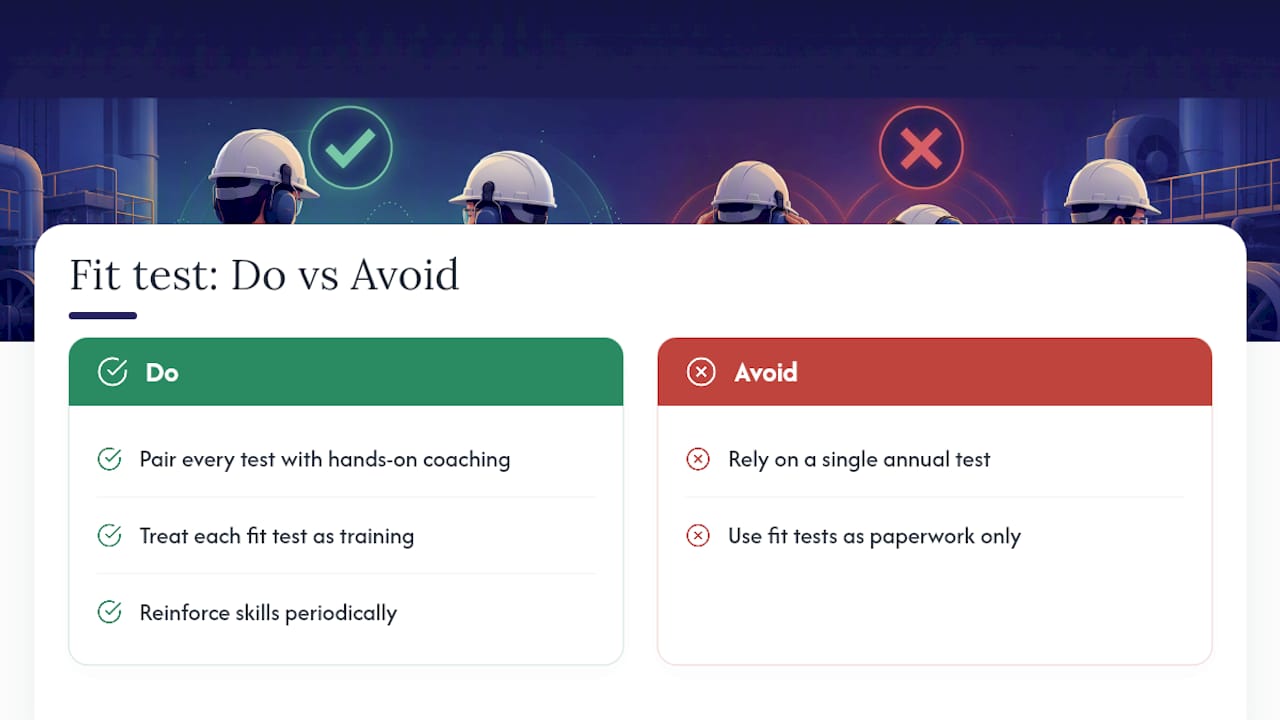
Treating fit testing purely as a measurement exercise misses half the value. The number matters, but the coaching moment that produces a better number matters just as much, because evidence shows initial gains fade without reinforcement. A single annual test that isn’t paired with hands-on insertion coaching risks becoming a paperwork exercise rather than a protection strategy.
The programs that actually reduce threshold shifts over years, not just on paper, are the ones that treat every fit test as a short training session first and a compliance record second.
— Vapour
Book mobile fit testing and staff training with Primetraining
Primetraining is the direct route to compliant, on-site fit testing without the delay of sending crews off-site or chasing separate providers for training and certification. We run mobile fit-testing sessions across industrial, remote, and healthcare workplaces, pairing every test with real insertion coaching and fast-tracked certificates so your records are ready the same day.
Whether you need a single site visit or an ongoing schedule tied to your hearing conservation program, our trainers bring the equipment and the experience to get it done properly the first time. Browse our full course offering to see how fit testing fits alongside other compliance training, or head straight to book online and lock in a session for your crew.
Sources
For policy decisions, consult the NHCA position statement, NIOSH’s 2025 recommendation, and SafeWork NSW’s PPE guidance.
Inter-laboratory comparison of three earplug fit-test systems — PMC
Recommended
Comments