
Preserve Shifts: Mobile First Aid Training for Australian Workplaces

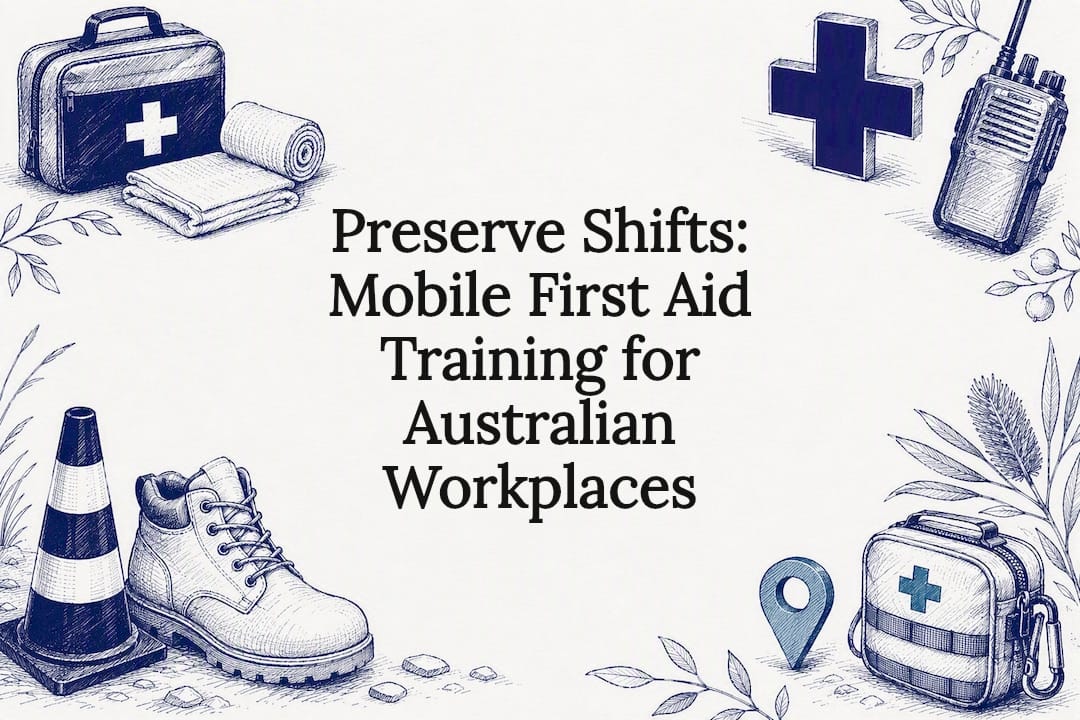
Mobile first aid training brings a qualified trainer to your workplace or school instead of sending your people to a public classroom. The process runs in three stages: online prestudy where required, an onsite practical session for skills and assessment, and certificate issuance once competency is confirmed. For organisations, that means less downtime, less travel, and content built around your actual site risks.
TL;DR:
Mobile first aid training is ideal for remote, shift-based, or site-specific environments where travel or shift patterns make public courses impractical.
The training includes online theory, onsite practical assessments, and immediate certificate issuance, with assessments requiring in-person skill checks by qualified trainers.
Trainers must be affiliated with a registered organization and hold current assessor qualifications to verify competency through skill demonstrations and scenario tasks.
Booking several weeks in advance is crucial for remote sites to coordinate logistics, space, and equipment, ensuring the session runs smoothly.
Tailored scenarios and group rates make onsite training more cost-effective and relevant than generic public courses, especially for larger teams or complex risk profiles.
Table of Contents
How does mobile first aid training work step by step?
Booking mobile training starts well before the trainer arrives on site, and each stage exists to make sure the final certificate reflects real, observed skill.
Scoping call. You confirm which accredited units you need, how many participants are involved, and any site-specific hazards worth building into the scenarios, whether that’s confined spaces on a mine site or medication protocols in a childcare centre.
Pre-course theory. Many units use blended delivery, where participants complete online modules before the trainer arrives. This is where you check that everyone has a device and stable internet, because a person who hasn’t finished the theory component usually can’t sit the practical assessment on the day.
Onsite practical session. The trainer runs demonstrations, supervised skill practice, and simulated scenarios such as CPR on a mannequin or managing a chemical exposure. Sessions typically run in structured blocks so every participant gets hands-on time rather than watching from the back of the room.
Assessment and verification. The trainer observes each person against the required performance criteria, checks photo ID against enrolment records, and signs off competency. Where the assessment is successful, certificates are usually issued same day or within a short turnaround, which matters when a compliance deadline is close.
Blended delivery cuts the time a trainer needs onsite, but it doesn’t replace the face-to-face component. Practical units still require an assessor to watch you perform the skill in person.
Which accredited units get delivered onsite?
Not every first aid unit suits every workplace, and matching the right code to your risk profile saves you from booking (or being sold) more than you need.
HLTAID009 (Provide Cardiopulmonary Resuscitation) is a short, practical-only unit focused purely on CPR technique. It suits refresher training and roles where CPR is the primary requirement.
HLTAID011 (Provide First Aid) is the standard workplace unit covering CPR plus broader first aid response, and it’s the one most Australian businesses need for general compliance.
HLTAID013 (Provide First Aid in Remote or Isolated Site) and HLTAID014/HLTAID015 extend into advanced and remote-context skills, built for teams working hours from the nearest hospital.
HLTSS00068 (Occupational First Aid Skill Set) groups several units together for designated workplace first aiders who need a broader scope of practice.
Most of these units use blended delivery for the theory component, but the face-to-face assessment is non-negotiable for any unit with a practical skills component. Expect anywhere from a half day to a full day onsite depending on the unit and group size.
What are the benefits of mobile first aid training?
Mobile delivery earns its place when travel time, shift patterns, or site-specific hazards make a public course impractical.
Reduced downtime. Sending a dozen shift workers offsite for a day of training costs more in lost productivity than the course itself. A trainer coming to you keeps people on site between shifts.
Tailored scenarios. A construction site, a school, and an aged care facility face different emergencies. Onsite delivery lets the trainer build scenarios around your actual risks rather than generic textbook examples.
Group cost efficiency. Training ten or more people at once onsite is usually more cost-effective than paying for ten individual public course seats, once travel and lost hours are factored in.
Pro Tip: If your site has irregular shift patterns, ask whether the trainer can split a group session into two shorter blocks. It’s often easier than trying to get an entire shift into one room at once.
What do you need to prepare before the trainer arrives?
Lead times matter more than most organisers expect, particularly for remote sites where flights, road access, or fly-in-fly-out rosters affect scheduling. Book several weeks ahead where possible, and further out again for isolated locations where a trainer needs to coordinate transport.
Space. A clear floor area free of furniture, suitable for CPR practice and group scenarios.
Power and AV. Access to power points and, ideally, a screen or projector for any video-based content.
Privacy. A space where assessments can run without interruption from other staff walking through.
Equipment. The trainer typically brings mannequins, first aid kits, and training materials. Hosts are usually asked to confirm access, parking, and site induction requirements in advance.
Getting this logistics sorted before the visit is the difference between a session that runs to time and one that eats into your afternoon chasing a spare room.
How are trainers qualified and how is competency assessed?
Every trainer running an accredited unit must be affiliated with a Registered Training Organisation (RTO) and hold current assessor qualifications, not just first aid experience. That distinction matters. A workplace first aider and a qualified trainer/assessor are not the same thing.
Observed skill checks against set performance criteria, such as correct compression depth and rate for CPR.
Simulated scenario tasks where participants respond to a mock emergency under time pressure.
ID verification at the start of the session, matched against enrolment details.
Attendance and competency records kept for audit purposes, which employers and schools may need to produce if a regulator or insurer asks for proof of training.
These records matter as much as the certificate itself if your workplace is ever audited over a safety incident.
What does mobile delivery actually look like on the ground?
Delivering training on a working mine site is a different exercise to running a course in a training room. Rosters shift, access requires induction, and equipment has to travel with the trainer.
Coordinating around fly-in-fly-out rosters means the training has to fit the site’s clock, not the other way around. Tailoring content to genuine site hazards, whether that’s heat stress on a Pilbara mine site or manual handling injuries on a construction job, makes the difference between a course people tolerate and one they actually use.
Confirming online module completion before the visit, reserving a genuinely usable assessment space, and coordinating any related requirements like respiratory fit testing alongside first aid all reduce the chance of a wasted trip. Mobile delivery also preserves rosters and reduces the travel burden that would otherwise pull staff off remote or shift-based sites for a full day.
When mobile training is the better choice
Mobile onsite training earns its keep for larger groups, site-specific scenarios, or remote and shift-based teams where travel isn’t practical. A single new starter or a straightforward refresher is often better served by a public course or online update. If you’re deciding, ask: how many people need training, how unusual are your site risks, and how far is the nearest public course?
— Vapour
Booking mobile first aid training with Primetraining
We offer onsite delivery of accredited first aid units, including HLTAID011 Provide First Aid, HLTAID013 for remote and isolated sites, and the HLTSS00068 Occupational First Aid Skill Set, which can be tailored to mine sites, construction crews, schools, and healthcare teams.
We work with businesses that can’t afford to lose a shift to travel and with schools that need training built around their own risk profile, not a generic textbook scenario. Browse the full range of courses to see which unit fits your team, then request your preferred dates through our online booking page. For remote sites, book several weeks ahead so we can plan logistics properly, and have your space and participant list ready when we confirm.
Sources and further reading
Injury data from the AIHW’s report on injuries in children and adolescents and its state and territory breakdown informs why schools prioritise onsite readiness. The WA Department of Education’s guidance outlines staff capability expectations for education settings.
FAQ
How does first aid training work?
Accredited first aid training combines theory, either in a classroom or completed online beforehand, with a face-to-face practical session where a qualified assessor observes your skills and confirms competency before issuing a certificate.
What does “mobile training” mean?
Mobile training means the trainer travels to your workplace, school, or remote site to deliver the course, rather than participants attending a fixed public venue.
Is there a free online first aid course with a certificate available in Australia?
Free online modules exist for general awareness, but they don’t meet accreditation requirements on their own. Nationally recognised units like HLTAID011 require an observed practical assessment, so a genuine accredited certificate isn’t available through online study alone.
Is an online first aid course valid?
Online-only completion is valid for the theory component of blended units, but it isn’t sufficient on its own for units with a practical skills requirement. You still need a face-to-face assessment with a qualified trainer to receive a nationally recognised certificate.
Recommended
Comments