
HLTAID012: Childcare First Aid Rules Aussie Parents Can Verify

The core childcare first aid requirement in Australia is HLTAID012, Provide First Aid in an Education and Care Setting, held by staff whose CPR stays current annually and whose full certificate is renewed roughly every three years. Beyond the qualification itself, a compliant service needs stocked first aid kits, written asthma and anaphylaxis plans, and, in many settings, an accessible defibrillator. State and territory rules add further detail. It pays to check your local regulator too.
TL;DR:
The training unit HLTAID012 is essential for staff with ongoing responsibility for children, covering infant CPR, choking, asthma, and allergy management.
Staff must undergo annual CPR refreshers and renew the full first aid certificate roughly every three years to maintain compliance.
Childcare services need properly stocked first aid kits in all areas, individual emergency plans for children with health issues, and accessible defibrillators where appropriate.
Practical, face-to-face assessment with hands-on CPR and choking drills is required for a course to meet the standard, not just online theory.
Responsibilities and requirements vary by state and center size, making risk-based staffing and kit planning crucial for actual emergency readiness.
Table of Contents
What childcare first aid requirements actually cover under Australian law
There’s no single “childcare first aid law” that spells everything out in one document. Instead, the requirement sits across a nationally recognised training unit, a workplace safety code, and state-based education and care regulations, and it helps to understand how these three pieces fit together.
HLTAID012 – Provide First Aid in an Education and Care Setting is the unit designed specifically for this environment. It’s not the same as a standard workplace first aid certificate. HLTAID012 covers infant and child CPR, choking response for children and babies, and management of conditions like asthma and anaphylaxis in a childcare context, along with practical, hands on assessment using manikins. A carer trained only in adult first aid may not know the different compression depth, breathing technique, or airway management a toddler needs, which is precisely the gap this unit closes.
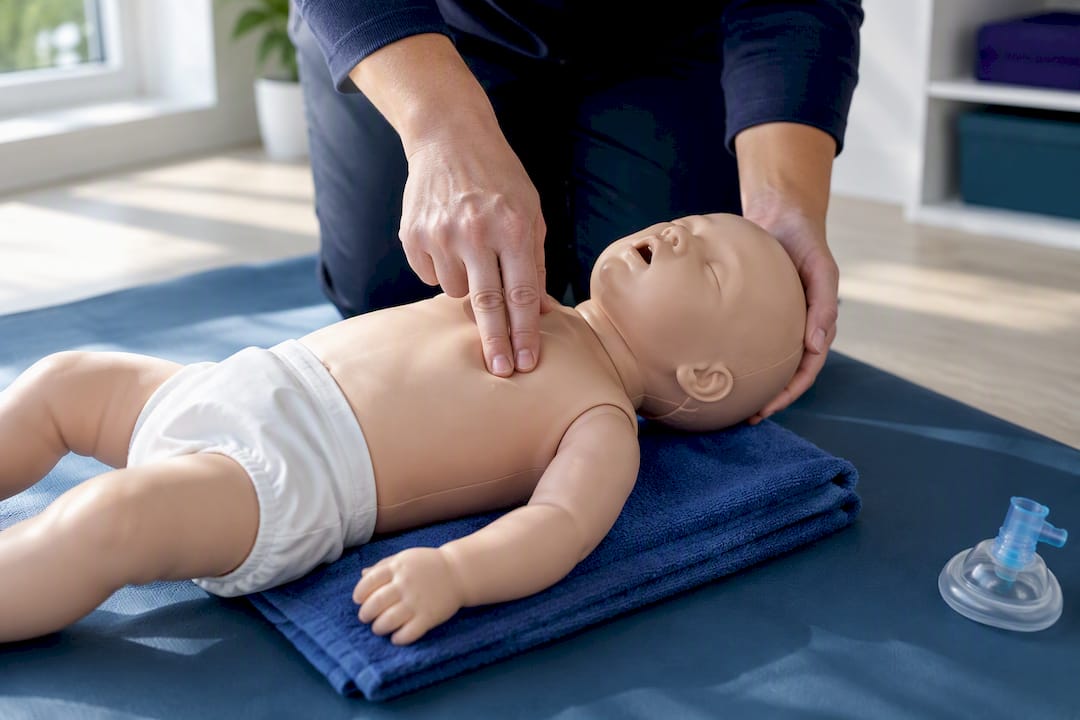
The Australian Resuscitation Council (ARC) sets the clinical guidelines behind the CPR technique taught in every accredited course, including how defibrillator use is adjusted for smaller bodies. Training providers build their courses around these ARC guidelines, so when you see “ARC-aligned” on a course outline, that’s what it’s referring to.
Then there’s the Safe Work Australia Code of Practice, which governs first aid arrangements more broadly across workplaces, childcare centres included. It recommends:
A risk-based approach to deciding staffing, kit numbers, and placement rather than a one-size-fits-all rule
Annual CPR refreshers and first aid renewal roughly every three years as common practice
Regular review of arrangements as the service, its numbers, or its layout change
Because licensing rules vary between states and territories, always check your own regulator’s requirements alongside these national standards. What’s mandatory in Western Australia may differ slightly from Queensland or Victoria.
Practical first aid arrangements every childcare service should have
Compliance isn’t just a certificate on a wall. It’s stocked kits, the right number of trained people, and plans that staff can follow under pressure. Here’s what to look for when you’re assessing a service, whether you’re a parent choosing care or a manager running one.
First aid kits, properly placed. Every room and outdoor play area should have quick access to a stocked kit, and centres should carry a portable version for excursions and outings.
Enough trained first aiders on every shift. Safe Work Australia’s risk management approach means a small family day care might need one trained carer present, while a larger centre with 60 or more children across multiple rooms needs several, positioned so no room is ever without cover.
AED access or a first aid room where warranted. Larger centres, or those in areas with slower emergency response times, often benefit from an on-site defibrillator and a dedicated space to manage an incident away from other children.
Documented emergency action plans. Every child with asthma or a diagnosed allergy needs an individual plan on file, reviewed with parents, that names symptoms, medication, and exactly who administers it.
Clear EpiPen protocols. Staff need to know where each child’s auto-injector is stored, who’s trained to use it, and how quickly they can reach it during an outing, not just inside the centre.
Pro Tip: Ask to see a sample emergency action plan (with names redacted) before enrolling your child. A centre that can produce one instantly, rather than promising to “get back to you,” usually has genuinely embedded systems rather than paperwork built for inspection day.
Who needs which qualification, and how currency actually works
Not every adult in a childcare setting needs the same certificate, and understanding the distinctions helps you ask sharper questions when you’re checking a service’s compliance.
Educators and carers with direct, ongoing responsibility for children should hold HLTAID012, given its paediatric focus. Kitchen staff, administrative personnel, or casual visitors might only need general first aid (HLTAID011) or CPR (HLTAID009), depending on their level of contact with children and the service’s own risk assessment. This is a genuine difference, not a technicality: a course built for adult workplaces simply doesn’t teach the child-specific compression rates and airway techniques HLTAID012 does.
On currency, the common baseline nationally is:
CPR should be refreshed regularly, as the skill can degrade without practice
Full first aid certification is commonly renewed every few years
Services checking their own state or territory rules, since some regulators set stricter timeframes
Rostering is where this gets tested in the real world. A compliant service maps its shifts so a currently certified first aider is on the floor at all times, including during lunch breaks, early drop-offs, and late pickups when staffing thins out. Family day care educators, working solo in a home setting, carry that responsibility every hour they have children in care, which is exactly why their currency needs even closer attention than staff in a centre with backup colleagues nearby.
What a genuinely compliant HLTAID012 course looks like
A certificate alone doesn’t tell you much. What matters is whether the training behind it actually prepared someone for a real paediatric emergency.
A proper HLTAID012 course includes hands-on CPR practice on infant and child manikins, choking response drills, and at least one simulated scenario contextualised to a childcare setting, not a generic office or factory floor. Blended delivery is acceptable, where theory is completed online, but only when the practical, face-to-face assessment component is still included and documented. A certificate issued from an entirely online course with no hands-on assessment doesn’t meet the standard.
When you’re evaluating a provider, look for:
The unit code HLTAID012 printed on the certificate, not a vague “childcare first aid” label
Evidence of practical assessment, not just an online quiz
Trainers who can speak specifically to asthma, anaphylaxis, and paediatric scenarios
Flexible delivery, onsite or mobile, that fits around rostering without pulling every educator off the floor at once
Prime First Aid and Training runs HLTAID012 courses with onsite and mobile delivery, tailored content, and prompt certification once assessment is complete, which matters for services trying to keep enough qualified staff rostered without long turnaround waits.
Why checking credentials properly matters more than most parents realise
Most parents take a centre’s first aid signage at face value. That’s a mistake, not because childcare providers are dishonest, but because “first aid trained” can mean wildly different things depending on which course someone actually sat.
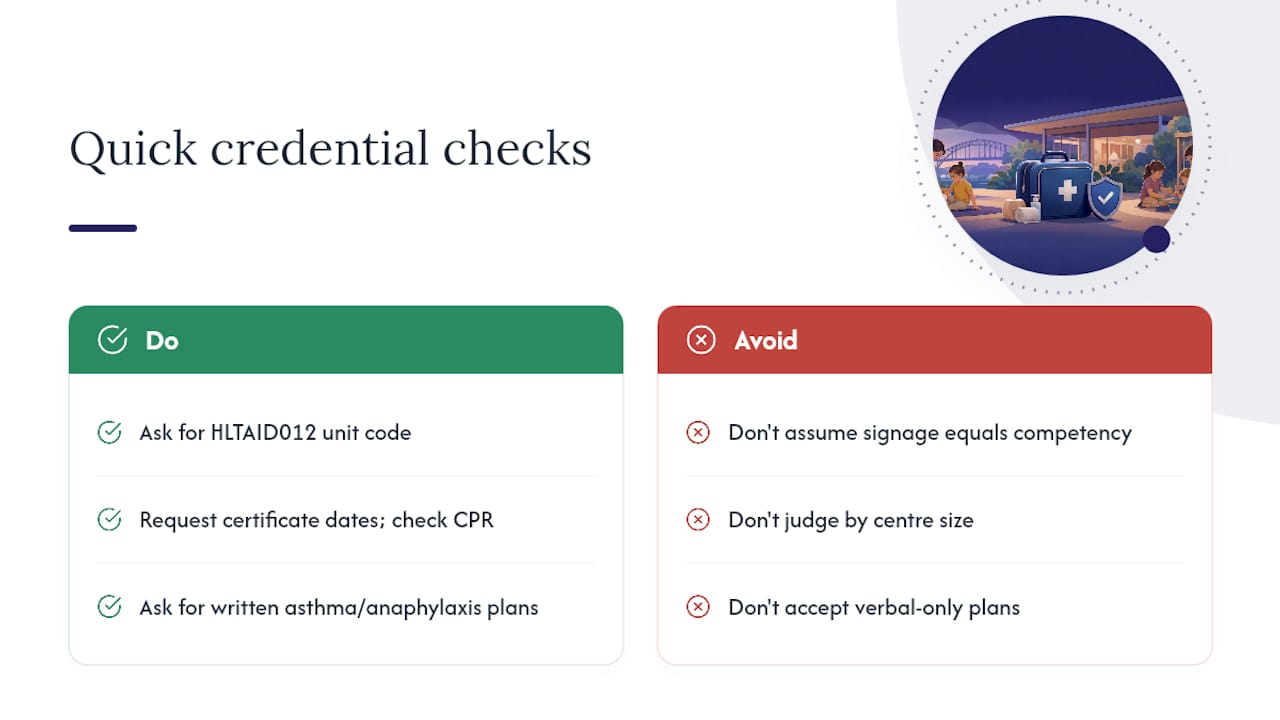
Three quick checks tell you almost everything. Ask which unit code staff hold, HLTAID012 specifically, not a general certificate. Ask to see certificate dates, since an expired CPR refresher is common and easy to miss in a busy centre. And ask how the service documents asthma and anaphylaxis plans for individual children, because a policy that exists only in someone’s head isn’t a plan.
You’ll also notice services look different from each other, and that’s by design. The risk-based approach behind the Safe Work Australia code means a 15-child family day care and a 100-child long day care centre will have different staffing ratios, kit numbers, and even AED decisions. Neither is cutting corners. What actually moves the needle in a real emergency isn’t the size of the centre. It’s whether the person nearest the child knows exactly what to do in the first sixty seconds.
— Vapour
Get your team HLTAID012 certified without the wait
There are other ways to sort childcare first aid training, TAFE-run block courses, generic online providers, or waiting on a centralised booking system that takes weeks to confirm a date. Some training providers offer onsite or mobile delivery with course content tailored to a service’s risk profile, and certificates issued promptly once practical assessment is done, so services are not left short-staffed while paperwork catches up.
For services needing the full paediatric unit, HLTAID012 – Provide First Aid in an Education and Care Setting is $250 per person, one-off, delivered face-to-face with proper practical assessment built in. If your team just needs the annual CPR refresh to stay current, HLTAID009 – Provide Cardiopulmonary Resuscitation runs at $150. General workplace first aid, HLTAID011 – Provide First Aid, is available at $240 for support staff who need broader coverage without the paediatric focus. Book a session or check available dates on the Prime First Aid course catalogue to get your roster compliant before your next audit.
Sources
Verify your own understanding against the primary sources rather than relying solely on centre paperwork:
FAQ
What qualification do childcare workers need for first aid?
Educators with direct child contact should hold HLTAID012, Provide First Aid in an Education and Care Setting, since it covers paediatric CPR, choking, and anaphylaxis management. Support staff with limited contact may only need general first aid or CPR, depending on the service’s own risk assessment.
How often does childcare first aid certification need renewing?
CPR is commonly refreshed annually, while the full first aid qualification is typically renewed about every three years. Some states set stricter timeframes, so check your local education regulator to confirm.
Is HLTAID012 different from standard first aid training?
Yes. HLTAID012 is built specifically for education and care settings, covering infant and child CPR, paediatric choking response, and management of asthma and anaphylaxis, none of which a standard adult-focused first aid course addresses in the same depth.
Do all childcare staff need the same first aid qualification?
No. Educators with ongoing responsibility for children generally need HLTAID012, while staff with minimal contact, such as kitchen or admin personnel, may only need HLTAID011 or HLTAID009 depending on the centre’s risk assessment.
Where can I get HLTAID012 training in Western Australia?
Some training providers deliver HLTAID012 courses onsite and mobile in various regions, with practical assessment and certification included. Pricing details are available on their official course pages.
Recommended
Comments