
Meet 2026 Standards: First aid assessment process for Australian RTOs

The first aid assessment process is a competency check built around three evidence types: observed practical skills, scenario-based responses, and underpinning knowledge checks. Trainees must demonstrate every required task correctly and safely to be judged competent, and the whole process sits under national vocational education standards administered through registered training organisations. Pass every element and you walk away with a nationally recognised Statement of Attainment, not just a certificate of attendance.
TL;DR:
Practical skills must be performed continuously and correctly during assessments, including CPR, AED operation, and casualty management, to meet unit standards.
Assessors verify knowledge and skills through live observation, realistic simulations, and online or written tests, using industry-appropriate equipment and scenarios.
Assessment tools must be validated regularly by industry professionals, ensuring fairness, validity, currency, and compliance with the 2025 Standards.
Immediate feedback and targeted follow-up are typical on assessment day, with certification issued promptly once all elements are proven competent.
Tailored, industry-specific assessments provide more reliable competence verification for remote, high-risk, or specialized workplaces.
Table of Contents
What does the first aid assessment process actually check?
Assessors aren’t watching for effort. They’re checking whether a candidate can perform specific, defined tasks to a set standard, under conditions that mirror a real emergency.
The performance evidence for units like HLTAID011 spells this out with unusual precision. Candidates must complete uninterrupted single-rescuer CPR on both adult and infant manikins for the duration specified in unit requirements, operate an AED correctly, and manage an unconscious casualty through a simulated incident, according to the Training. Wound care, bleeding control, and choking response typically round out the practical component.
Scenario-based tasks go further than rote repetition. They test whether a candidate can recognise a deteriorating patient, choose the right response, and know when to escalate, which is exactly what happens in a real workplace incident when there’s no instructor standing beside you.
Assessors also need knowledge evidence covering:
Legal and workplace obligations around duty of care
Infection control procedures and PPE use
Incident reporting requirements and documentation
Recognising when a casualty’s condition falls outside first aid scope
One detail surprises a lot of safety managers: assessors are required to sight uninterrupted CPR performance for a minimum duration, not just a quick demonstration. A candidate who stops halfway through, even briefly, often needs to repeat the sequence.
How are first aid assessments carried out in practice?
Most RTOs use a blend of three methods rather than relying on one.
Direct observation — the assessor watches practical skills performed live, whether that’s CPR, bandaging, or managing a simulated collapse.
Simulation — realistic scenarios test decision-making under time pressure, often with a “patient” playing a deteriorating casualty.
Written or online knowledge checks — multiple-choice or short-answer questions confirm understanding of legal obligations, infection control, and escalation protocols.
Providers such as Australian Red Cross note that assessments commonly combine observation, questioning, and role play, with digital portals increasingly used for the knowledge component, according to their first aid course requirements. If your course includes an online element, expect the same rigour as a face-to-face session. Remote assessment still requires an assessor to verify identity and observe practical skills, either live via video or during a supervised in-person component.
Equipment matters just as much as method. A compliant assessment setting needs adult and infant manikins, AED trainers, adrenaline auto-injector trainers, a placebo spacer for asthma scenarios, assorted dressings, and personal protective equipment.
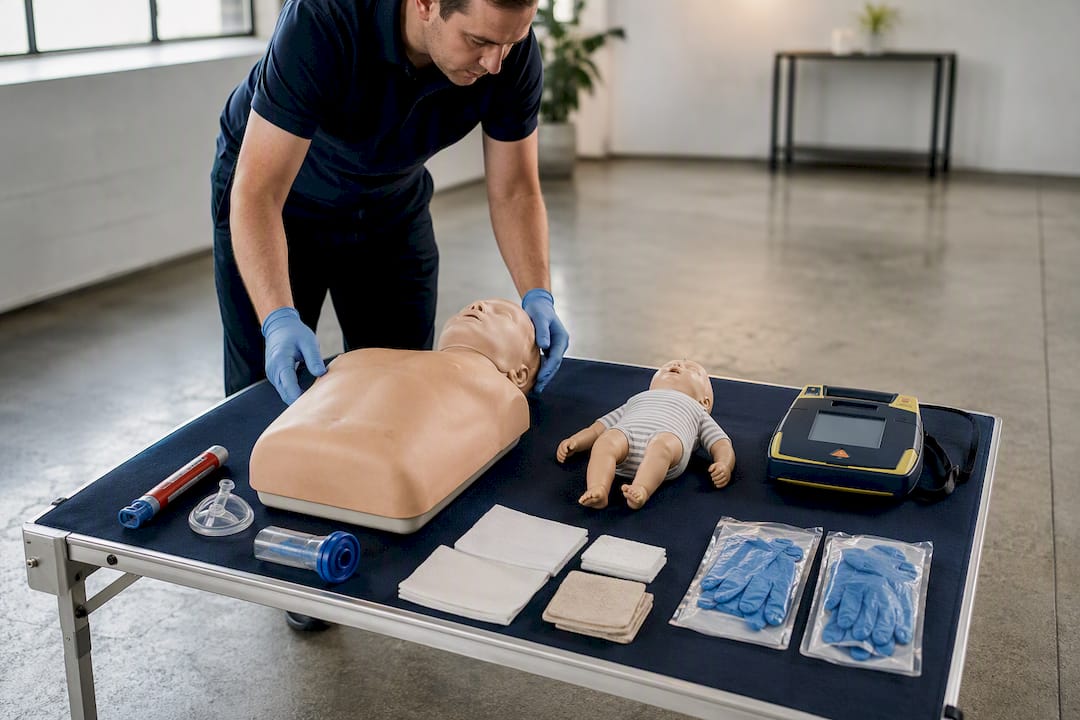
Pro Tip: Ask your provider whether assessment conditions will reflect your actual workplace, not a generic classroom. A mine site emergency response looks nothing like a office first aid scenario, and a good assessor tailors the simulation accordingly.
What standards govern how assessors make their judgement?
Every assessment decision has to satisfy the Rules of Evidence and the Principles of Assessment, the two frameworks that stop first aid certification from becoming a rubber stamp.
The Rules of Evidence require that evidence be valid (it actually proves the skill), sufficient (enough of it exists to be confident), authentic (it’s genuinely the candidate’s own work), and current (skills reflect present-day practice, not knowledge from a decade ago). The Principles of Assessment demand fairness, flexibility, validity, and reliability across every candidate and every delivery of the same unit.
This isn’t abstract theory. It shapes who is allowed to sign off on your competency and how often assessment tools get checked.
Assessment tools must be reviewed before use and periodically validated against industry practice.
Validation should involve people who weren’t the ones who designed or delivered the training.
Assessors need current industry competency, not just a qualification earned years ago.
Assessment validation must involve people with current industry competency, and judgement of competence should never rest solely with the person who designed or delivered the training.
Under the 2025 Standards, RTOs are required to formally review assessment tools before each use and engage industry input in the validation cycle. That review process is what stops a first aid course from drifting into a box-ticking exercise.
What happens on assessment day, and how fast does certification arrive?
Most candidates who complete the practical and knowledge components correctly are marked competent on the day. If a task isn’t performed to standard, the usual outcome is “not yet competent,” which triggers targeted feedback and a chance to redo that specific element rather than the entire course.
Assessors are required to record why a judgement was made, creating an audit trail that supports both fairness and any later appeal, a requirement outlined in ASQA’s guidance on assessment systems.
What to expect around outcomes and paperwork:
Immediate verbal feedback on practical tasks, right after each demonstration.
A short gap-training session if one element needs another attempt, rather than a full retake.
AQF certification documentation issued promptly once competency across all elements is confirmed.
Records retained by the RTO, since providers must keep enough evidence to reissue a Statement of Attainment later if it’s lost.
Where a physical limitation genuinely prevents a candidate from meeting a unit’s requirements, some RTOs can issue a Statement of Attendance and skills transcript instead, a provision noted on the HLTAID011 unit page.
How Primetraining runs a compliant assessment process
Assessments are built around the workplace the trainee actually works in, rather than a one-size-fits-all classroom script. For crews in remote locations, scenarios reflect real site hazards and response times, rather than a generic office setting.
Courses are contextualised for the industry and location booking the training, including remote and isolated site units.
Certification is issued promptly once competency is confirmed, so workplaces aren’t left waiting on paperwork to meet compliance deadlines.
Trainers bring industry-relevant experience into how they run scenarios and judge performance.
Reasonable adjustment is offered where a participant needs it, without lowering the standard the unit requires.
Pro Tip: If your workforce includes shift workers or FIFO staff, ask about mobile or on-site delivery. Bringing the assessment to your site removes the logistics headache of pulling a whole crew off-site for a day.
Participant feedback loops back into how sessions are run, which matters under the Principles of Assessment as much as it matters for a good learning experience.
Tailored assessment or standard classroom delivery: which fits your team?
High-risk industries, remote crews, and businesses with specialised equipment usually get more value from tailored, workplace-context assessment. It’s harder to fake competence in a scenario that mirrors your actual hazards.
Standard classroom delivery is perfectly adequate for low-risk office environments where the scenarios trained are close enough to what staff will realistically face.
Before booking, ask any provider how recently their assessment tools were validated, and who conducted that validation.
Booking a compliant assessment with Primetraining
Businesses get a direct route to certification designed to reflect their specific site conditions. Courses can be delivered on-site, mobile, or online, with assessment scenarios built around the trainee’s actual work environment.
When you enquire, have a few details ready: number of participants, the specific workplace context (confined spaces, remote location, healthcare setting), and any reasonable adjustment needs so trainers can plan for them ahead of time. Browse the full range of courses to match the right unit to your industry, from standard first aid through to remote and isolated site units. Ready to lock in a date? Book online and get your team assessed and certified without the usual back-and-forth.
Where to check the rules yourself
ASQA guidance on provider obligations and the 2025 Standards
HLTAID011 unit page for performance evidence and assessment conditions
Guide to assessment tools (ASQA PDF) for validation and recordkeeping detail
Sources
FAQ
What is the pass mark for a first aid assessment?
There’s no percentage score. Candidates are judged “competent” or “not yet competent” against defined performance and knowledge evidence, with every required task needing to be demonstrated correctly.
Can I fail a first aid practical assessment?
Yes, though the usual outcome is “not yet competent” rather than an outright fail, followed by targeted feedback and a chance to redo the specific element that fell short.
How long does it take to get my certificate after assessment?
Providers issue AQF certification documentation promptly once competency across all required elements is confirmed, and Primetraining fast-tracks this step once every task is signed off.
Does online first aid training include a practical assessment?
Yes. Online components cover knowledge checks, but units like HLTAID011 still require an assessor to observe practical skills such as CPR and AED use, either live or in a supervised session.
What if I have a physical limitation that affects a practical task?
RTOs can offer reasonable adjustment without lowering the competency standard, and where a physical requirement genuinely can’t be met, some providers issue a Statement of Attendance and skills transcript instead of a Statement of Attainment.
Recommended
Comments