
3 Year First Aid Validity in Australia: Annual CPR and Onsite Renewal

Most Australian first aid qualifications, including HLTAID011 Provide First Aid, typically stay current for a period generally accepted around three years based on industry convention, while CPR skills need refreshing more frequently to maintain practical competency. That gap between certificate expiry and recommended refresher cadence trips up plenty of employers. The authoritative places to check are Safe Work Australia, the Training national register, and your USI transcript.
TL;DR:
Most Australian first aid certificates, including HLTAID011, are considered current for about three years, but specific industry requirements can be shorter.
CPR skills need annual refreshers to maintain practical competency due to faster skill degradation, even if certificates remain valid longer.
Employers are responsible for assessing workplace risks and may require shorter refresh cycles, especially in healthcare, childcare, or remote site settings.
The actual qualification and currency are confirmed by the HLTAID code on the statement of attainment, not just the certificate’s expiry date.
Combining online theory with practical in-person sessions and scheduling refreshers well in advance helps maintain continuous compliance.
Table of Contents
Typical validity by first aid qualification
Not every HLTAID unit follows the same clock, and knowing which one applies to your workplace matters more than most people realise.
HLTAID011 Provide First Aid is the core qualification most workers, volunteers, and parents complete. It covers CPR, wound management, anaphylaxis response, and basic emergency care. The currency period is generally accepted to be about three years, based on industry practice and training provider convention rather than a fixed legal requirement.
HLTAID009 Provide Cardiopulmonary Resuscitation is the standalone CPR unit, often bundled inside HLTAID011 but also available on its own. Because CPR is a physical, muscle memory skill, it degrades faster than knowledge-based first aid content. That’s why practical CPR refreshers about once a year are widely recommended, recognizing that practical skills degrade faster, even if formal certificates last longer.
A few sector-specific units carry their own nuances:
HLTAID012 covers first aid in an education and care setting, with added focus on infant and child scenarios, and childcare regulators sometimes expect it alongside anaphylaxis and asthma management training.
HLTAID013 addresses first aid in remote or isolated sites, relevant for mine sites, agriculture, and fieldwork, and often paired with extended trauma or evacuation content.
Every one of these units is listed on the national VET register, and Registered Training Organisations (RTOs) issue a nationally recognised statement of attainment showing the exact HLTAID code completed. That code, not the certificate’s design or wording, is what actually confirms what you’re qualified to do.
Employer obligations and industry variations in currency
A certificate’s printed expiry date is only the starting point. Workplace policy can, and often does, demand more.
Safe Work Australia’s model Code of Practice sets the baseline: employers must assess the number of first aiders needed and how current their skills must be, based on workplace risk. State regulators like SafeWork NSW build on this at a state level, reinforcing that “compliant” isn’t a fixed national number, it’s a risk-based judgement employers must make and document.
In practice, several industries set tighter timelines than the base three-year qualification period:
Healthcare settings frequently require annual CPR competency checks tied to clinical governance standards.
Childcare and education services often mandate HLTAID012 renewal aligned with state licensing cycles, sometimes shorter than three years.
Mining and remote-site operations, common across the Pilbara, often build annual refresher drills into site inductions regardless of certificate expiry.
If you’re setting policy as an employer, start with three questions: what does your risk assessment say about first aider numbers, does your industry regulator specify a shorter interval, and are you documenting refresher dates against each worker’s USI record?
How to renew, refresh, or requalify your first aid certificate
Keeping your certification current comes down to picking the right course type at the right time, not just booking whatever’s available.
There’s a real difference between a CPR refresher and full requalification. A CPR refresher is typically a short, skills-focused session, sometimes just a few hours, that renews HLTAID009 competency without repeating the full first aid curriculum. Requalification means resitting the complete HLTAID011 (or sector-specific unit) before it lapses, including theory and practical assessment.
Here’s a practical action plan:
Check your certificate date against your USI transcript or RTO records, not just the physical card, which can go missing or get damaged on-site.
Book CPR refreshers annually, even if your full certificate hasn’t expired, to keep practical skills sharp.
Schedule full requalification at least four to six weeks before your three-year HLTAID011 lapses, giving you buffer room if a course is booked out.
Choose blended learning where available, combining online theory with a shorter in-person practical session, to reduce time away from work.
Confirm the RTO is currently accredited for the specific unit code before booking, since not all providers hold every HLTAID qualification.
Pro Tip: Set a calendar reminder six months out from your certificate’s three-year mark, not one month. Popular course dates in regional areas, especially around the Pilbara, fill quickly, and leaving it too late risks a gap in your workplace’s compliance.
Checking and storing first aid certificates correctly
Verification matters just as much as renewal, particularly when a worker’s original certificate has gone missing or an employer needs to confirm a claim before rostering someone as a designated first aider.
Individuals can retrieve their USI transcript at any time, which lists every nationally recognised unit completed, including the HLTAID code, completion date, and issuing RTO. This is often faster and more reliable than digging up a paper certificate.
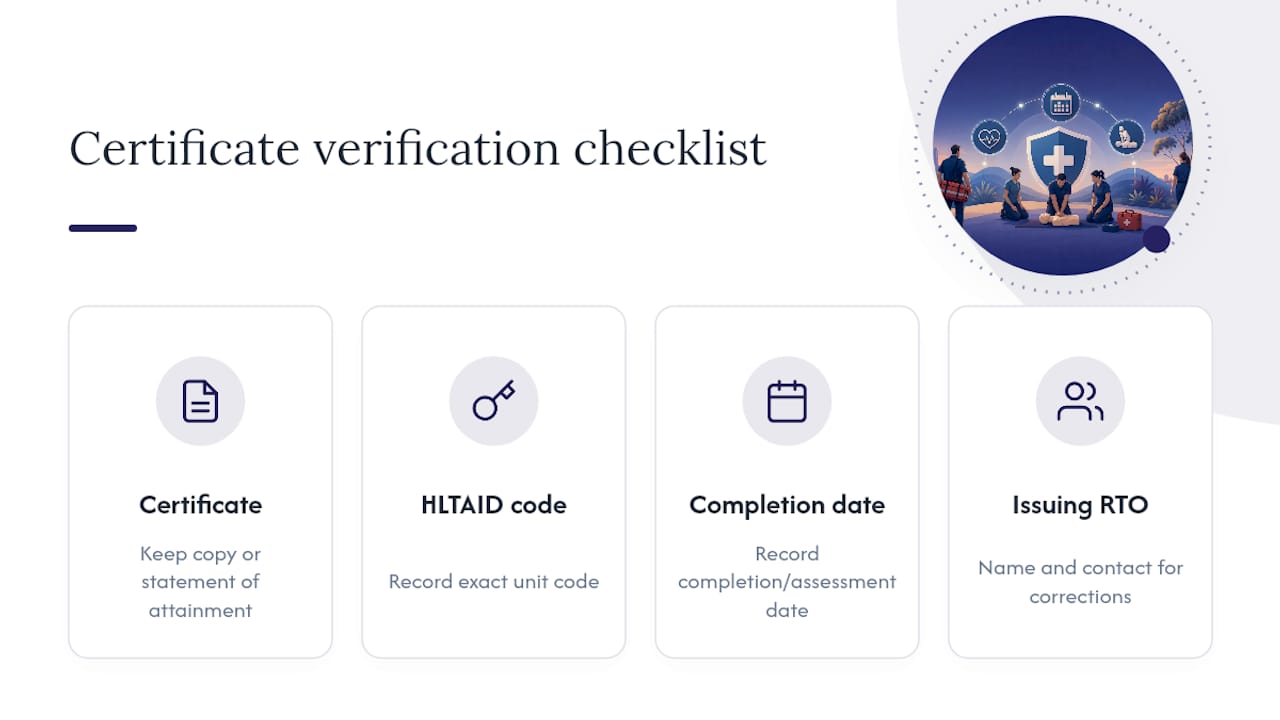
Employers should keep, at minimum, a copy of the certificate or statement of attainment, the exact HLTAID unit code (not just “first aid certificate”), the completion date, and the RTO’s name. Two common issues crop up: certificates missing the unit code entirely, and post-dated documents that don’t match the actual assessment date. Both are fixable by contacting the issuing RTO directly, who can reissue a corrected statement of attainment. The Australian Skills Quality Authority also publishes guidance on confirming an RTO’s accreditation status if you’re ever unsure a provider is legitimate.
How Primetraining keeps workplaces compliant and current
Renewing certification shouldn’t mean shutting down a worksite for a day. Primetraining delivers nationally recognised HLTAID courses through on-site, mobile, and online formats, built around the reality that businesses in remote locations can’t always send staff off-site for training.
Mobile delivery means trainers come to the workforce rather than the other way around, cutting downtime that would otherwise come from travel. Course content is tailored to the specific demands of each business, and certificates are issued promptly once assessment is successfully completed, so there’s no lag between finishing a course and having proof of currency on file.
A few things employers consistently value:
Trainers bring industry-relevant experience rather than generic classroom delivery.
Fast certificate turnaround supports rostering decisions that can’t wait weeks for paperwork.
Flexible formats suit teams in different locations needing HLTAID013-style training.
A pragmatic approach to refresher cadence
The three-year requalification cycle is a reasonable floor, but skill decay doesn’t wait three years, particularly for CPR. Annual CPR refreshers paired with triennial full requalification is the most defensible baseline for employers balancing cost against real competence.
Short, five-minute workplace drills between formal courses do more for retention than most safety managers assume. Budget for both: a light annual touchpoint and a proper three-year reset, rather than treating the certificate’s expiry date as the only trigger for action.
— Vapour
Book a course that matches your compliance needs
There are other ways to sort out your team’s currency, chase down an RTO independently, compare course calendars, or wait for your next scheduled induction. A training provider offers a faster route for businesses that need certificates locked in without the back-and-forth: mobile delivery that comes to your site, tailored content matched to your industry, and certificates issued promptly once assessment is done.
Before booking, confirm exactly which HLTAID unit code your employer requires, HLTAID011, HLTAID009, HLTAID012, or HLTAID013, and whether they need on-site, mobile, or online delivery. Browse the full range of accredited first aid courses to find the right match, or head straight to book online if you already know which course your team needs and when.
Sources
FAQ
How long does a first aid certificate last in Australia?
HLTAID011 Provide First Aid is generally treated as current for around three years, based on industry convention rather than a single fixed legal rule.
Is first aid good for three years?
Yes, most Australian employers and RTOs treat three years as the standard currency period for HLTAID011, though workplace policy can shorten this based on risk assessment.
How long is CPR certification valid?
CPR skills under HLTAID009 are often refreshed about annually to maintain muscle memory and practical ability, even if the certification itself remains recognized for longer periods.
Does HLTAID011 expire?
HLTAID011 doesn’t expire in a legal sense, but it loses recognised currency after roughly three years, meaning most employers and regulators expect requalification by that point.
How do I check if my first aid certificate is still valid?
Check the completion date on your statement of attainment against your USI transcript, which lists the exact HLTAID unit code and issuing RTO.
Recommended
Comments