
Audit Ready First Aid Kit Requirements for Australian Workplaces

Employers must provide accessible, risk based first aid facilities determined by a first aid risk assessment, not a generic store bought box. The Model Code of Practice from Safe Work Australia sets the benchmark, and courses like HLTAID011 build the human capability behind it. The immediate action for any manager reading this: run a first aid risk assessment this month and nominate someone to own kit maintenance.
TL;DR:
Most workplaces must regularly reassess their first aid kit contents and location whenever hazards or staff numbers change.
Remote or high-risk sites require additional supplies such as extra dressings, thermal blankets, and signaling devices to manage extended wait times.
A nominated person should be responsible for kit maintenance, including immediate restocking and record-keeping, to ensure ongoing compliance.
First aid training tailored to the site, such as HLTAID011 or HLTAID013 courses, is essential to enable staff to use the kit properly in emergencies.
Kit placement should follow accessibility rules, with clearly marked, weatherproof cases in multiple locations matching the workplace’s specific hazards.
Table of Contents
What are the legal first aid kit requirements for Australian workplaces?
What should be in a workplace first aid kit? A practical checklist
How many first aid kits do you need, and where should they go?
Tailoring kits for remote sites, chemicals and other elevated risks
Training and nominated first aiders: the other half of compliance
What are the legal first aid kit requirements for Australian workplaces?
The Model Code of Practice does not hand you a fixed national list and tell you to tick it off. It asks you to work out what is “adequate and appropriate” for your specific workplace, based on a genuine risk assessment of the hazards, the number of workers, and how far away help is.
That assessment has to weigh a few concrete factors: the nature of the work (an office versus a workshop versus a mine site), the size and layout of the site, the number of workers and shifts, and how long it would realistically take for emergency services to arrive. A single-storey admin office with twelve staff has very different obligations to a 24/7 processing plant with rotating crews.
Certain facility elements are non-negotiable regardless of your risk profile:
Access to a telephone or another reliable emergency call system at or near every kit
Clear signage showing where kits and first aid facilities are located
Protection of kit contents from dust, moisture, and contamination, usually via a sealed or weatherproof case
At least one first aid kit accessible to every worker, with no exceptions for small sites
The Code also flags when a dedicated first aid room or health centre becomes appropriate, generally low-risk workplaces with 200 or more workers, or high-risk workplaces with 100 or more, though the Model Code’s own guidance makes clear these numbers are a starting point for judgement, not a hard trigger you can simply wait to hit.
What should be in a workplace first aid kit? A practical checklist
Appendix C of the Model Code gives the closest thing Australia has to an official contents list, and it is the standard most auditors will check against. Build your kit around these core items:
Resuscitation mask or face shield for safe rescue breathing
Disposable gloves (several pairs, non latex where possible)
Sterile gauze swabs and non-adherent dressings for wounds
Adhesive strips and dressings for minor cuts and abrasions
Conforming bandages for securing dressings and supporting sprains
A crepe bandage for soft tissue injuries
Triangular bandages for slings and immobilisation
A rescue or thermal blanket for shock and exposure
Scissors (blunt-tipped, safe for cutting clothing or dressings)
Saline solution or hydrogel for burns and eye irrigation where relevant
Tweezers or forceps for splinter and debris removal
Eye pads for eye injuries, plus an instruction card
Pro Tip: Laminate a contents list and sticky-tape it inside the kit lid. It doubles as a restocking guide and gives an auditor an instant answer to “what’s supposed to be in here?”
Notice what’s missing: analgesics like paracetamol or aspirin. Both Healthdirect and Safe Work Australia advise against stocking general medications in workplace kits, largely because of allergy risk, dosage liability, and the fact that most workplaces aren’t equipped to manage adverse reactions safely. If a worker needs prescribed medication, that’s a matter for their own management plan, not the shared kit. Store it separately, with the worker’s consent and a documented process.
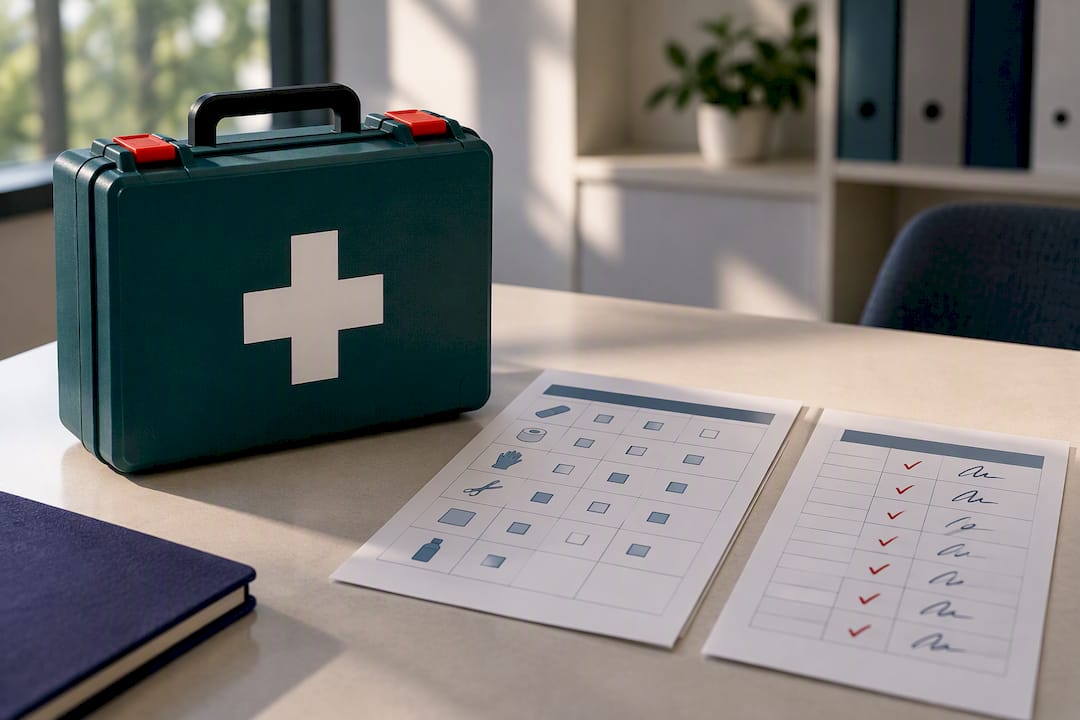
Every kit should carry two things beyond the physical contents: a laminated inventory card listing what’s meant to be inside, and a sign-off card where the nominated custodian logs each check with a date and initials. Without these two administrative anchors, you have supplies but no audit trail.
How many first aid kits do you need, and where should they go?
Placement is where a lot of otherwise compliant workplaces fall down. A kit locked in a manager’s office three floors from the factory floor fails the “readily accessible” test the moment there’s an actual emergency.
Work to these rules of thumb:
At least one kit for any workplace, regardless of size
One kit per floor as a minimum, and at least one for every second floor in taller buildings
Additional kits stationed near higher-risk areas: workshops, loading docks, kitchens, chemical storage
Portable kits fitted into vehicles for any worker who drives between sites or works mobile
Kits should be visually unmistakable, marked with a white cross on a green background, housed in an intact, weatherproof case, and clearly labelled with the contents list on the outside or inside lid. On security-controlled sites, mine gates, secure healthcare wards, and similar, make sure kit locations appear on emergency floor plans and that access doesn’t require a key held by someone who might not be on shift when it’s needed.
Keeping kits compliant: maintenance, restocking and records
A kit is only compliant on the day it’s stocked unless someone owns it going forward. SafeWork NSW and the national Model Code both point to the same operational fix: nominate a person, give them clear duties, and check on a schedule.
Assign one nominated person (or a backup) responsible for every kit on site
Restock any item immediately after use, don’t wait for the next scheduled check
Check expiry dates and sterile seals on every visit, discard and replace anything out of date
Inspect kits after every use and at minimum once a year, more often on high-turnover or high-injury sites
Sign and date the inventory card at each check, and file it with training records
Pro Tip: Tie kit inspections to a recurring calendar reminder, not memory. Sites that only check kits “when something feels off” are the ones that fail an audit on an expired saline sachet nobody noticed.
An auditor reviewing your first aid program will want to see the inventory cards, the dates, and a name against each entry. That paper trail is often the difference between a workplace that looks compliant and one that can prove it.
Tailoring kits for remote sites, chemicals and other elevated risks
Standard kits assume help is minutes away. Remote or isolated sites can’t make that assumption, and the Model Code says so directly.
For remote worksites, Safe Work Australia recommends stocking beyond the standard list:
Extra dressings and bandages in higher quantities, since resupply isn’t quick
Large sheeting or thermal blankets for exposure and shock management
A torch and whistle for signalling in low-visibility or remote terrain
Enough consumables to sustain an injured worker for a genuinely extended wait
Workplaces with chemical or eye hazards, welding bays, laboratories, and industrial processing among them, need additional eyewash stations, extra eye pads, and burn instruction cards, along with hydrogel sachets and polythene sheets for burns. Outdoor and rural worksites often benefit from sting relief and instant ice packs too. For anything genuinely high-risk, mine sites, isolated construction, remote agriculture, it’s worth consulting a person conducting a business or undertaking’s health and safety adviser, or a qualified health professional, to confirm your kit and response plan actually match the exposure.
Training and nominated first aiders: the other half of compliance
A fully stocked kit with nobody trained to use it is a box of supplies, not a safety control. The Model Code expects trained first aiders to be on hand, particularly where the nearest clinical facility is a long drive away.
HLTAID009 – Provide Cardiopulmonary Resuscitation is a shorter, standalone refresher for CPR-specific readiness
HLTAID013 – Provide First Aid in Remote or Isolated Site is built for exactly the extended response scenarios described above
Keep training certificates alongside your kit inventory records, and roster first aider availability the same way you roster kit checks, so a shift is never left without either. A card with emergency contact numbers taped inside the kit lid rounds out the setup.
Treat first aid provision as a control, not a checkbox
Most first aid failures aren’t caused by a missing bandage. They happen because a kit was compliant on installation day and never revisited after the work changed. If your workforce grows, a new machine arrives, or you take on a job in a more remote location, the kit that satisfied last year’s risk assessment probably doesn’t satisfy this year’s.
Reassess kits whenever hazards or headcount shift, not just on an annual calendar. Mobile delivery of training on-site at remote camps means the people using the kit are trained where they’ll actually use it, which matters more than any single item on a checklist.
— Vapour
Book first aid training that matches your kit and your site
Stocking the right kit is only half the compliance picture. Primetraining is the practical way to close the other half: getting your people certified without pulling them off the tools for days or flying trainers in from interstate. Courses can be delivered on-site anywhere in the Pilbara, including active mine and construction sites, and scheduled outside standard business hours so training doesn’t collide with production.
For most workplaces, HLTAID011 – Provide First Aid at $240 one-off gives you a nationally recognised, audit-ready certificate for your nominated first aiders. Sites with genuinely remote or isolated locations should look at HLTAID013 – Provide First Aid in Remote or Isolated Site at $400 one-off. It is built specifically for the extended response times covered above. Every course is tailored to your actual worksite hazards and comes with prompt certification your safety file can rely on at audit time. Ready to lock in dates? Book your course online and get your team compliant on a timeline that suits your operation.
Where to check the rules yourself
For the full legal detail, keep these on file: the Model Code of Practice PDF for Appendix C contents and thresholds, Safe Work Australia’s first aid page for national guidance, Healthdirect’s first aid kit guide for practical item advice, and SafeWork NSW’s first aid page for state-level interpretation.
Sources
FAQ
What is legally required in a first aid kit?
There is no single fixed national list. Australian law requires kit contents to match a documented risk assessment, though Appendix C of the Model Code sets the recommended baseline most workplaces build from.
What should be in a first aid kit in Australia?
A standard workplace kit should include a resuscitation mask, gloves, sterile gauze, adhesive dressings, conforming and crepe bandages, a triangular bandage, scissors, tweezers, eye pads, and a rescue blanket. General medications like paracetamol are typically excluded due to allergy and liability risk, as noted by Healthdirect.
What does a workplace first aid kit checklist include for 2026?
The checklist itself hasn’t changed with the year. It still follows the Model Code’s Appendix C contents, tailored by risk assessment, with additions for remote sites, chemical hazards, or high-injury environments as your workplace requires.
What are the basic requirements for a first aid kit?
At minimum, every workplace needs at least one accessible kit, a nearby telephone or emergency call system, clear signage, and protection from contamination. Beyond that baseline, Safe Work Australia expects contents and quantity to scale with your specific hazards and worker numbers.
Who should manage first aid kit maintenance at work?
A single nominated person, with a backup, should own restocking, expiry checks, and inventory sign-off for every kit on site. Pairing that role with HLTAID011 training means the custodian also knows how to use what’s inside the kit.
Recommended
Comments