
How Employers Verify First Aid Statements of Attainment in Australia

A first aid Statement of Attainment is the official, nationally recognised document your Registered Training Organisation (RTO) issues once you’re assessed as competent in a first aid unit like HLTAID011 Provide First Aid or HLTAID009 Provide CPR. It’s what employers and regulators across Australia accept as proof you can respond to an emergency at work. HLTAID011 is generally treated as current for a period, while CPR competency needs refreshing more frequently to maintain currency.
TL;DR:
A Statement of Attainment is only issued by an RTO after full assessment of competency, not as an interim training record.
The document must include your full name, unit code and title, assessment date, RTO name and provider code, and the VET qualification code.
The most common units for workplace first aid are HLTAID011 Provide First Aid and HLTAID009 Provide CPR, with the latter needing more frequent refreshers.
Employers should verify the unit code and issuing RTO details before accepting the certificate, and keep a digital copy for quick reissuance if needed.
The Statement of Attainment is distinct from a full qualification certificate but is widely accepted for employment requirements in first aid roles.
Table of Contents
What is a Statement of Attainment and who can issue it?
A Statement of Attainment sits inside the Australian Qualifications Framework (AQF), the national policy that governs how vocational training is certified. Under the AQF’s issuance policy, only a Registered Training Organisation can legally issue one, and only after you’ve been assessed as competent, not partway through a course as some kind of progress report.
The Australian Skills Quality Authority (ASQA) regulates RTOs and sets the compliance bar. ASQA’s own guidance on qualifications and statements of attainment spells out exactly what must appear on the document, and it also confirms that an RTO must not hand out a Statement of Attainment as an interim progress record while training is still underway.
A compliant Statement of Attainment includes:
Your full name as it appears on your enrolment record
The unit code and full unit title (for example, HLTAID011 Provide First Aid)
The date you were assessed as competent
The issuing RTO’s name and national provider code
The national code confirming it was delivered under the VET framework
That last point matters more than most people realise. It’s the RTO’s registration and correct AQF wording, not the design of the PDF, that gives the document its authority.
Which unit codes appear on a first aid Statement of Attainment?
Most Australian workplaces ask for one of three units, and each covers different ground. Knowing which one you hold (and which one your employer actually needs) saves a lot of back and forth with HR.
HLTAID011 Provide First Aid is the standard workplace unit. It’s assessed in line with Australian Resuscitation Council guidelines and covers everything from wound management to responding to medical emergencies.
HLTAID009 Provide CPR is often listed as its own line item on your Statement of Attainment, even when you completed it in the same course as HLTAID011. It’s a narrower unit, and Training lists it separately because it carries its own currency expectations.
HLTAID012 Provide First Aid in an Education and Care Setting applies specifically to childcare workers, educators, and family day care providers. It builds on general first aid skills with content on paediatric response, and most centres and services will only accept this specific unit rather than HLTAID011 alone.
If you work in childcare, check which of these your role actually requires. Prime First Aid and Training’s HLTAID012 course is built for exactly this gap.
How long is your Statement of Attainment valid?
There’s no single legislated expiry date stamped onto a first aid unit. What you’re really managing is currency, the idea that first aid knowledge and CPR technique both fade, so training packages and employers set practical refresh windows rather than hard legal deadlines.
HLTAID011 is generally considered current for a certain period before a refresher course is recommended.
HLTAID009 (CPR) requires more frequent refreshers due to the need to maintain technique and confidence.
Industry and role-specific rules can shorten both windows. Mine sites, healthcare facilities, and childcare centres often set their own tighter refresh schedules on top of the general guidance, so always check your workplace’s WHS policy rather than assuming three years applies everywhere.
Renewal doesn’t always mean redoing the full course. Blended refresher options, where you complete theory online and attend a shorter practical session, are common and still meet ARC and training package requirements provided the hands-on assessment is genuine.
How do you find or verify your Statement of Attainment?
Lost your certificate, or need to prove it’s genuine for a new employer? Start with your Unique Student Identifier (USI). Every nationally recognised training result you’ve ever achieved is tied to it.
Log in at Usi to view your national transcript, which lists every unit you’ve completed with any RTO, including HLTAID011 and HLTAID009.
Contact the issuing RTO directly if you need the original document reissued. Have your full name, date of birth, USI, and approximate completion date ready, since this speeds up the search significantly.
Check Training to confirm a unit code exists and to verify an RTO’s registration is current and legitimate.
Expect a small admin fee for replacement certificates from most providers, with turnaround typically a few business days once your identity is confirmed.
Pro Tip: Save a digital copy of your Statement of Attainment the day it arrives, not the week before you need it for a job application. RTOs can take time to process reissue requests, especially during busy enrolment periods.
Statement of Attainment vs a full AQF certificate: what’s the difference?
A Statement of Attainment and a full AQF certificate (called a testamur) are both nationally recognised, but they certify different things. A testamur confirms you’ve completed an entire qualification, think a full Certificate III. A Statement of Attainment confirms you’ve completed one or more individual units within that qualification, which is exactly what happens when you finish a standalone first aid course.
Both carry equal weight for credit transfer between RTOs and for demonstrating competency to an employer.
Most workplaces only need the Statement of Attainment for first aid roles, since the job requires the specific skill, not a full diploma.
A full qualification is generally only requested when a role formally requires that qualification as an entry requirement, such as certain paramedical or training-delivery positions.
How does prompt, compliant issuance actually work?
Compliance on paper is one thing. Watching it work in practice, especially somewhere remote, tells you more about whether a provider takes it seriously.
Reputable RTOs issue Statements of Attainment the moment competency is confirmed, often by email on the same day training wraps up. Australian Red Cross follows this model, sending a nationally recognised Statement of Attainment as soon as a participant successfully completes their assessment, whether that training happened in person or through a blended online format.
Prime First Aid and Training operates the same way, including for crews working on Pilbara mine sites where waiting weeks for paperwork simply isn’t an option. Whether training is delivered on-site, mobile, or through a blended format combining online theory with practical assessment, the Statement of Attainment still has to meet the same AQF and ASQA requirements as any classroom course. Delivery mode changes; the compliance bar doesn’t.
What should you check on your Statement of Attainment before showing an employer?
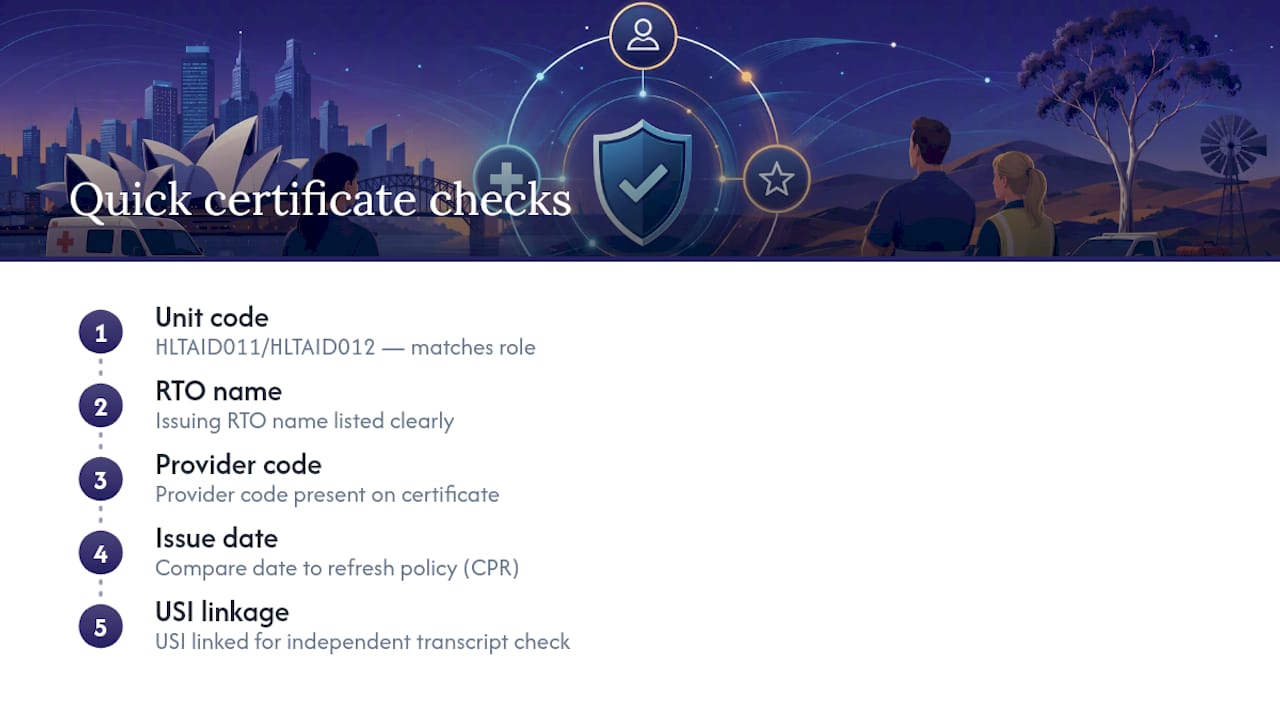
Before you hand your certificate to a new employer or safety manager, run a quick check yourself rather than assuming everything’s in order. Confirm the unit codes match what the role requires (HLTAID011 for general workplace first aid, HLTAID012 for childcare), and check the RTO’s name and provider code are both listed clearly. Look at the issue date against your employer’s refresh policy, particularly for CPR, and make sure your USI is correctly linked so the record can be verified independently if questioned.
Keep both an emailed PDF and a separate backed-up copy somewhere you won’t lose, like cloud storage or a personal email folder. If either goes missing, you already know the drill: USI transcript first, then a direct request to the issuing RTO for a reissue.
How can Prime First Aid and Training help you get certified fast?
If you need a Statement of Attainment sorted without the usual paperwork delays, Prime First Aid and Training runs HLTAID011, HLTAID009, and HLTAID012 across onsite, mobile, and blended delivery formats, built around how your business actually operates rather than a fixed classroom schedule.
For teams in remote or industrial settings, including Pilbara mine sites, trainers come to you rather than the other way around. Courses are structured so your Statement of Attainment is issued promptly on successful completion, with no unnecessary wait between finishing your assessment and having a usable, verifiable document in hand. Childcare providers needing HLTAID012 can book directly through the dedicated course page, while businesses after broader workplace first aid can browse the full course range or head straight to book online to lock in a session that fits your roster.
Sources
Recommended
Comments