
For a crew at a remote mine, camp or construction site, the practical answer is to bring a competent fit tester and the equipment to the crew, rather than sending workers to a city clinic. A fit test is a hands-on procedure using specialised equipment or test solutions, and it has to be matched to each worker’s face and each respirator they will wear. We deliver respirator fit testing on site across the Pilbara, with scheduling that works around rosters, so your team is tested where they work.
TL;DR
Every worker who wears a tight-fitting respirator needs a fit test before first use, whenever the make or model changes, when their face changes, and at least annually.
A daily fit check (the seal check you do each time you put the mask on) never replaces the fit test.
Choose the method by respirator type: taste-based qualitative testing suits disposable and half-face masks, while quantitative testing covers every tight-fitting style.
Keep a written record per worker: test type, make, model, style, size, date and result.
For remote crews, mobile on-site testing with a trainer who understands site conditions saves travel, downtime and missed rosters.
Table of Contents
Why remote teams need a plan, not a one-off booking
Faces differ widely in shape and size, so one respirator model or size is unlikely to fit everyone. WorkSafe Queensland notes that inadequate fit significantly reduces protection and can cause immediate or long-term health effects. A mask that leaks gives a worker the feeling of protection without the substance.
The difficulty for remote operations is logistics. Workers are on fly-in fly-out (FIFO) rosters or spread across several sites. New starters arrive on different dates. Annual retests fall due at different times. If testing is handled ad hoc, someone is always overdue, and the person who is overdue is usually the one about to start a dust-exposed task.
A plan built around three things solves most of this: knowing who needs a test, choosing the right method once, and bringing the testing to the site on a predictable schedule.
Who needs fit testing
Fit testing applies to tight-fitting respirators, those that rely on a seal against the face. SafeWork NSW states it is required for all close-fitting half and full facepiece respirators, and that loose-fitting hoods or head tops on powered air-purifying respirators (PAPR) or compressed airline do not need it.
In practice that covers:
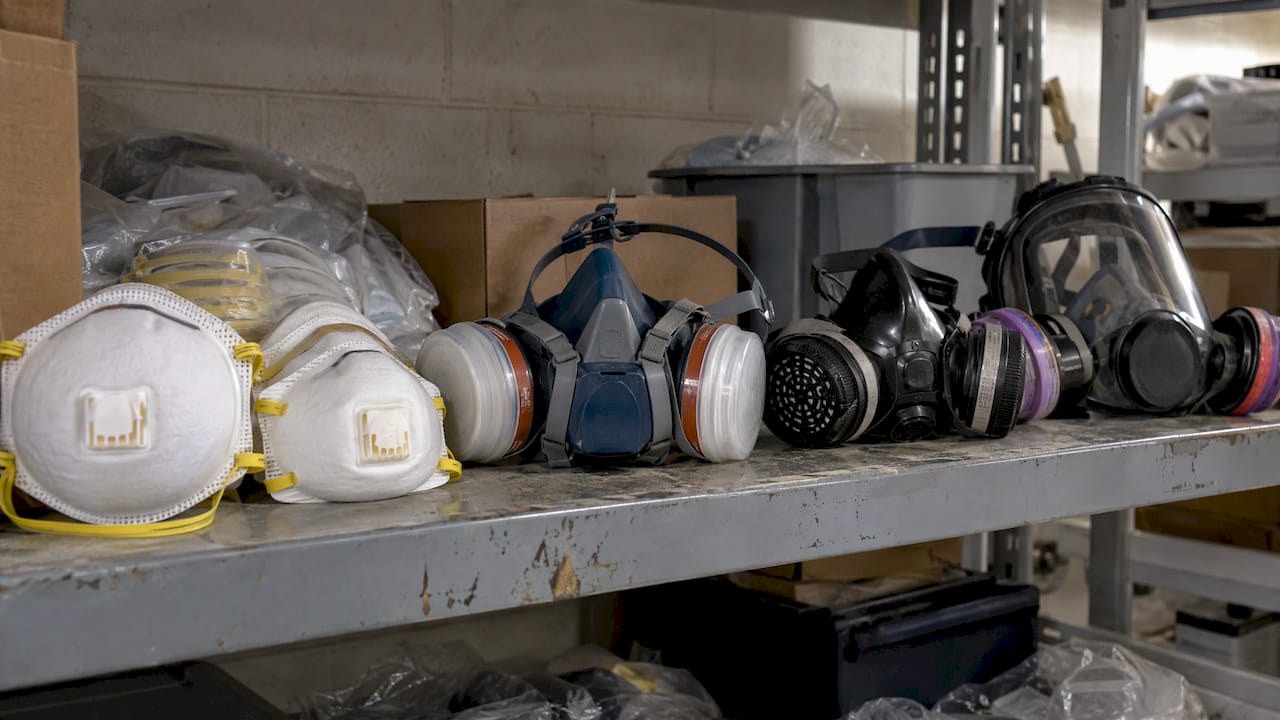
disposable P2 masks
reusable half-face respirators
full-face respirators
tight-fitting PAPR and airline units
That last group surprises people. WorkSafe Queensland points out that even tight-fitting powered or airline apparatus under positive pressure still requires fit testing, because studies show inward leakage is possible during heavy exertion. If your site uses PAPR, our guide on why PAPR blowers are switched off during fit tests explains how the test is run.
Industry context matters too. Construction, mining, welding and healthcare all carry their own hazards and masks. We cover the specifics in our guides to construction respirator fit testing, welding respirator fit testing and P2 mask fit testing for employers.
When a test is due
The triggers are consistent across Australian regulators. SafeWork NSW lists them as before first use, each time a new make or model is issued, whenever facial characteristics change (for example weight loss or gain), and at least annually. WorkSafe Queensland’s RPE guidance gives the same pattern.
In Western Australia, WorkSafe WA’s fit testing information sheet calls for testing on a regular basis based on risk assessment, with a written record for each worker.
For a remote team, turn those triggers into a simple calendar:
New starters: test during induction, before they are issued a respirator for site work.
Equipment changes: if procurement switches brand or model, that is a retest for everyone who wears it. Our post on what employers must do before first use of a new respirator walks through it.
Annual retests: group them by site or roster block so one visit clears many workers.
Face changes: ask supervisors to flag significant weight change, dental work or facial injury so the worker is retested early.
One helpful detail from WorkSafe Queensland: workers do not need retesting when replacing a respirator with the exact same make and model that they have already passed on.
Fit test versus fit check
These are different things and they are often confused. A fit test confirms that a particular respirator style, brand and size can achieve a seal on a particular wearer. A user seal check, also called a fit check, is done each time the mask is put on, to confirm it is seated properly. RESP-FIT, the national accreditation program for fit testers, explains the checks are done by blocking the exhalation valve and breathing out (positive pressure) or blocking the intake and breathing in (negative pressure), and stresses that studies show the two are not equivalent.
The shoe analogy RESP-FIT uses is easy to teach on a toolbox talk: the fit test is choosing the right size shoe, the fit check is lacing it up properly every time. Workers need both. Our article on AS/NZS 1715, fit test and daily fit check gives you wording you can use with crews.
Choosing a method: qualitative or quantitative
Two methods meet AS/NZS 1715:2009, according to SafeWork NSW: a qualitative pass/fail test based on taste or smell, suitable for half-face respirators only, and a quantitative test that uses specialised equipment to measure leakage, suitable for half- and full-face.
RESP-FIT adds detail:
The qualitative aerosol test uses saccharin or Bitrex and suits disposable filtering facepieces and half-face reusables.
Quantitative testing with a condensation nuclei counter can test all tight-fitting styles.
Another quantitative technique, controlled negative pressure, tests reusable half- and full-face respirators but not disposable facepieces.
For higher-risk respirators the guidance leans quantitative. Safe Work Australia’s national silica guide recommends the quantitative method for full-face respirators and PAPR, because taste and smell tests can produce false passes.
Respirator type | Qualitative (taste) | Quantitative |
Disposable P2 | Suitable | Suitable (particle counting) |
Reusable half-face | Suitable | Suitable |
Full-face | Not suitable | Suitable |
Tight-fitting PAPR | Not suitable | Suitable, recommended for silica work |
A mixed workforce is common on remote sites, so one visit often needs both approaches. Our guide for safety officers on qualitative versus quantitative fit testing helps you decide who gets which.
Preparing workers so the day runs smoothly
Preparation decides whether a visiting tester clears your whole list or leaves half of it for another trip.
Facial hair. Workers must be clean-shaven, with no hair between the face and the respirator’s sealing surfaces. The NSW Resources Regulator notes the standard stipulates a clean shave, preferably within 12 hours of the test. On a roster, tell workers the night before. Loose-fitting respirators are the option for people who cannot shave, but they are not a fit-tested mask, so decide this at the planning stage, not on test day.
Smoking, vaping, eating. Standards Australia’s FAQ on the new respiratory protection standards says AS/NZS ISO 16975.3 recommends avoiding smoking, vaping, eating or drinking (except water) beforehand. Vaping and smoking can falsely lower results in particle-counting tests and dull taste in the qualitative test.
Bring the masks they actually use. A typical session lasts about 15 minutes, according to a 2024 fact sheet from Environmental Health Solutions, and workers should bring job-relevant masks, ideally more than one type, because no certificate is issued if the fit cannot be brought up to standard.
A suitable space. Quantitative testing needs a quiet room with power. Identify one at each site in advance, such as a training room or a demountable.
What happens when someone fails
A fail is a normal outcome, not a disciplinary one. RESP-FIT advises that a different style, brand, size or model should be selected and tested until an adequate fit is shown, generally trying any one style, brand, size or model only twice before moving on. A respirator that fails must not be used.
For your procurement, this means holding a small range of models on site. If the only mask issued is one model, the worker who cannot seal it has no safe option. Ask your supplier for two or three alternatives in different sizes before the testing visit.
Records that stand up to an audit
Regulators ask for the same details. SafeWork NSW and WorkSafe Queensland both require a written record for each worker covering the test type, the make, model, style and size of respirator, the date and the result. WorkSafe Queensland’s fit-testing flyer also directs employers to issue each worker a fit-test record card.
For a dispersed workforce, keep one central register, with each worker’s next due date, and make sure the card travels with the worker between sites. Our guide to fit testing records employers must keep sets out the fields in more detail.
Standards changes worth knowing
Standards Australia has adopted AS/NZS ISO 16975.3:2023, which covers fit-testing procedures, tester competencies, interpretation of results and record keeping, with RESP-FIT as the national accreditation program. A June 2024 industry forum paper also reports that facial hair prevents a good seal for all tight-fitting respirators, including tight-fitting PAPR, and that the 1 September 2024 model WHS Regulation amendment requires respirators used as a silica control to comply with AS/NZS 1716 and AS/NZS 1715. Check with your state regulator for how this applies in your jurisdiction.
Bringing testing to the site
RESP-FIT notes that AS/NZS 1715 does not define the competencies a fit tester needs, so businesses use different ideas of a competent person. Whoever tests, in-house or external, must be competent and use a validated method. Running it in-house means buying equipment and training an employee to become an accredited tester, which suits a large single-site operation. For crews across several remote sites, a mobile service removes that overhead.
That is where we come in. Our courses are available on site anywhere in the Pilbara, including remote mine and construction sites, with flexible scheduling outside standard business hours. That matters for night shift and FIFO changeovers, when you can only catch everyone at the edges of the roster. We can tailor the session to the industry and the risks your people face, and our trainers have industry-relevant experience, so the conversation on the day is about your real tasks and masks.
Perspective
Remote teams do not struggle with fit testing because the rules are unclear. They struggle because the testing is treated as a separate errand, away from the work. Our approach is to fold it into the site’s rhythm. We come to you in the Pilbara, we schedule around shifts rather than office hours, and we tailor the session to the risks of your operation. Workers who are tested in familiar surroundings, by a trainer who knows their industry, ask better questions about fit and use their masks with more confidence. The same visit can sit alongside the other safety training your crews need, from remote-site first aid to working at heights and confined spaces. One partner, one plan, fewer gaps in your compliance register. Vapour
Book fit testing for your crew
We offer respirator protective equipment fit testing and hearing protective device fit testing on site, alongside first aid and WHS courses delivered to your workplace. Tell us your sites, headcount and the respirators in use, and we will shape the visit around your roster. See the full range on our courses page.
If your team works in healthcare settings, our guides on fit testing for Australian healthcare and healthcare fit testing policy cover what applies there. Remote crews also need first aid cover: our HLTAID013 Provide First Aid in Remote or Isolated Site course is $400.
FAQ
How often do remote workers need to be fit tested?
Before first use of a tight-fitting respirator, whenever a new make or model is issued, whenever facial characteristics change, and at least annually, per SafeWork NSW and WorkSafe Queensland. WorkSafe WA also asks for regular testing based on risk assessment.
Does a fit check each shift replace the annual test?
No. The fit check confirms the mask is seated correctly each time it is put on, but it does not show that the respirator suits the wearer’s face. WorkSafe Queensland states a fit check does not replace a fit test.
Can workers with beards be fit tested?
No, not for tight-fitting respirators. Workers must be clean-shaven where the mask seals, preferably within 12 hours of the test. Loose-fitting hoods or head tops are the alternative for those who cannot shave.
What should we do if a worker fails the test?
Try another style, brand, size or model and retest until an adequate fit is shown. RESP-FIT suggests attempting any one option only twice. The failed respirator must not be used.
Sources
WorkSafe Queensland: Fit testing for tight-fitting respirators
SafeWork NSW: Respiratory protective equipment and requirements for fit testing workers
WorkSafe WA: Respiratory protective equipment, fit testing requirements
Safe Work Australia: Working with silica and silica containing products
NSW Resources Regulator: Facial hair and respiratory protective equipment
Environmental Health Solutions: Respirator fit testing fact sheet 2024
Airborne Contaminants and Health Surveillance Forum paper, June 2024
Recommended