
APF over 10: Safety officers' choice, QNFT or QLFT for fit testing
- Vapour Graphics
- 7 hours ago
- 7 min read
Quantitative fit testing (QNFT) is the method to reach for whenever a task carries an assigned protection factor above 10 or demands auditable proof of seal quality. Qualitative fit testing (QLFT) remains a legitimate, cost-effective choice for lower-risk work where a pass/fail sensory check is enough. The real decision comes down to risk, record-keeping needs, and what your budget can absorb in disposables and equipment.
TL;DR:
Quantitative fit testing provides a numerical fit factor that is easier to document, defend, and verify during audits or incident investigations.
Qualitative fit testing relies on the wearer’s senses and is suitable for low-risk roles where subjective results and lower costs are acceptable.
For tasks with an assigned protection factor above 10 or involving high hazards, quantitative testing is typically required or strongly preferred.
Budget considerations include the cost of disposable respirators for QNFT, calibration and maintenance of testing instruments, and recurring challenge-agent supplies for QLFT.
A mixed approach, starting with quantitative testing for high-risk groups and using qualitative testing for larger, lower-risk populations, offers balanced safety and cost-efficiency.
Table of Contents
Qualitative vs quantitative fit testing: what QLFT actually involves
Qualitative fit testing (QLFT) is a pass/fail method that relies entirely on the wearer’s own senses. There’s no instrument reading, no fit factor, no printout for the file. If the person being tested can taste, smell, or feel an irritant leaking past the seal, the respirator fails.
The protocol runs in two stages. First, a sensitivity screening confirms the wearer can actually detect the test agent at a low concentration. Then they wear a hood or enclosure while the challenge agent is introduced, working through a set sequence of exercises including normal breathing, deep breathing, head turns, and talking. Accepted agents include Bitrex (denatonium benzoate), saccharin, and isoamyl acetate. Irritant smoke is technically permitted under some protocols but discouraged because the irritant response can be confused with other reactions.
For workplace managers, QLFT has clear appeal:
Lower upfront equipment cost, with no instrument to buy, maintain, or calibrate.
Faster to administer for straightforward, low-risk roles.
No respirator sacrificed for a probe hole; the tested unit stays serviceable.
The trade off is subjectivity. A wearer with a poor sense of smell, a cold, or a strong desire to pass can skew the outcome, which is exactly why QLFT is reserved for lower assigned protection factor applications.
How quantitative fit testing (QNFT) measures a real seal
Quantitative fit testing swaps the wearer’s judgement for an instrument reading. The two common methods are ambient aerosol condensation nuclei counting (CNC), performed with a device such as a PortaCount, and controlled negative pressure (CNP) systems. Both produce a numerical fit factor, essentially a ratio comparing contaminant concentration outside the mask to what leaks in.
Guidance widely cites minimum pass thresholds of a fit factor of 100 for half-facepiece respirators and 500 for full-face respirators. Those numbers aren’t arbitrary; they build in a safety margin above the respirator’s assigned protection factor.
Pro Tip: A higher fit factor doesn’t mean proportionally more protection once you’re above the minimum. Fit testing confirms an adequate seal; it doesn’t scale exposure reduction beyond the respirator’s rated APF.
Two practical points matter for anyone running a program:
QNFT for a tight-fitting respirator typically requires a probe or sampling port, which means punching a small hole in the facepiece.
Any disposable respirator tested this way gets discarded afterwards. It can’t go back into service with a hole in it.
That single fact drives most of the budgeting conversation later in this guide.
How QLFT and QNFT actually compare on the ground
Objectivity is the headline difference. QNFT hands you a number in a report; QLFT hands you a person’s word that they didn’t taste anything. For any audit, insurer review, or incident investigation, a documented fit factor is far easier to defend than a verbal pass.
Throughput tells a different story. A basic QLFT session can move faster per person for straightforward low-risk roles, though modified FAST protocols have narrowed that gap considerably for quantitative testing across large workforces.
Cost hides in different places for each method:
QNFT consumes a disposable respirator per test subject once a probe is fitted, on top of the instrument’s purchase and calibration cost.
QLFT consumes challenge-agent solutions and hood kits, cheaper individually but recurring with every session.
Both methods depend on operator competence; a poorly trained tester undermines either result equally.
Pro Tip: Ask any provider for a sample QNFT report before you book. If it doesn’t show the fit factor, the test protocol used, and the respirator model tested, keep looking.
When quantitative testing becomes the required or preferred option
The trigger is almost always the assigned protection factor of the task, not personal preference. Anything above an APF of 10, meaning the respirator needs to reduce exposure by more than a factor of ten, points firmly toward QNFT. Below that threshold, and where resources are tighter, QLFT with proper controls is still defensible.
Standards and guidance shape this decision as much as the numbers do. NIOSH and CDC fit-testing guidance and OSHA’s Appendix A protocols set the baseline most technical bulletins reference. In Australia, AS/NZS 1715 provides selection and use guidance for respiratory protective equipment that workplace programs should be checked against before settling on a method.
Real workplace examples where QNFT is the practical default:
Healthcare settings using N95-equivalent respirators for airborne pathogen exposure.
Tasks involving hazardous chemical vapours or particulates above occupational exposure limits.
Confined-space entry where atmospheric hazards can shift quickly and margin for error is thin.
Budgeting for a fit testing programme that holds up
Throughput expectations should be realistic, not aspirational. A standard QNFT session, run without a streamlined protocol, takes longer per person than a basic QLFT check, though FAST-style modified protocols close much of that gap for larger cohorts.
Budget line items to plan for:
Replacement respirators for every worker fit tested via QNFT, since the tested unit is discarded.
Calibration and servicing costs for CNC or CNP instruments, plus operator competency training.
Consumables for QLFT, including sensitivity screening solutions and hood kits, restocked per session.
Documentation matters just as much as the test itself. Keep records of the respirator make and model, test method and fit factor (where applicable), test date, operator name, and any facial hair or medical conditions noted at the time. That file is what protects you when an auditor or WorkSafe inspector comes asking.
A step by step checklist for choosing your fit testing method
Step 1: Assess task APF and risk. Anything above an APF of 10, or involving airborne pathogens or serious chemical exposure, points to QNFT.
Step 2: Consider workforce size and throughput. Large cohorts of low-risk workers may suit QLFT; a smaller high-risk group justifies the instrument cost of QNFT.
Step 3: Assess audit and record needs. If you need a defensible numeric record for compliance or insurance purposes, QNFT wins outright.
Step 4: Budget and logistics. Factor in disposable respirator replacement for QNFT versus recurring consumables for QLFT.
Questions worth asking any fit-testing provider:
When was your instrument last calibrated, and can you show the certificate?
What competency training have your operators completed?
What does a sample report look like, and does it record the fit factor and protocol used?
Pro Tip: Walk away from any provider using irritant smoke as a challenge agent, offering no written report, or unable to explain their protocol step by step. Those are the three biggest red flags in fit testing.
How Primetraining runs fit testing and why it works
Primetraining runs both QLFT and QNFT on-site, including at remote locations across the Pilbara where workers can’t easily travel to a fixed testing clinic. For high-APF roles, confined-space work, and healthcare-adjacent tasks, we recommend and deliver quantitative testing with proper calibrated instrumentation. For lower-risk, high-volume workforce testing, qualitative testing remains a sound, defensible option when run to protocol.
Our trainers bring industry-relevant experience across mining, construction, and healthcare settings, and every session is tailored to the respirator models and tasks your business actually uses. Whether you need a respirator fit test for a small crew or a broader rollout, we build the paperwork trail into the session from the start.
What we’ve learnt from years of fit testing debates
Most guidance treats QNFT as the unquestioned gold standard and leaves it there, but that framing skips the part that actually matters to a safety officer with a budget and a roster to manage. QNFT gives you a number. It doesn’t automatically give you a better outcome if the number comes from a poorly calibrated instrument or an operator who rushed the exercises. A rigorous QLFT session run to protocol, with proper sensitivity screening, will beat a sloppy QNFT session every time.
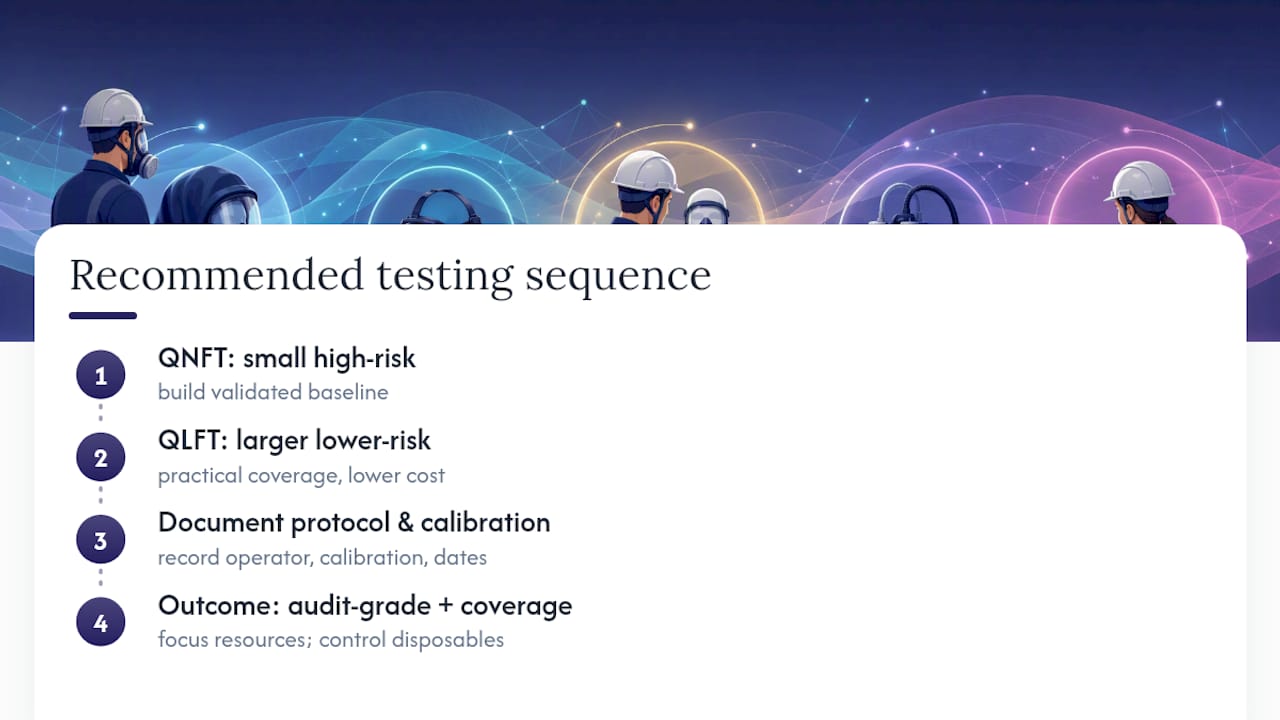
The smarter approach, and one worth borrowing from practitioners who run large programs, is to sequence your testing rather than pick one method for everyone. Run QNFT first on your smallest, highest-risk cohort to build a validated baseline. Roll QLFT out to your larger, lower-risk groups once that baseline is set. This isn’t a compromise; it’s how you get audit-grade protection where it counts and practical coverage everywhere else, without blowing the budget on disposables for roles that never needed that level of scrutiny in the first place.
What people underestimate most is the paperwork. A fit factor without a documented protocol, operator name, and calibration record is barely more defensible than a qualitative pass. The number matters less than the trail behind it.
— Vapour
Booking Primetraining for your fit testing programme
Primetraining runs on-site quantitative and qualitative fit testing, along with combined training packages, at your workplace or ours, including remote sites across the Pilbara where a mobile service saves you the logistics headache entirely. Rather than sending your crew off-site and losing a shift to travel, we bring calibrated instruments and trained operators to you.
Before you book, have a few details ready: the number of staff needing testing, the respirator models currently issued, and your preferred dates. That lets us plan the right mix of QNFT and QLFT for your roles and quote accurately from the outset. If your team also needs confined-space or gas-test training alongside fit testing, we can bundle the sessions to save you downtime.
Browse our full range of courses or head straight to book online to lock in a date. We’ll confirm your fit-testing method and get certificates into your hands promptly once the session wraps up.
Sources
Recommended
Comments