
10 Minute RTO & USI Checklist for Blended First Aid for Employers

Blended first aid combines online theory modules with a mandatory, face-to-face practical assessment, and when a registered training organisation delivers it properly, it leads to the same nationally recognised Statement of Attainment as a fully in-person course. Completing the online component alone never satisfies units like HLTAID011. You need to attend the practical session, demonstrate the skills, and pass. Before you enrol, check the RTO code on Training and make sure your certificate will be linked to a valid USI.
TL;DR:
A practical first aid course requires attending a face-to-face session to demonstrate skills like CPR, AED use, and casualty assessment, not just completing online modules.
Employers must verify the RTO code, unit codes, and USI registration before booking to ensure the certificate is nationally recognized and valid.
Assessment is staged: online quizzes build knowledge, while practical skill demonstrations and scenario responses measure real-world competency.
Blended courses are flexible, allowing practical sessions to be staggered across shifts or scheduled on-site, minimizing operational disruption.
Certification for units like HLTAID011 remains valid for three years, with refresher training recommended to maintain hands-on proficiency.
Table of Contents
What does a blended first aid course actually look like?
Most blended courses split neatly into two halves, and understanding that split helps you plan around work rosters, shift patterns, or a training day for a whole team.
The online theory component usually runs several hours, depending on which units are packaged into the course. You’ll work through short video lessons, interactive modules, and scenario-based questions covering topics like recognising a medical emergency, calling for help correctly, and understanding basic anatomy and physiology relevant to first aid response. Multiple-choice checkpoints are standard throughout, and most providers require you to pass these before you’re allowed to book into a practical session. This isn’t busywork. It’s the theoretical foundation the practical assessment builds on.
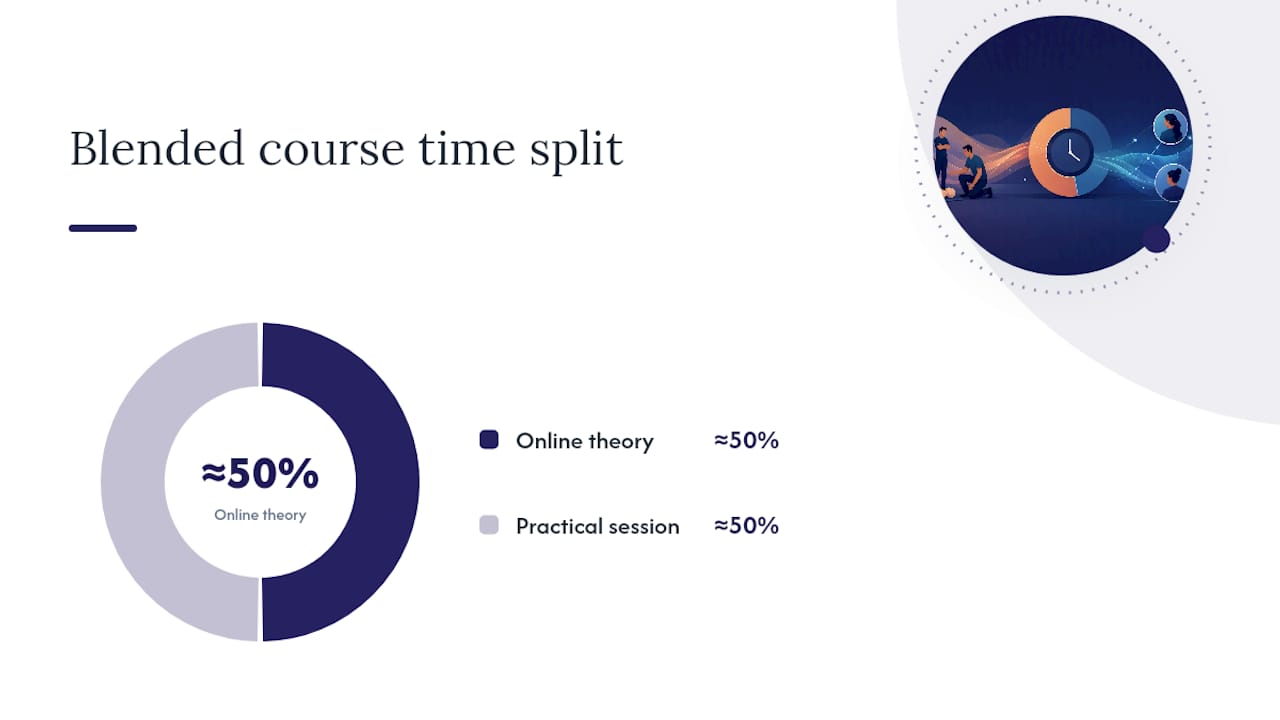
The face-to-face practical session is where the real assessment happens, and it typically takes several hours to a full day, depending on how many units you’re completing. If you’re doing HLTAID011 alone, expect a shorter session. Bundle in HLTAID009 for CPR or additional units for remote-site or childcare settings, and the day stretches out.
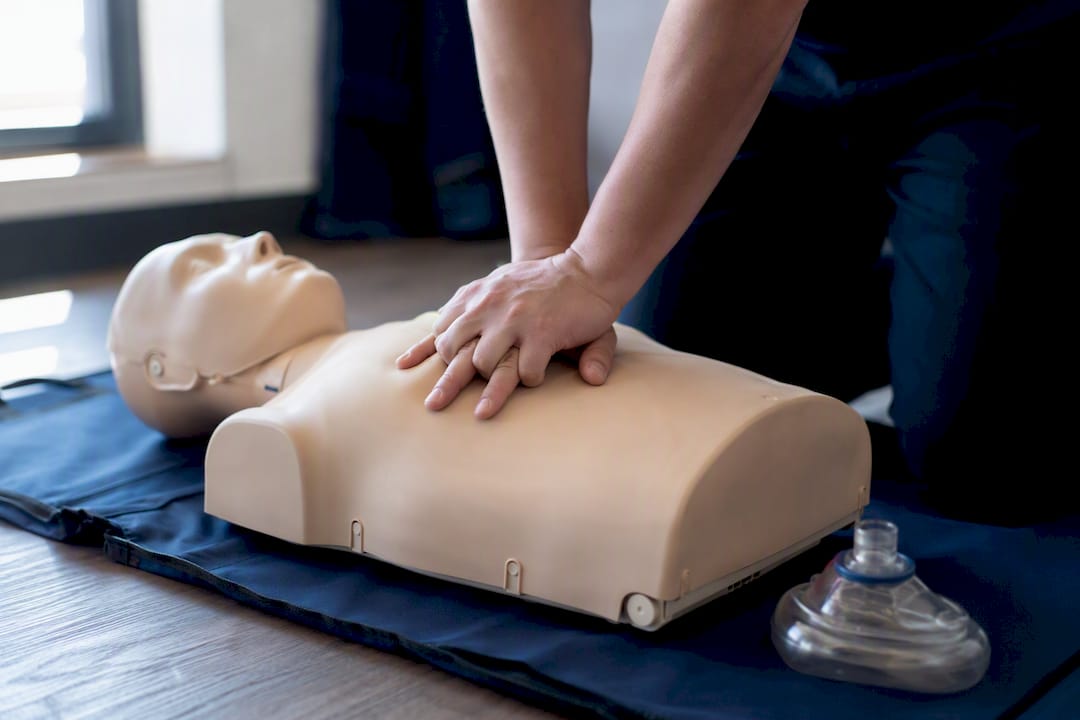
During the practical, a qualified trainer observes you performing skills that simply cannot be assessed through a screen. These typically include:
Cardiopulmonary resuscitation technique on a training manikin, including correct hand placement, compression depth, and rate
Casualty assessment and the DRSABCD action plan in a simulated emergency
Automated external defibrillator (AED) use, from power-on through to shock delivery
Bandaging and wound management for cuts, burns, and fractures
Scenario-based decision making, where you respond to a simulated incident as it unfolds in real time
That last point matters more than people expect. A written quiz can test whether you know the theory behind anaphylaxis management. It cannot test whether you’ll stay calm and act correctly when someone in front of you is struggling to breathe. That’s the gap the practical session closes, and it’s the reason no legitimate provider will hand you a nationally recognised certificate for finishing the online module by itself.
What units and accreditation should you look for?
The specific unit code on your certificate tells you exactly what you’re qualified to do, and it’s worth knowing the codes before you book rather than after.
HLTAID011 - Provide first aid is the core nationally recognised unit for general first aid competency in Australia. It covers the skills most workplaces and community settings require: managing casualties, basic life support, and responding to common medical emergencies. Many blended courses package it alongside HLTAID009 - Provide cardiopulmonary resuscitation, a separate unit specifically focused on CPR technique and often required for annual refresher purposes.
Once you finish both the online and practical components, a registered training organisation issues a Statement of Attainment, not a generic completion certificate. That distinction matters. A Statement of Attainment references the exact unit codes you’ve achieved, names the issuing RTO, records your trainer’s name, and carries a completion date. Anyone can check that the issuing organisation is legitimate through the ASQA explainer on what an RTO is, which sets out how registration and audit work for training providers across the country.
Before your first session, a few quick checks save headaches later:
Search the provider’s RTO code on training.gov.au to confirm it’s current and covers the units you’re booking
Ask what unit codes will appear on your certificate, and cross-check them against your workplace’s requirements
Create your USI in advance through Usi if you don’t already have one, since nationally recognised certificates can’t be issued without it
Confirm the RTO’s scope of registration matches the specific course you’re enrolling in, using the organisation lookup on training.gov.au
Skip these checks and you risk turning up to a practical session only to discover the “certificate” waiting at the end isn’t nationally recognised at all.
How is competency actually assessed in a blended course?
Assessment in a blended first aid course happens in two stages, and each one tests something different.
Online, you work through theory lessons and interactive scenarios designed to build knowledge before you ever touch a manikin. Quizzes throughout the module check your understanding of concepts like the chain of survival, recognising anaphylaxis, and managing shock. Most RTOs require full completion of this stage, verified by the system, before you’re permitted to book a practical slot. It’s a gatekeeping step that keeps the practical day focused on skills rather than remedial theory.
The practical component tests something the online module can’t: performance under simulated pressure. Trainers observe your CPR technique directly, checking compression depth and rate against required standards. They run casualty management scenarios where you have to assess, prioritise, and act. AED demonstration is usually built in as a discrete skill check. Throughout the day, trainers are watching for sound first-aid decision making, not just correct answers to a hypothetical.
Complete all online theory modules and pass the required quizzes.
Attend the scheduled practical session with any pre-course paperwork completed.
Demonstrate CPR, casualty assessment, and AED use to the trainer’s satisfaction.
Participate in scenario-based assessment covering realistic emergency situations.
Receive feedback on the day, with re-assessment offered on the spot for most skills gaps.
If a participant doesn’t quite meet the standard on a particular skill, most trainers offer immediate re-attempt opportunities rather than failing someone outright on the day. Competency gets documented against each unit’s performance criteria, and trainers keep records showing exactly what was observed and when.
Scheduling flexibility is where blended delivery earns its keep for businesses. Providers can stagger practical sessions across a week so an entire shift isn’t pulled off the floor at once, run team bookings for a whole department, or bring mobile trainers on-site rather than sending staff off to a training centre.
Pro Tip: If you’re booking for a team, ask whether the practical sessions can be staggered across different days or shifts. It’s a small scheduling request that can save a business from shutting down operations for an entire afternoon.
Who actually needs blended first aid training?
Whether blended delivery satisfies your obligations depends on your role and setting, and it’s worth checking before you assume one course covers everyone in your business.
HLTAID011 is the standard requirement across most general workplaces, from offices to retail to light industrial settings. Childcare and education environments typically require HLTAID012 - Provide first aid in an education and care setting, which layers in paediatric-specific content that general workplace courses don’t cover. Remote or isolated worksites, common in mining and resources, often call for additional units built around delayed emergency response times.
Employers carry the responsibility of matching training to actual workplace risk, a principle set out clearly in guidance from Safe Work Australia and mirrored in state-level codes of practice such as SafeWork NSW’s first aid in the workplace code. That means a construction site and a suburban office won’t necessarily need the same first-aid arrangements, even if both fall under general workplace obligations.
What you need to keep on file as evidence of compliance:
The Statement of Attainment for each staff member, listing exact unit codes achieved
Attendance and assessment records confirming who completed the practical component and when
Trainer details and the issuing RTO’s registration information
A record of when refresher training is due, so certificates don’t lapse unnoticed
Higher-risk settings warrant a closer look at extra units. A mine site or remote construction crew, for instance, often benefits from first aid training for remote or isolated sites, which accounts for the reality that help might be hours away rather than minutes.
How to choose a blended first aid provider: a quick checklist
Picking a provider comes down to verification and a handful of direct questions, and doing this properly takes about ten minutes before you commit to a booking.
Confirm the RTO code. Search it on training.gov.au and check the provider’s scope of registration actually covers the units you want.
Ask for exact unit codes. A reputable provider will tell you upfront whether you’re getting HLTAID011, HLTAID009, or a bundle, not a vague “first aid certificate.”
Check ASQA status. A current, unrestricted RTO registration is non-negotiable for a nationally recognised outcome.
Confirm USI handling. Ask how they collect your USI and how long after the practical session your certificate will be issued.
Ask about class size and trainer credentials. Smaller groups generally mean more individual attention during the practical assessment.
Clarify the re-assessment policy. Find out what happens if someone doesn’t demonstrate a skill correctly on the first attempt.
Ask about mobile or group delivery. If you’re booking for a team, confirm whether the provider travels on-site and what that costs.
On pricing and scheduling, probe for travel fees on mobile deliveries, any minimum group numbers required for an on-site session, and realistic turnaround time from practical completion to certificate issuance. A provider who can’t give you a straight answer on any of these is worth a second look before you pay a deposit.
Watch for a few red flags that should stop you before you book: vague or evasive answers about which RTO is actually issuing the certificate, any claim that an online-only course delivers a nationally recognised outcome without a practical component, or a total absence of detail about what the practical assessment covers.
Pro Tip: Call the provider and ask them to read out their RTO code over the phone, then check it yourself on training.gov.au while you’re still on the call. A legitimate provider won’t hesitate.
What drives cost, duration, and certificate validity?
Blended delivery generally cuts onsite time compared with a full face-to-face course, because the theory content that would otherwise eat half a training day gets completed online, at your own pace, beforehand. That leaves the in-person session focused purely on hands-on skills, which is why practical days often run shorter than traditional single-format courses covering the same units.
Cost tends to move with a few clear factors: group size, whether you need mobile delivery to a worksite (which typically involves travel considerations), and how many units you’re bundling into one session. A single HLTAID011 course for one person looks very different, budget-wise, from a mobile session for twenty staff covering HLTAID011, HLTAID009, and a remote-site unit.
Certificate validity commonly runs for a few years for HLTAID011, though CPR-specific competency is generally recommended for regular refreshing given how quickly hands-on technique can fade without practice. Treat the three-year mark as the outer limit, not a target to run right up against, particularly in higher-risk workplaces.
Before booking, have a few things sorted:
Your USI, created or looked up in advance
Proof of online module completion, if your provider requires it before the practical
Site requirements confirmed if you’re booking mobile or on-site delivery, including space and equipment needs
A clear headcount and preferred date range, especially for group bookings
Why Primetraining fits the way blended training actually gets used
This blended first aid offering is designed around the reality that most businesses booking training aren’t training centres, they’re worksites trying to stay compliant without grinding operations to a halt. That’s shaped everything from course design to delivery logistics.
Course content gets tailored to the business booking it, rather than a one-size-fits-all module. Mobile delivery is a core part of the offering, not an add-on. This matters when the alternative is pulling an entire crew off-site for a day.
Fast certificate turnaround is an operational advantage for businesses working to compliance deadlines, as delays in certificate issuance close to audits can be problematic.
The ability to stagger practical sessions across shifts or days can benefit corporate clients by avoiding large groups off the roster simultaneously, thus keeping operations running while meeting in-person assessment requirements. Browse the full range of available courses or head to the booking page to see current session options.
The gap between what “online certification” promises and what actually holds up
Plenty of first aid marketing leans hard on convenience, and convenience is genuinely valuable. But the industry has a persistent blind spot: some providers imply, through vague wording rather than outright lies, that online completion alone gets you a nationally recognised certificate. It doesn’t, and it never will for units like HLTAID011, because ASQA’s standards require observed, hands-on competency assessment.
The conventional advice tells buyers to compare price and course length. That’s backwards. The first question should be whether the RTO code checks out on training.gov.au, because everything else, price, scheduling, trainer quality, is irrelevant if the certificate at the end isn’t worth the paper it’s printed on.
What actually matters is treating the practical session as the main event, not an inconvenient add-on to an online module. Businesses that get the most value from blended training are the ones that plan around the practical day properly, staggering it, staffing around it, and treating attendance as non-negotiable rather than optional.
Prioritise verification first, convenience second. The order matters more than most buyers realise.
— Vapour
Book blended first aid training that works around your business
Primetraining is the practical alternative to choosing between rigid, full-day face-to-face courses and unverified online-only certificates that won’t hold up. You get flexible online theory paired with a properly assessed practical session, delivered on-site, at a workplace, or through scheduled public sessions, with a fast turnaround on your Statement of Attainment once you’re done.
Getting started is straightforward. Have your USI ready (or create one beforehand), know roughly how many people need training, and have a sense of your preferred dates. From there, browse the full range of courses, including options like the Provide First Aid in an Education and Care Setting unit for childcare and education staff, or the remote and isolated site unit for mine sites and other high-risk locations. Delivery runs three ways: mobile on-site training brought straight to your workplace, scheduled workplace sessions, or public course dates for individuals and smaller teams.
Head to the booking page to check available dates and lock in a session that fits your roster, not the other way around.
Sources
Recommended
Comments