
Standards to action: Fit testing for Australian healthcare

If you wear a tight-fitting P2 or N95 respirator as part of your clinical role, you must be fit tested before you rely on it, then annually, and again whenever the model, size, or your face changes. The simplest next step is to speak with your workplace’s respiratory protection programme coordinator or book directly with an accredited provider. Fit testing confirms the specific respirator you’ve been issued actually seals against your face.
TL;DR:
Quantitative fit testing offers a more objective, repeatable score and is preferred for staff in high-risk departments engaging in aerosol-generating procedures.
Fit testing should be conducted at employment start, annually for ongoing risks, and immediately after any facial changes or respirator model updates.
Employers must implement a comprehensive respiratory protection program that includes risk assessment, medical evaluation, training, maintenance, and record keeping, not just annual testing.
If a worker fails multiple fit tests despite trying different models and adjusting donning techniques, they should be provided with alternative protection such as a powered air-purifying respirator.
On-site or remote fit testing services, like Primetraining, streamline scheduling and integrate training, helping to maintain ongoing compliance and staff confidence.
Table of Contents
Qualitative vs quantitative fit testing for healthcare workers
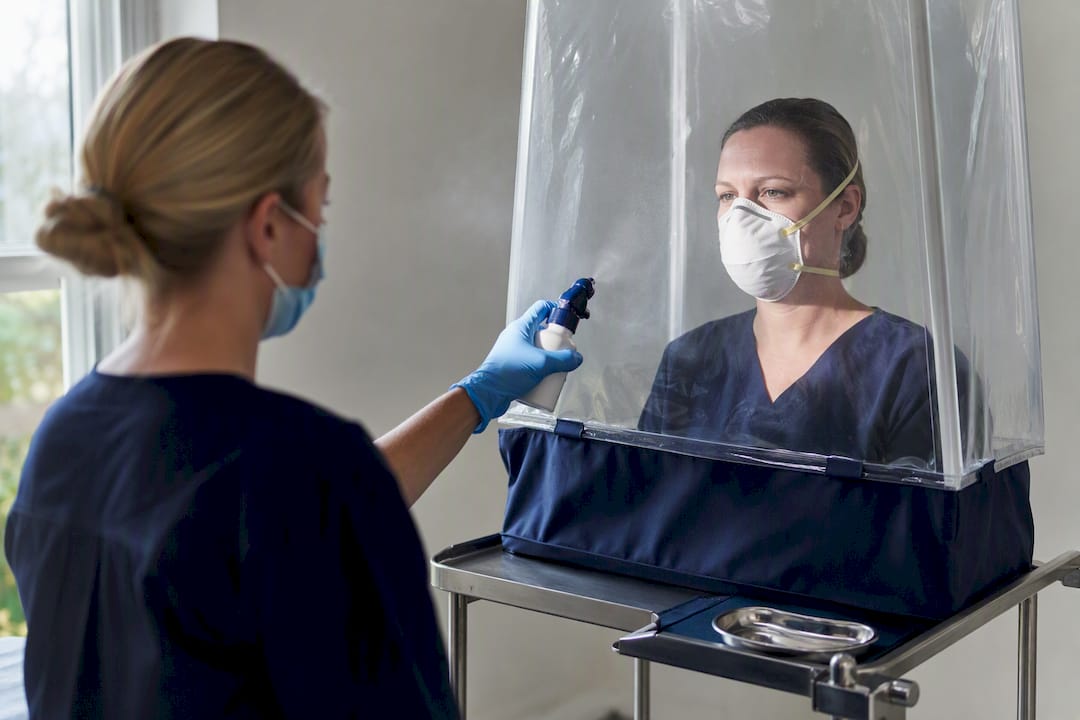
Two testing methods dominate fit testing for healthcare workers in Australia, and they work quite differently. Qualitative fit testing (QLFT) relies on your senses. A tester releases a fine aerosol, usually a bitter or sweet-tasting substance, into a hood placed over your head while you wear the respirator. If you can taste or smell it, the seal has failed. It’s a pass or fail result, nothing more precise than that.
Quantitative fit testing (QNFT) takes the guesswork out. A machine counts particles inside and outside the mask through a small probe fitted into the respirator, then calculates a numerical fit factor. This method removes wearer bias entirely and gives an objective score rather than a subjective sensory judgement, which is why it’s preferred for staff facing frequent or prolonged airborne exposure, according to NIOSH’s fit-testing guidance.
The practical trade offs matter when you’re choosing a method for your workplace:
Equipment and portability: QLFT needs only a hood and test solution, so it travels easily between wards or sites. QNFT requires a particle-counting instrument, which is bulkier and needs calibration.
Respirator fate: QNFT typically punctures the respirator to fit the sampling probe, so that specific mask can’t be reused afterwards. QLFT leaves the respirator intact.
Operator skill: QNFT demands trained technicians familiar with the equipment. QLFT is simpler to administer but more open to interpretation.
Objectivity: QNFT produces a repeatable number. QLFT depends on the wearer’s sensory response, which varies from person to person.
For most healthcare employers, the choice isn’t strictly either/or. Wards with lower airborne risk might reasonably use QLFT, while intensive care, emergency departments, and anywhere aerosol-generating procedures happen regularly should lean toward QNFT where it’s accessible. Either method satisfies the intent of AS/NZS 1715:2009 when performed correctly, but the risk profile of the role should guide which one you choose.
What happens during a fit test, step by step
A fit test isn’t a training session. You should already know how to don your respirator correctly before you turn up, because the test is there to confirm competence, not teach it, a point emphasised in TSI’s application guidance on N95 fit-testing. Turning up without prior donning practice slows the whole process down and can produce a false fail.
Before the test:
Complete respirator donning training so you can fit the mask unassisted.
Disclose any facial hair, since even light stubble along the seal line will usually cause a fail.
Confirm medical clearance if your workplace requires it before respirator use.
Select two or three respirator models and sizes to trial, since fit varies significantly between brands.
During the test:
You don the respirator yourself, without the tester adjusting straps or repositioning the mask.
You perform a series of standardised exercises, typically including normal breathing, deep breathing, head movement side to side and up and down, talking, and bending over.
For QNFT, a probe is inserted into the respirator to sample air continuously while you move through the exercises.
The tester records the exact model, size, and fit factor or pass/fail result against your name.
After the test:
You receive a documented fit-test record noting which respirator model and size passed.
If you pass, that specific model and size becomes your allocated respirator until the next scheduled or trigger-based retest.
If you fail, the tester moves to a different model or size before declaring the session unsuccessful.
Pro Tip: Bring your own reading glasses, hearing aids, or any accessory you’d normally wear on shift. Testing with gear you won’t actually wear on the ward gives you a fit result that doesn’t reflect real working conditions.
Documentation matters more than most staff realise. A fit-test record isn’t just a compliance box, it’s the reference point for reordering stock, rostering staff into high-risk areas, and proving due diligence if an incident review ever asks why a particular respirator was issued to a particular person.
Who needs testing and how often it’s required
Not every healthcare worker needs the same testing schedule, but the principle behind prioritisation is straightforward: match testing frequency and coverage to actual airborne exposure risk. Local risk assessment should drive the decision rather than assuming only clinical staff qualify. Wardspersons, cleaners, and maintenance staff who enter high-risk areas can require fit testing too, if the risk assessment identifies genuine exposure potential.
In practice, most Australian health services prioritise:
Intensive care and high dependency unit staff, who work in sustained proximity to critically unwell patients.
Emergency department clinicians managing undifferentiated presentations.
Respiratory and infectious diseases ward staff.
Anyone regularly performing or assisting with aerosol-generating procedures, such as intubation or bronchoscopy.
Allied health and support staff whose duties place them in these same high-risk spaces.
Retesting isn’t a once-a-year formality you can schedule and forget. According to the ACIPC and Queensland Health guideline on fit testing, retesting is required at commencement of employment, annually for staff at ongoing risk, and immediately whenever the respirator model or size changes or a worker’s facial features change, whether through weight fluctuation, dental work, scarring, or surgery.
Where budgets or staffing don’t allow immediate testing of every eligible worker, a staged rollout guided by risk assessment is a legitimate and practical approach, rather than an admission of non-compliance. Start with the highest-risk roles, document your prioritisation logic, and expand coverage on a realistic timeline.
Employer duties and building a respiratory protection programme
A single fit test event means little without the programme wrapped around it. The NHMRC’s Australian guidelines for the prevention and control of infection in healthcare set out that a functioning respiratory protection programme needs several components working together, not just an annual testing appointment.
A compliant programme typically includes, as highlighted by Aman Engineering Consultancy’s comprehensive PPE inspection checklist, several components working together, not just an annual testing appointment.
Risk assessment identifying which roles and tasks carry airborne exposure risk.
Respirator selection matched to that risk, considering both protection level and available sizes.
Medical evaluation where a worker’s health status might affect their ability to safely wear a respirator.
Fit testing at the frequencies and triggers already covered above.
Training in correct donning, doffing, and daily seal checking.
Maintenance and storage procedures so respirators aren’t damaged or contaminated between uses.
Record keeping linking each worker to their tested model, size, and test date.
Programme review on a regular cycle to catch gaps before they become incidents.
SafeWork NSW’s guidance on respiratory protective equipment reinforces that under work health and safety law, providing suitable, properly fitted respiratory protection sits squarely within an employer’s duty of care. That duty extends to consulting with staff and health and safety representatives when selecting respirator models, not just handing down a decision made in a boardroom.
One detail employers often overlook: fit testing and fit checking are not interchangeable, and treating them as such undermines the whole programme. A systematic review on fit testing versus fit checking found fit testing is considerably more effective than relying on a self-administered seal check alone. Best practice pairs annual fit testing with a mandatory fit check every single time the respirator goes on, not one or the other.
What to do when a fit test fails
Failing a fit test isn’t a dead end, and it shouldn’t be treated as a personal failing either. Face shape genuinely doesn’t suit every respirator design, and the fix is usually mechanical rather than behavioural.
Work through these troubleshooting steps before assuming a worker simply can’t be protected:
Try a different make, model, or size, since fit varies enormously between manufacturers even within the same respirator class.
Check donning technique carefully, since a poorly seated nose clip or twisted strap will fail almost any model.
Remove interfering accessories, including facial hair along the seal line, jewellery, or glasses frames that sit under the mask edge.
Reassess after any of these changes rather than declaring failure after a single attempt.
Pro Tip: Keep at least three different respirator brands or shapes in your testing kit. Facial fit is genuinely individual, and a worker who fails one model can pass another within minutes.
If every available tight-fitting option fails despite trying multiple models, the ACIPC guideline is clear that employers must provide an alternative. That usually means a loose-fitting powered air-purifying respirator (PAPR), which doesn’t rely on a facial seal, or reassigning the worker away from duties that carry airborne exposure risk. Whichever path you choose, document the decision, the reasoning, and any training provided. A worker who can’t pass a fit test still has a legal right to a safe working environment, and the employer still has a duty to provide one.
A practical implementation checklist for employers
Setting up fit testing for healthcare workers doesn’t need to be complicated, but skipping steps creates gaps that surface later, usually during an audit or an outbreak when there’s no time to fix them.
Run a risk assessment identifying which roles, tasks, and locations carry airborne exposure risk.
Write a short policy stating who gets tested, how often, and which method your service uses.
Choose your test type and provider, weighing QLFT’s simplicity against QNFT’s objectivity for higher-risk roles.
Schedule testing logistics, deciding between centralised sessions or ward-based testing that comes to staff.
Brief staff beforehand on donning technique and what to expect, since untrained staff slow down testing days considerably.
Conduct the tests and record results against each worker’s name, model, and size.
File records and set review dates so retesting triggers don’t get missed.
A few practical realities worth planning around:
Testing typically takes 15 to 20 minutes per person once staff are briefed and prepared beforehand.
Cost drivers include provider travel to remote or regional sites, the number of respirator models tested per person, and whether you need QNFT equipment on hand.
Ward-based testing reduces staff downtime but needs more provider visits; centralised sessions are more efficient for large cohorts but pull staff away from clinical areas for longer.
The data captured during testing should feed directly back into procurement. If your testing sessions repeatedly show one brand failing across a cohort, that’s a signal to stock a different model rather than keep retesting against the odds.
How Primetraining supports healthcare respiratory protection programmes
Primetraining delivers on-site, mobile, and online training alongside respirator fit testing services designed to slot straight into a workplace respiratory protection programme. Testing can happen at your facility rather than requiring staff to travel, which matters for services running tight rosters or operating outside metropolitan areas. Course content is tailored to the specific risks your team faces, and certificates are issued promptly once testing or training is complete. That combination, tailored content plus fast turnaround, is what lets fit testing sit comfortably inside a busy clinical calendar rather than becoming another scheduling headache.
Getting fit testing right takes more than good intentions
Most of the fit testing failures I’ve seen described in Australian workplace safety guidance don’t come from ignorance of the rules. They come from treating fit testing as a once-off compliance event rather than a living programme. A health service that fit tests everyone in one enthusiastic push, then lets records lapse for three years, hasn’t built protection, it’s built a paper trail.
The staged, risk-prioritised approach the ACIPC guideline recommends deserves more attention than it gets. Testing your ICU and ED staff properly this quarter beats testing everyone poorly by December. There’s also a confidence dividend that gets overlooked: staff who trust their respirator actually fits show up differently during outbreaks, because the anxiety of wondering whether the mask is working has been dealt with in advance. That’s not a soft benefit. It’s workforce retention during exactly the periods you can least afford to lose people.
— Vapour
Book fit testing and workplace training with Primetraining
Some providers offer an alternative to managing separate providers for testing, training, and certification. Healthcare employers can arrange respirator fit testing and workplace-specific training through one provider that comes to the site, including remote and regional locations.
Fit testing sits alongside a broader course list covering respirator and hearing protective equipment testing, confined spaces, and working at heights, which matters if your service is trying to consolidate multiple compliance requirements into fewer provider visits. For clinical teams that also need first aid coverage, courses like HLTAID011 Provide First Aid and HLTAID014 Provide Advanced First Aid can be scheduled alongside a fit-testing session to reduce disruption to rosters. If your health service needs testing scheduled around shift patterns rather than the other way around, book online to check available dates and get a session locked in.
Sources
For readers who want to go straight to primary guidance rather than a summary, these are the documents that shape fit testing for healthcare workers in Australia:
Check your own state WHS regulator for enforcement specifics, since expectations can vary slightly outside NSW and Queensland.
This article is general information, not a substitute for advice from a qualified doctor. Consult a qualified healthcare professional about your own circumstances before acting on anything here.
FAQ
How often do healthcare workers need to be fit tested?
Fit testing is required at the start of a role, then annually for staff at ongoing risk, and immediately whenever the respirator model, size, or the worker’s facial features change, according to the ACIPC and Queensland Health guideline. Facial changes include weight fluctuation, dental work, scarring, or new facial hair along the seal line.
Do you need a certification to perform fit testing?
Testers need proper training in the specific method they’re using, whether qualitative or quantitative, along with hands on familiarity with the equipment and protocol. Many Australian health services engage accredited external providers, including Primetraining’s on-site fit testing service, rather than building in-house testing capability from scratch.
What is the Australian standard for fit testing respirators?
AS/NZS 1715:2009 and AS/NZS ISO 16975.3:2023 govern respiratory protective equipment selection, use, and fit testing in Australia. These standards work alongside clinical guidance from the ACIPC and NHMRC to set the framework healthcare employers follow.
Where can nursing staff get their masks fit tested?
Fit testing is typically arranged through the health service’s infection control or respiratory protection programme coordinator, either using in-house testers or an external accredited provider. Services covering Western Australia and the Pilbara, including remote sites, can arrange on-site fit testing so staff aren’t required to travel.
What’s the difference between fit testing and fit checking?
Fit testing is a formal, documented procedure performed annually or after a trigger event to confirm a specific respirator model and size seals correctly on an individual’s face. Fit checking is a quick self-administered seal check done every single time the respirator is worn, and research shows the two together offer considerably better protection than either alone.
Recommended
Comments