
Safety Managers: Why PAPR Blowers Are Switched Off During Fit Tests

Tight-fitting PAPRs with half-masks or full-facepieces must be fit tested; loose-fitting hoods and helmets do not. That single distinction, based on how each design achieves its seal, decides whether your workplace carries a fit-testing obligation at all, and it’s the first thing we check when a safety manager calls us about compliance.
TL;DR:
Tight-fitting PAPRs with half-masks or full-facepieces require fit testing, while loose-fitting hoods and helmets do not, based on how they achieve their seal.
Quantitative fit testing using a probe is mandatory for full-face respirators and tight-fitting PAPRs, with tests conducted in negative-pressure mode to validate face-seal integrity.
Workers must undergo an initial fit test before first use, with annual retests and immediate re-testing after equipment changes or significant facial alterations.
Employers must maintain a written respiratory protection program, record fit test details, and include medical evaluations before respirator use.
On-site, mobile fit testing and training streamline compliance, minimize workplace downtime, and ensure workers are tested with the exact equipment they will wear.
Table of Contents
PAPR fit testing requirements: which designs need testing
The rule comes down to how the respirator meets the face. SafeWork NSW guidance confirms that tight-fitting PAPRs using a half-mask or full-facepiece require fit testing, while loose-fitting hoods, helmets and loose headcovers do not, because they rely on positive airflow rather than a facial seal to keep contaminants out.
That single fact shapes procurement decisions across an entire site. A blower doesn’t change the equation. Plenty of safety managers assume a powered air-purifying respirator is exempt from fit testing purely because it’s “powered”, but the presence of a blower has no bearing on whether the facepiece itself seals against the skin.
Tight-fitting PAPRs: half-mask or full-facepiece designs that depend on a seal against the wearer’s face; these require fit testing.
Loose-fitting PAPRs: hoods, helmets and loose headcovers that use continuous positive airflow instead of a seal; these are exempt.
Assigned protection factor (APF) differs between the two. Tight-fitting full-facepiece PAPRs typically carry a higher APF than loose-fitting hoods, which matters when you’re selecting equipment for higher-hazard atmospheres.
Choosing loose-fitting gear purely to dodge the testing requirement can leave workers under-protected if the job demands a higher APF. Match the equipment to the hazard first, then work out the testing pathway that follows.
Qualitative vs quantitative fit testing methods
Two testing methods exist, and CDC/NIOSH guidance defines both clearly. Qualitative testing relies on the wearer’s sensory response, usually to a bitter or sweet test agent, and delivers a simple pass or fail. Quantitative testing uses an instrument, most commonly a PortaCount, to measure an actual fit factor and produce an objective numerical result.
For PAPRs specifically, WorkSafe Queensland states that full-face respirators and tight-fitting PAPRs are generally tested using a quantitative fit test method, and that testing must be carried out by a competent person.
Tight-fitting PAPRs are tested in negative-pressure mode, meaning the blower is switched off during the test. That’s not an oversight in the procedure. The purpose is to validate the static seal geometry of the facepiece against the wearer’s face, not the blower’s performance, according to SafeWork SA guidance.
Qualitative test: sensory pass/fail, faster to administer, suited to lower-hazard tasks.
Quantitative test: instrumented fit factor, required for full-face respirators and tight-fitting PAPRs, needs a probed facepiece.
Negative-pressure mode: blower off throughout the test, isolating the seal from airflow assistance.
Quick fact: quantitative testing requires a probe fitted into the facepiece, and that penetration typically renders the tested unit unusable for actual work afterwards. Budget for spare facepieces on test day, particularly if you’re testing several workers on the same model.
When to schedule fit tests and what triggers a re-test
Every worker needs an initial fit test before they use a specific tight-fitting facepiece for the first time, and that test should be repeated annually or as required by workplace policy, per SafeWork NSW. Annual retesting isn’t the only trigger, though, and this is where a lot of programs quietly fall out of compliance.
First use: a fit test is mandatory before any worker relies on a new tight-fitting facepiece.
Annual cycle: retest at least every 12 months, even if nothing else has changed.
Equipment change: switching brand, model, style or size invalidates the previous result and typically requires a fresh fit test, since fit results don’t transfer between makes and models.
Facial changes: significant changes in facial structure such as weight changes, dental work, scarring, or other alterations that may affect the respirator seal.
Roster planning matters here more than most safety calendars account for. If procurement swaps a supplier mid-year, every worker on that facepiece needs retesting, not just new starters.
Employer responsibilities for a compliant respiratory program
A fit test on its own isn’t a program. Employers need a written respiratory protection program with a nominated administrator who understands the standards and can answer for the documentation if it’s ever audited.
Medical evaluation: arrange this before a worker uses a respirator, and retain medical records as required by your jurisdiction.
Written program: document who’s covered, which respirators are approved, and how fit testing and training are scheduled.
Recordkeeping: keep the worker’s name, test date, respirator make, model and size, the test method used, and the pass or fail result on file until the next test, a requirement outlined in guidance on PAPR fit test recordkeeping.
Program review: revisit the written program periodically, especially after equipment changes or incident investigations.
Auditors go straight for the paperwork trail before they look at the equipment itself. A facepiece with a perfect fit factor is worthless from a compliance standpoint if there’s no record showing when, how, or by whom it was tested.
Pre-test checklist: getting fit test day right the first time
Most failed or wasted fit tests trace back to preventable issues on the day, not equipment problems. A short prep routine saves everyone time and avoids the cost of repeating a quantitative test with a fresh probed facepiece.
Shave the sealing area. Facial hair crossing the seal line invalidates a tight-fitting PAPR test, and SafeWork NSW is explicit on this point. Workers who won’t shave need a loose-fitting hood instead.
Avoid food, coffee and smoking for at least an hour before testing, since taste sensitivity affects qualitative results.
Remove jewellery, glasses and headgear that could break the seal or interfere with the test agent.
Bring the exact make, model and size intended for actual work. Testing a different unit produces a result that doesn’t apply on the job.
Complete a user seal check every time the respirator is donned, understanding this is a daily habit, not a substitute for the annual fit test.
Pro Tip: Keep a labelled sample of each facepiece size on hand during group testing sessions. Swapping between sizes mid-session to “find the right fit” wastes probed masks and blows out your testing schedule fast.
Sequencing training and fit testing correctly
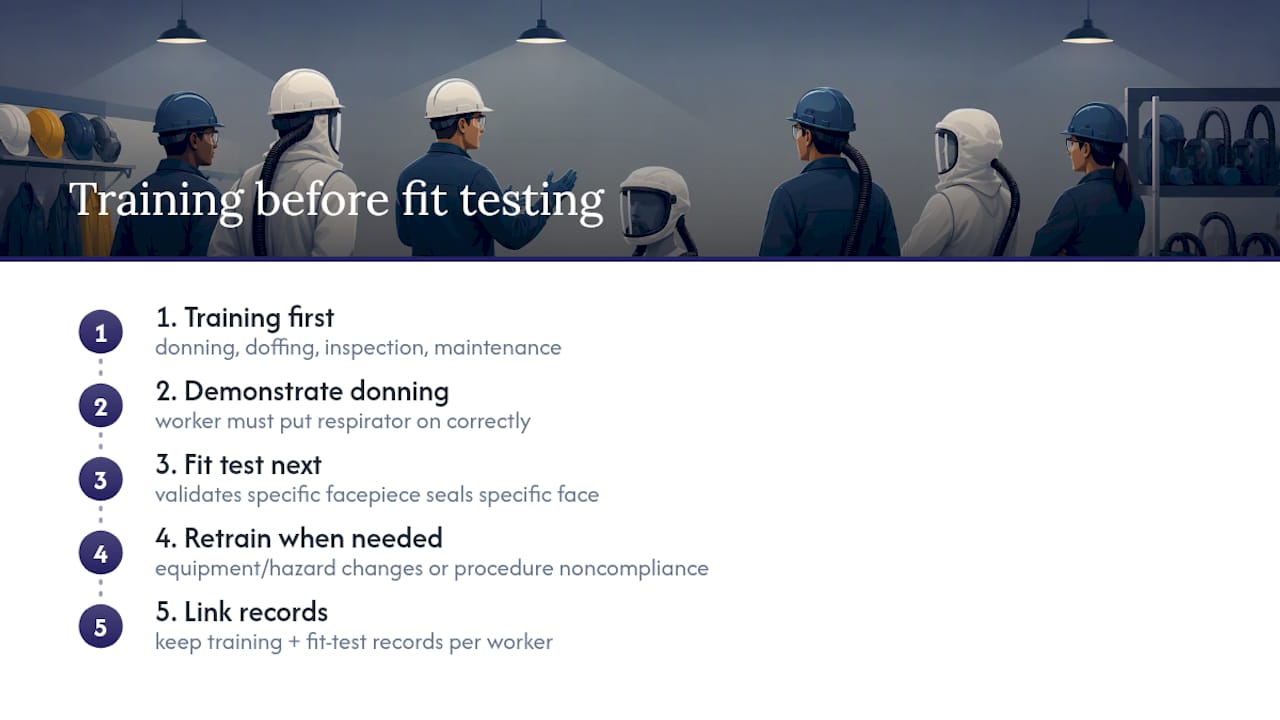
Training and fit testing answer different questions, and treating them as one event is where a lot of programs go wrong. Training covers donning, doffing, inspection and maintenance. The fit test validates that a specific facepiece actually seals against a specific face.
Run training first, so the worker understands correct donning technique, then fit test once they can put the respirator on properly. A worker who’s never been shown correct donning is more likely to produce a false fail simply from wearing the mask incorrectly.
Retraining is triggered by the same events that trigger fit testing: equipment changes, workplace hazard changes, or evidence a worker isn’t following procedure. Keep training records linked to fit-test records for each individual, so an auditor can trace both events for any worker on request.
Prime First Aid and Training: on-site and mobile fit testing
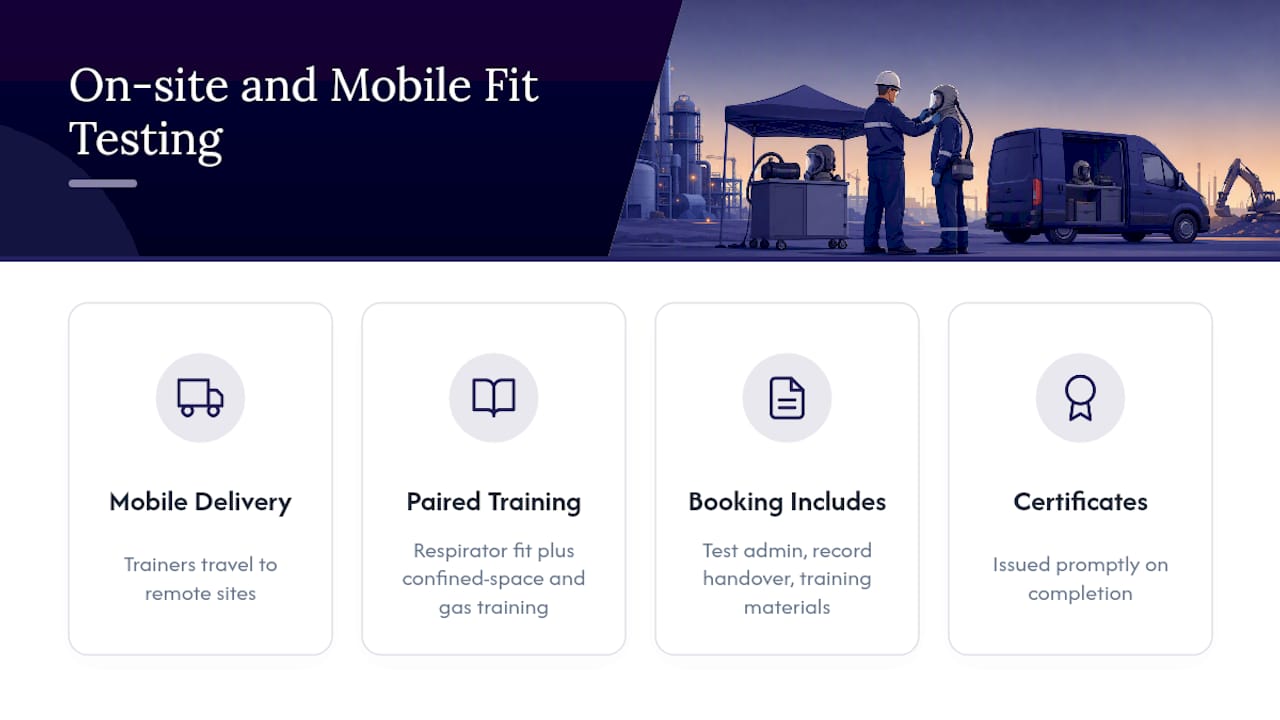
We deliver respirator protective equipment fit testing on-site, alongside hearing protective device fit testing, so your team doesn’t lose a shift travelling to a testing facility. Bookings include test administration, a completed record handover, and training material your program administrator can file straight into your compliance system.
For remote or high-risk sites, we often pair respirator fit testing with confined space and gas test atmosphere training in the same visit, cutting down the number of separate call-outs your site needs. Mobile delivery means our trainers travel to you, including remote locations, with certificates issued promptly on completion.
Practitioner perspective: common pitfalls and practical fixes
The mistake we see most often isn’t a missed test date, it’s choosing a loose-fitting PAPR purely to sidestep testing when the hazard actually demands a higher assigned protection factor. That decision looks efficient on a procurement spreadsheet and looks very different in an incident report.
Schedule fit tests around your roster and procurement cycles, not the other way round, so every worker tests with the exact facepiece they’ll wear on shift. And keep spare facepieces on hand for quantitative testing. A probed mask is rarely usable afterwards, and running out mid-session stalls an entire group.
— Vapour
Book on-site fit testing and training with Prime First Aid
Fit testing and respirator training can be delivered on-site as one coordinated visit rather than two separate bookings, helping workplaces avoid downtime associated with travel to testing facilities.
Bookings typically include compliant test administration under the negative-pressure method, documentation to support recordkeeping obligations, and training covering donning, doffing, and inspection for users and program administrators. Ventilation and other control measures remain part of a layered approach to airborne hazards alongside PPE, and trainers can explain where fit testing fits in that broader safety strategy during visits.
Ready to get your team compliant without the downtime? Browse our full course offerings or head straight to book online and lock in a date that works around your roster.
Sources
FAQ
Does a PAPR need to be fit tested?
Only if it’s a tight-fitting design using a half-mask or full-facepiece. Loose-fitting hoods and helmets rely on positive airflow instead of a facial seal, so they’re exempt from fit testing.
What are the fit testing requirements for respirators in workplaces?
Workers need an initial fit test before first use of a tight-fitting facepiece, annual retesting at minimum, and immediate retesting after any change in brand, model, size or facial structure. Primetraining delivers this testing on-site alongside the required documentation.
What actually happens during a fit test?
A qualitative test checks for a sensory response to a test agent for a simple pass or fail, while a quantitative test uses an instrument like a PortaCount to measure a numerical fit factor; tight-fitting PAPRs are tested with the blower switched off.
How often is a respirator fit test required?
At least every 12 months, with earlier retesting required whenever the respirator model, size or the wearer’s facial features change enough to affect the seal.
Recommended
Comments