
30 Days to Meet Construction First Aid Requirements in Australia

As the person conducting a business or undertaking (PCBU) on a construction site in Australia, you must provide accessible first aid kits, appropriate facilities and trained first aiders. The starting point for every one of those decisions is the same: complete a first aid risk assessment and act on what it tells you. Get that assessment right, and the rest of your construction first aid requirements fall into place.
TL;DR:
First aid staffing and kit requirements depend on a site-specific risk assessment, considering hazards, location, workforce size, and shift patterns.
Remote and high-risk sites require additional supplies, advanced training, and resilient communication and evacuation plans to manage delays in professional medical response.
Regular inspection, immediate restocking, and updating risk assessments ensure ongoing compliance and preparedness, especially for vehicle kits and remote site arrangements.
Building first aid coverage around operational realities, including rostering deputies and dispersed placement, prevents gaps during leave or shift changes.
On-site training tailored to actual hazards, with flexible scheduling, improves competency and compliance without disrupting construction schedules.
Table of Contents
What are the legal construction first aid requirements in Australia?
What extra first aid arrangements suit remote and FIFO construction sites?
How do you keep first aid supplies and training compliant over time?
What’s a practical 30‑day action plan for meeting first aid requirements?
What construction sites get wrong about first aid, and how to fix it
Get construction‑ready first aid training without the downtime
What are the legal construction first aid requirements in Australia?
Every PCBU carries a primary duty of care under model Work Health and Safety (WHS) law, and that duty covers first aid without exception. Safe Work Australia requires all workplaces, including construction sites, to give workers and others access to at least one first aid kit, suitable facilities and trained first aid people. The exact number of kits, first aiders and facilities isn’t fixed in legislation. It’s determined by a risk assessment that weighs your site’s hazards, size, location and workforce.
Model WHS law operates alongside state and territory regulators, and this is where a lot of site managers get tripped up. National guidance from Safe Work Australia sets the framework, but each jurisdiction administers its own WHS Act and Regulations, and issues its own supporting material. SafeWork NSW publishes practical guidance on determining first aid needs, choosing suitable training and maintaining kits, while Safe Work South Australia reiterates the same baseline duties for that state. If you operate across borders, don’t assume Queensland guidance applies word for word in New South Wales.
Codes of Practice add another layer. The WorkSafe Queensland Code of Practice: First aid in the workplace (2021) is an approved code in that state, meaning it sets out a way of complying with the WHS Regulation that a court will recognise. You don’t have to follow an approved code to the letter, but if you choose a different method, you need to be able to demonstrate it delivers an equivalent or better standard of safety. That’s a much harder position to defend after an incident than simply pointing to the code you followed.
Three obligations sit underneath all of this, and each needs to be visible, not just done:
Consultation: you must consult workers and their health and safety representatives when working out first aid arrangements, because the people doing the work usually know where the real risks sit.
Recordkeeping: keep a written risk assessment, dated and version controlled, not a mental note from three years ago.
Currency: check the current version of your state’s WHS Regulation, since instruments do get amended, as seen in recent NSW delegated legislation updates.
How do you assess first aid needs on a construction site?
A generic checklist won’t cut it on a construction site, because the hazards, crew size and location change from one project to the next. Safe Work Australia’s guidance points to four factors that should drive every decision you make: the nature of the hazards, the size of the site, its location, and the number and composition of the workers and other people on it. Run through these systematically rather than guessing at what “feels right.”
Map the hazards first. List the realistic injury scenarios for your site, meaning falls from height, crush injuries, lacerations from powered tools, electrical contact, heat stress and manual handling injuries, as explained in industrial stair standards: a crosswalk for safety officers. Trench work and demolition carry different first aid profiles to a low-rise residential build.
Assess location and access. How far is the nearest hospital or ambulance station, and how long would it realistically take emergency services to reach the site? A CBD tower crane job and a rural pipeline job need very different answers.
Count and classify the workforce. Total headcount matters, but so does composition, including subcontractors, apprentices, visitors and delivery drivers who may be on site briefly but still need coverage.
Factor in shift patterns. A single day shift is simple. Rotating shifts, night works or weekend crews all need their own first aider coverage, not a single person who happens to clock off at 3pm.
Document every answer. Write down what you found and why it led to the staffing, kit and facility decisions you made, because this record is what a WHS inspector or a court will ask to see.
Pro Tip: Run the risk assessment as a walk-through, not a desk exercise. Walking the actual site with your safety officer and a couple of workers surfaces hazards a spreadsheet never will, and it satisfies your consultation duty at the same time.
Once you’ve worked through those factors, the outputs translate directly into decisions: how many first aiders you need and where they’re posted, what goes in each kit, and whether you need a dedicated first aid room or a mobile alternative. Consultation isn’t a box to tick before you finalise the plan. Ask workers directly where near misses happen, where they’d struggle to reach a kit quickly, and whether shift handovers leave any gaps in coverage. Those answers should show up in your written assessment, not just in a meeting minute nobody reads again.
How many first aiders does a construction site need?
Safe Work Australia’s benchmark is one trained first aider for every 25 workers on a high-risk construction site, tightening to one for every 10 workers on remote, high-risk sites such as mine sites and isolated construction projects. Treat these ratios as a floor, not a target. They’re guidance to help you land in the right range, not a legislated minimum that guarantees compliance once you’ve hit the number.
The ratio only works if it holds across every shift, not just the one you happened to be thinking about when you did the sums. A site running three shifts with 30 workers each needs first aider coverage on all three, which usually means more than a simple headcount multiplication suggests once you account for leave, rostering gaps and workers moving between areas.
A few practical strategies keep coverage genuine rather than theoretical:
Build rosters around first aider availability, not the other way around, so a first aider isn’t rostered off on the one day their zone is short-staffed.
Nominate deputies for each shift so a first aider taking leave or moving off site doesn’t leave a gap nobody notices until it matters.
Use on-call arrangements sparingly and only where response time genuinely allows it, because a first aider fifteen minutes away is a poor substitute for one on the floor.
Split coverage across dispersed work areas, since a single first aider posted at the site office is no use to a crew working 400 metres away behind a stockpile.
Reassess ratios after a workforce change, including bringing on additional subcontractors, adding a night shift, or moving into a higher-risk phase of the build such as structural steel or demolition.
Upskilling matters as much as headcount. If your risk assessment turns up hazards that a basic first aider can’t confidently manage, such as suspected spinal injuries, significant burns or a chemical exposure, that’s a signal to invest in advanced training for at least some of your first aiders rather than simply adding more people with the same baseline skill set. The construction industry’s injury data consistently shows a higher rate of serious injury than most other sectors, which is a solid reason to plan staffing conservatively rather than to the bare minimum the ratio implies.
What should a construction first aid kit contain?
A first aid kit designed for an office won’t do the job on a construction site, and that’s one of the most common compliance gaps site managers walk into. Safe Work Australia is explicit that kit contents need to be tailored to the hazards on site and to how long it will realistically take for professional care to arrive. A kit stocked with band-aids and paracetamol is not fit for a site where crush injuries, deep lacerations and falls are genuine possibilities.
Construction first aid kits need trauma-grade contents on top of the standard basics:
Major bleeding control, including combine dressings, trauma pads and, on higher-risk sites, a haemostatic dressing or tourniquet where the risk assessment supports it.
Burns management, including burn dressings and a means of cooling the injury, particularly relevant near hot works, welding or bitumen.
Eye irrigation, given how common dust, grinding debris and chemical splash injuries are on a build site.
Fracture and sprain support, including splints, slings and rigid immobilisation options for limb injuries from falls or being struck by equipment.
Standard consumables, meaning bandages, wound dressings, gloves, antiseptic, resuscitation masks and a thermal blanket.
Vehicle kits deserve just as much attention as the main site kit, and they’re frequently the weak point in an audit. Any vehicle used to move workers between work fronts, or used by a supervisor covering a large site, should carry its own compact kit built around the same trauma priorities, because a crew working at the far end of a linear site can’t always get back to the main compound quickly. Treat vehicle kits as genuine response points, not a spare kit thrown in the glovebox and forgotten.
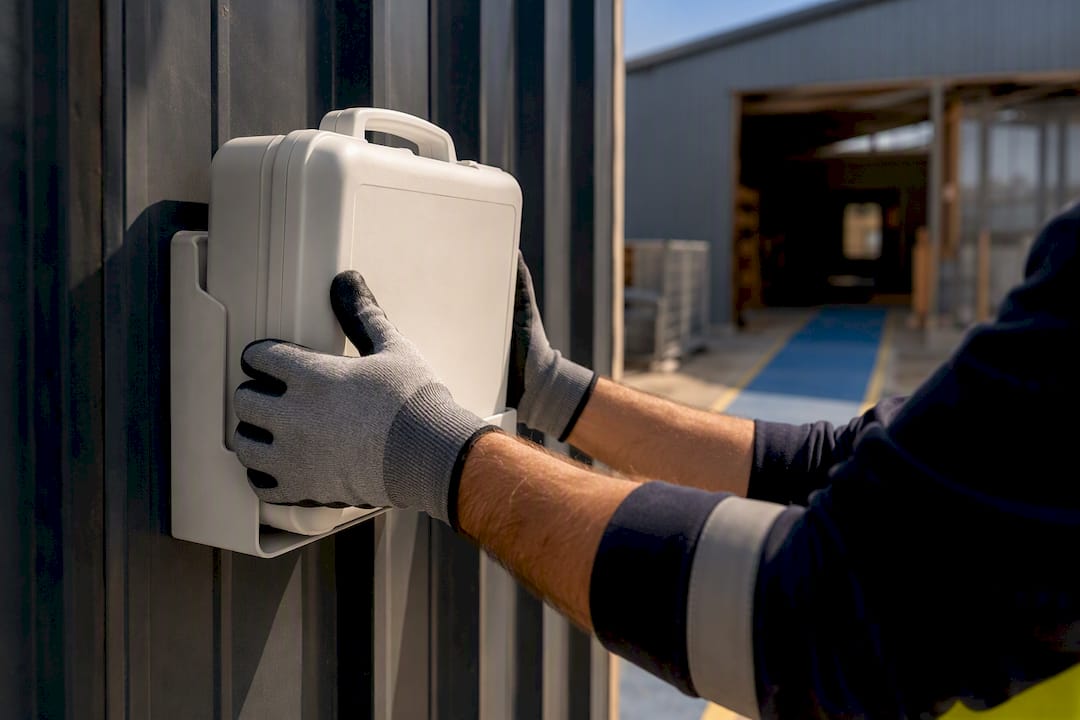
Storage matters more on a construction site than almost anywhere else. Kits need to sit in a dust-proof, weather-resistant container, positioned somewhere workers can reach it without crossing an exclusion zone, and clearly signed so a stressed worker doesn’t have to hunt for it. If your site runs multiple work fronts, place kits at each one rather than relying on a single central point that’s a five-minute walk from where the injury actually happens.
When do you need a first aid room on a construction site?
A dedicated first aid room becomes appropriate on larger, higher-risk construction sites, particularly where the workforce is substantial, the site is remote from medical services, or the nature of the work means injuries requiring treatment and observation are a realistic prospect. The WorkSafe Queensland Code of Practice sets out the features a first aid room should have where one is warranted, including clean running water, adequate lighting, a couch, and enough space to treat a casualty privately and safely.
Most construction sites, especially smaller or shorter-duration projects, won’t need a purpose-built room, and a workable alternative usually covers the gap. That could be:
A designated treatment area within the site office or amenities block, kept clear and stocked rather than a stack of kits in a corner.
A vehicle-based facility, particularly on linear or dispersed sites where a fixed room simply isn’t practical.
A weatherproof container fit-out for larger sites without permanent structures yet in place.
Where the work involves chemicals, corrosives or hazardous substances, an eye wash or drench facility is not optional, and it needs to sit close enough to the hazard that a worker with chemical splash in their eyes can reach it in seconds, not minutes. Signage should mark every kit, treatment area and drench station clearly, in line with the same standard you’d apply to fire equipment or emergency exits.
What first aid training and qualifications are required?
HLTAID011 – Provide First Aid is the nationally recognised baseline qualification for a workplace first aider, and it’s the certificate you should expect to see for the large majority of first aiders on a standard construction site. It’s issued by a Registered Training Organisation (RTO), and you should keep a copy of each first aider’s certificate on file as evidence for an audit, not just take someone’s word that they’re qualified.
Baseline training isn’t always enough once your risk assessment flags remoteness or elevated acuity:
HLTAID013 – Provide First Aid in Remote or Isolated Site suits sites where professional medical help is genuinely delayed, such as regional infrastructure projects or FIFO construction work, and covers extended patient management skills a standard course doesn’t touch.
HLTAID014 – Provide Advanced First Aid fits sites with higher-acuity risk, such as those handling significant trauma potential or where a more senior first aider is expected to lead a response involving multiple casualties.
HLTAID015 – Provide Advanced Resuscitation and Oxygen Therapy is worth considering where oxygen therapy is a realistic part of your emergency response, particularly on remote or high-risk sites.
CPR skills degrade faster than most people assume, which is why most guidance treats a 12-month CPR refresher as good practice even though the full HLTAID011 certificate itself is typically valid for around three years, subject to your RTO’s specific currency requirements. Build refreshers into your training calendar rather than waiting for a certificate to lapse before you notice.
Pro Tip: Keep a simple training matrix listing every worker’s qualification, issue date and expiry date in one place. When a WHS inspector asks for evidence of a qualified first aider on shift, you want to produce that answer in seconds, not go digging through personnel files.
What extra first aid arrangements suit remote and FIFO construction sites?
Remote construction and mining-style sites need a fundamentally different first aid posture, because the determining factor isn’t headcount, it’s the delay before professional care arrives. That delay should drive your kit contents, your training choices and your communications plan far more than the number of workers on site.
Industry guidance for remote and mine sites points to a layered approach: site kits reinforced with vehicle kits, extra supplies for hazards specific to remote work such as snakebite management or heat illness, and communications systems that don’t rely on mobile coverage that may not exist.
A handful of arrangements matter most on a remote or FIFO site:
Two-way radio or satellite communications tested regularly, not just installed and forgotten, since a comms failure during an actual emergency is far worse than discovering it during a drill.
A documented medevac plan that names the nearest suitable facility, sets a designated evacuation point workers actually know, and records exact site coordinates for emergency services or an air ambulance.
Enhanced kit contents reflecting the specific hazards of the location, whether that’s extreme heat, isolation from potable water, or wildlife hazards relevant to the region.
Upskilled first aiders, with HLTAID013 or HLTAID014 becoming the appropriate baseline rather than the exception once response times stretch into hours.
Training without a practised evacuation and communication plan behind it is largely theoretical on a remote site. Run the medevac process as an actual drill at least once, not just as a paragraph in an emergency response plan nobody has tested.
How do you keep first aid supplies and training compliant over time?
First aid arrangements aren’t a set-and-forget task, and this is where a lot of otherwise well-planned sites quietly slip out of compliance. Kit contents get used, expire or go missing, training lapses, and your risk profile shifts as the project moves through different phases.
Inspect site kits weekly and vehicle kits fortnightly, or more often on high-tempo sites, checking for used, expired or missing items against a simple contents list.
Log every inspection with a date, inspector’s name and any action taken, for example: “14 March 2026, J. Kelly, replaced two burn dressings, restocked gloves.”
Replace used items immediately, not at the next scheduled inspection, since a partially stocked kit is often worse than no kit because it creates false confidence.
Record every time a kit is used for an actual injury, cross-referenced against your incident reporting system, so restocking and pattern analysis happen together.
Feed incident data back into your risk assessment on a set schedule, at minimum after any serious incident and otherwise at least annually, updating kit contents, staffing or facilities where a pattern emerges.
Pro Tip: Treat vehicle kit checks as part of the standard vehicle maintenance schedule, not a separate first aid task. Vehicle kits are the ones most often forgotten in audits, and bolting the check onto an existing routine fixes that almost automatically.
What’s a practical 30‑day action plan for meeting first aid requirements?
Getting a construction site fully compliant doesn’t need to take months, but it does need a sequence. Trying to do everything at once is how gaps get missed.
Days 1 to 3: Complete or refresh the site first aid risk assessment, walking the site with your safety officer and consulting workers directly.
Days 4 to 7: Place kits based on the assessment’s findings, covering the main compound, each dispersed work front and every vehicle used to move workers or supervisors between areas.
Days 8 to 14: Roster first aiders against the relevant ratio (1:25 for standard high-risk work, 1:10 for remote high-risk sites) and confirm coverage across every shift, including weekends.
Days 15 to 21: Book any outstanding training, prioritising HLTAID011 for general coverage and HLTAID013 or HLTAID014 where the risk assessment flags remoteness or higher acuity.
Days 22 to 26: Test communications and, on remote sites, run through the medevac plan with the people who’d actually execute it.
Days 27 to 30: Set your inspection schedule, log book format and audit file, then run a final consultation session with workers to confirm the arrangements make sense on the ground.
Keep three documents on file permanently, and update them as conditions change:
Template | What it contains | Review frequency |
Risk assessment record | Hazards, location, workforce data, and the staffing/kit decisions they drove | After any major change, minimum annually |
First aider roster | Names, qualifications, expiry dates and shift coverage | Every roster cycle |
Inspection log | Date, inspector, kit checked, items replaced | Weekly (site kits), fortnightly (vehicle kits) |
What construction sites get wrong about first aid, and how to fix it
Working across construction and remote sites reveals the same handful of gaps again and again, and none of them are complicated to fix once you know to look for them. Vehicle kits are the most consistently neglected item in any audit, usually because they’re treated as an afterthought bolted onto the main site kit rather than a genuine response point for a crew working away from the compound. Communications systems get installed and never tested, which means the first time anyone finds out the satellite phone doesn’t have coverage in that gully is during an actual emergency. Rostering is the third recurring problem, where the ratio maths looks fine on paper but a first aider ends up on leave during the exact week a work front is short-staffed.
Fixing these gaps usually comes down to running training and drills on site rather than in a classroom disconnected from the actual hazards. On-site sessions let workers practise with the equipment and communications systems they’ll genuinely use, and tailoring course content to a site’s specific risks, whether that’s confined space work, working at heights or remote isolation, builds far more useful competency than a generic course ever will.
— Vapour
Get construction‑ready first aid training without the downtime
Meeting your first aid requirements shouldn’t mean pulling your whole crew off site for a day to travel into town for training. Primetraining runs HLTAID011 – Provide First Aid and HLTAID013 – Provide First Aid in Remote or Isolated Site on-site, anywhere across the Pilbara including remote mine and construction locations, so your workers train where they work instead of losing a day to travel.
Course content is customised to your site’s actual hazards rather than delivered as a generic slideshow, and trainers bring industry-relevant experience that means they understand what your crew is genuinely dealing with. For sites with higher-acuity risk or crews needing to lead a multi-casualty response, HLTAID014 – Provide Advanced First Aid is available on the same mobile basis. Flexible scheduling outside standard business hours means shift coverage doesn’t get sacrificed for training, and certificates are issued promptly so your compliance records are current the moment the course ends. Browse the full course catalogue or head straight to book online to lock in a date for your site.
Where to check the official first aid rules
For the current legal detail behind everything in this guide, go straight to the source. Safe Work Australia’s first aid guidance sets the national framework, SafeWork NSW covers that state’s practical requirements, and the WorkSafe Queensland Code of Practice (2021) gives detailed facility and kit guidance. Always check your own state regulator, since local adoption of these standards varies.
This article is general information, not a substitute for advice from a qualified doctor. Consult a qualified healthcare professional about your own circumstances before acting on anything here.
Sources
FAQ
What are the requirements for a construction first aid kit?
A construction first aid kit must be tailored to your site’s specific hazards and to how long help would take to arrive, covering major bleeding control, burns treatment, eye irrigation and fracture support on top of standard consumables. Safe Work Australia confirms a standard office-style kit is usually inadequate for construction work, so contents should come out of your site’s own risk assessment rather than a generic checklist.
What are the requirements for first aid in Australia?
Every PCBU must provide accessible first aid kits, suitable facilities and trained first aiders, with exact numbers and contents determined by a risk assessment covering hazards, site size, location and workforce composition. Safe Work Australia sets the national benchmark, while state regulators such as SafeWork NSW add jurisdictional detail.
What is the difference between HLTAID014 and HLTAID011 courses?
HLTAID011 – Provide First Aid is the standard baseline qualification suited to most workplace first aiders, while HLTAID014 – Provide Advanced First Aid builds on that foundation for higher-acuity environments where a first aider may need to manage more serious trauma or lead a multi-casualty response. Choose HLTAID014 where your risk assessment identifies elevated injury severity or a need for a more senior on-site responder.
What is the minimum qualification requirement of a qualified first aider?
The common nationally recognised baseline is HLTAID011 – Provide First Aid, issued by a Registered Training Organisation, and this is generally what regulators expect to see as evidence of a trained first aider. Remote or higher-risk sites often need to go beyond this baseline to HLTAID013 or HLTAID014, depending on what the site’s risk assessment identifies.
Recommended
Comments