
0.02% Difference: P100 vs P3 and Why Fit Matters for Safety Managers

For particulate filtration, P100 and P3 filters deliver effectively equivalent protection, both sit at the top of their respective classification systems. The real decision comes down to which standard your workplace or contract requires (NIOSH for P100, AS/NZS or EN for P3) and whether oil-based aerosols are present. Get those two questions right, then make fit testing and a documented respiratory protection program the priority, because that outranks the filter label every time.
TL;DR:
P100 filters provide slightly higher filtration efficiency than P3 filters, but the 0.02 percentage point difference has minimal practical impact on protection.
Both filters do not protect against gases or vapours, only solid and liquid aerosols, requiring separate chemical protection for those hazards.
Proper fit testing and a documented respiratory protection program are more critical than filter class alone for ensuring safety during use.
Select P3 or P100 based on the hazard type, with P3 often used for asbestos and silica, and P100 when oil-based aerosols are present.
Filter replacement depends on factors like airflow resistance, visible damage, and contamination, not fixed time intervals.
Table of Contents
P100 vs P3 filters: what the standards actually mean
The confusion around P100 vs P3 filters arises from the fact that they belong to two completely separate certification systems, run by different regulators with different testing regimes.
P3 sits under the EN and AS/NZS particulate classifications, requiring a minimum filtration efficiency of 99.95% against test aerosols. P100 is a NIOSH classification under 42 CFR Part 84, certified at a minimum of 99.97% efficiency. NIOSH also tests P-series filters against a degrading aerosol to confirm oil resistance holds up over time, which is where the “P” designation earns its name, oil-proof.
That 0.02 percentage point gap between 99.95% and 99.97% looks meaningful on paper. In practice, it makes almost no difference to real-world exposure outcomes, because both classes are already filtering out virtually all particulates at the size range that penetrates most easily. The test methods differ too: NIOSH typically uses dioctyl phthalate (DOP) or a similar oil aerosol to challenge P-series filters, while EN/AS-NZS testing uses sodium chloride (NaCl) alongside paraffin oil depending on the filter class. Different labs, different challenge aerosols, same practical result.
Before trusting any filter on a job site, check for these on the packaging or the filter body itself:
The certification mark (NIOSH approval number, or the CE/AS-NZS mark with class designation)
The filter class printed clearly (P100, P3, P2, and so on)
A manufacturer date or batch code for traceability
Compatibility confirmation with your specific respirator facepiece
Technical similarities and differences that affect selection
Both P100 and P3 filters target the same enemy: the most penetrating particle size, roughly 0.3 micrometres, where particles are small enough to bypass simple mechanical capture but large enough to resist diffusion capture. Manufacturers design both filter classes around this exact vulnerability, which is why their real-world performance converges even though the certification numbers differ slightly.
Here’s where the similarities end and genuine differences start to matter:
Particulate only. Neither P100 nor P3 protects against gases or vapours. Both are mechanical filters built for solid and liquid aerosol particles, not chemical vapours.
Oil resistance. P100’s NIOSH testing explicitly verifies oil resistance through degradation testing. Some P3 filters carry equivalent oil resistance, but always confirm this on the specific product rather than assuming it.
Breathing resistance. Higher filtration efficiency generally means denser filter media, and denser media means more resistance to breathe through. For low-risk, high-exertion tasks, that extra resistance can actually reduce compliance if workers remove the respirator more often to catch their breath.
System certification, not component certification. A P100 filter fitted to an incompatible facepiece is not automatically a certified assembly. Mixing components from different manufacturers can undermine the whole-system approval, even when each part is individually certified.
Pro Tip: Never assume oil resistance from the class name alone. If your site has any oil mist, aerosol coolant, or lubricant exposure, check the manufacturer’s datasheet for explicit oil-proof certification before you commit to a filter.
When do you actually need P3 or P100 filters?
Matching the filter to the hazard is where most selection mistakes happen, usually because someone grabs whatever filter is left in the storeroom rather than checking what the job actually demands.
P3 (EN/AS-NZS) commonly gets specified for:
Asbestos removal and remediation work, where regulation frequently nominates P3 as the minimum acceptable class
Crystalline silica exposure on construction and demolition sites
Healthcare settings managing airborne pathogens, often alongside other infection control measures
Oil-proof P100 is the safer call when:
Spray painting operations generate oil-based overspray or solvent-borne particulates
Metalworking or machining produces oil mist from cutting fluids or lubricants
Welding fume exposure combines particulates with oil-based contaminants from coatings or lubricants on the workpiece
Facepiece choice matters just as much as filter class. 3M’s Australian guidance notes that P3 classification, particularly on negative-pressure respirators, often requires a full-facepiece to achieve an effective seal against highly toxic particulates. A half-mask P3 filter on a poorly fitted seal delivers nowhere near its rated protection, regardless of what the filter’s certification claims.
One point worth repeating: P100 and P3 are particulate filters only. If your hazard assessment turns up any gas or vapour component, welding fumes with metal oxide gases, solvent vapours from paint, or chemical off-gassing, you need combination cartridges rated for that specific chemical alongside the particulate filter.
Fit testing and the program that actually protects you
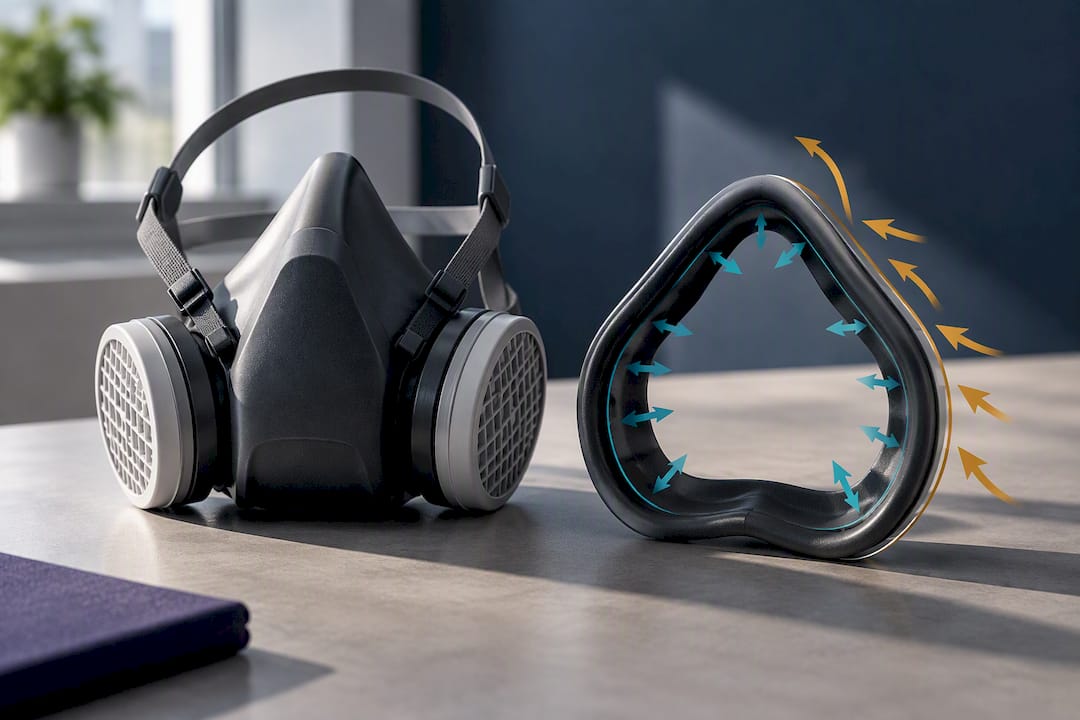
The filter class you choose matters less than most people assume once you factor in fit. A P100 filter on a poorly sealed mask can perform worse than a properly fitted P3 unit, which is why AS/NZS 1715 and Safe Work Australia frame filter selection as just one part of a broader respiratory protection program.
A functioning program needs:
Selection rationale documenting why this filter class suits this hazard
Medical assessment confirming the wearer can safely use tight-fitting RPE
Fit testing, either qualitative (taste or smell response) or quantitative (particle-counting instruments), repeated periodically and whenever facial characteristics change
Training records showing the wearer knows correct donning, doffing, and inspection procedures
Maintenance and replacement logs tracking filter use over time
Program element | What it proves |
Fit test record | The mask seals correctly on that specific wearer |
Medical clearance | The wearer can tolerate breathing resistance safely |
Filter use log | Traceability of when filters were fitted and changed |
Safe Work Australia’s RPE evaluation checklist flags missing documentation, particularly fit-test records and filter logs, as one of the most common audit failures on Australian worksites. The filter’s certification number rarely trips up an audit. The paperwork behind it does.
Filter maintenance and when to actually replace them
There’s no universal replacement interval for P100 or P3 filters, and any guidance promising a fixed number of hours is oversimplifying a genuinely situation-dependent decision. Safe Work Australia’s guidance on maintaining respiratory protective equipment points to exposure levels, filter loading, and manufacturer specifications as the real drivers of replacement timing, not a calendar.
Replace a filter when you notice any of the following:
Breathing resistance increases noticeably, a sign the filter media is loading up with particulate
Visible damage, cracking, or deformation appears on the filter housing or media
The filter has been exposed to oil-based contaminants and isn’t rated as oil-proof
Dampness or moisture has penetrated the filter, which can compromise the media’s structure
Contamination from a hazard outside the filter’s rated scope has occurred, even briefly
Resist the temptation to extend filter life through back-flushing, tapping out dust, or other informal hacks. These methods can damage the filter media’s structure invisibly, and there’s no reliable way to verify the filter still performs to its certified rating afterwards. When in doubt, replace it. A new filter costs far less than a compromised one.
A short decision framework for choosing P3 vs P100
Cutting through the P100 vs P3 filters debate gets a lot easier with a straightforward sequence rather than trying to weigh every variable at once.
Identify the hazard first. Confirm whether you’re dealing with particulates only, or whether gases and vapours are also present requiring combination cartridges.
Check what your contract or regulator specifies. Mining, construction, and asbestos remediation contracts often nominate a standard explicitly, AS/NZS, EN, or NIOSH, and that requirement overrides personal preference.
Assess oil mist exposure. If oil-based aerosols are part of the job, oil-proof P100 filters remove any ambiguity. Where no oil mist exists, P3 filters that meet your local standard work just as well.
Never separate filter choice from fit testing. The best filter on an unfitted mask still leaves gaps in protection that no certification number can close.
Pro Tip: Keep a simple hazard-to-filter reference sheet at your site office. When a new task comes up, matching it against documented past decisions is faster and more consistent than re-litigating filter choice from scratch every time.
The bottom line on P100 vs P3 filters
What actually determines whether a worker is protected comes down to standard acceptance for your contract, oil-mist presence in the hazard, and, above everything else, a properly fitted mask backed by documented training.
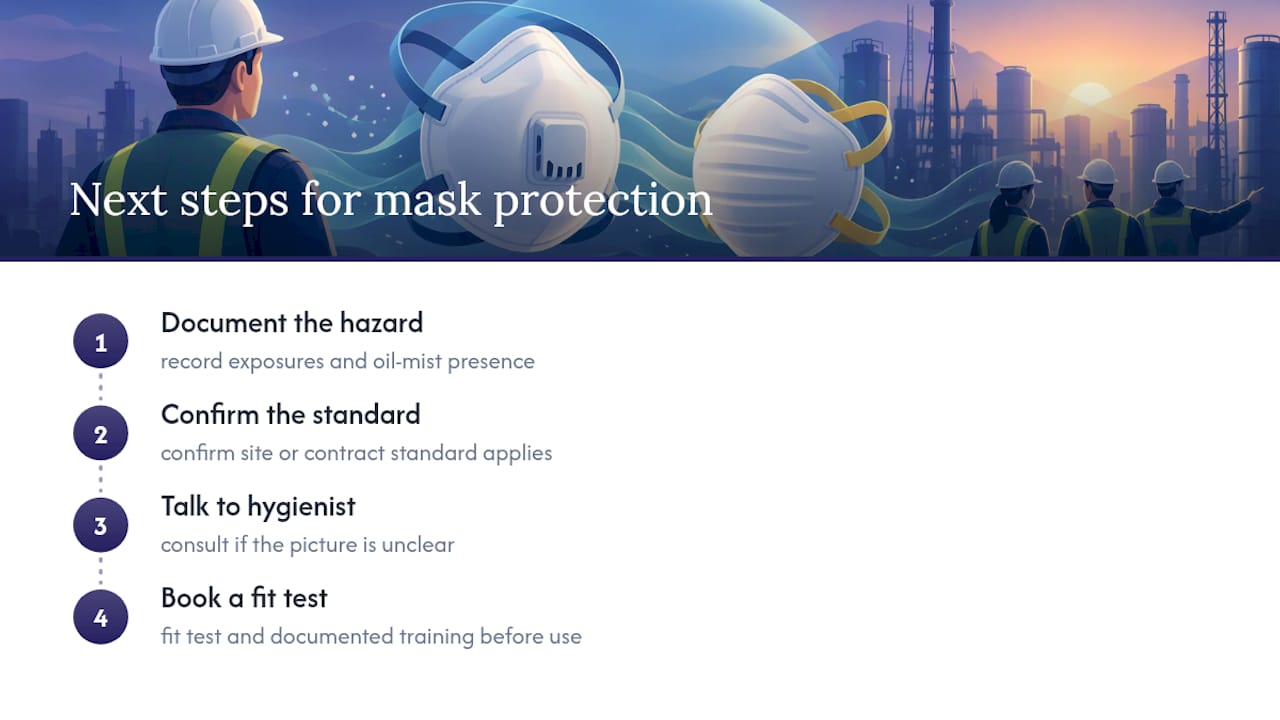
Your next steps are straightforward: document the hazard, confirm which standard applies to your site or contract, talk to an occupational hygienist if the picture is unclear, and book a fit test before anyone relies on either filter class for real protection.
What we see go wrong on Australian worksites
Most failures we encounter during fit testing have nothing to do with filter class. It’s the poorly sealed mask on a bearded worker, the missing fit-test record from three years ago, or the P3 filter sitting on a job that actually needed oil-proof P100 protection. Tailored training and scheduled fit testing close these gaps before an audit finds them for you.
— Vapour
How Primetraining supports your respiratory protection program
Choosing between P100 and P3 filters is only half the job, proving your program holds up under audit is the other half. Primetraining runs on-site and mobile Respirator Protective Equipment Fit Tests across the Pilbara, including remote mine and construction sites, so your team gets documented fit-test records without downing tools to travel.
Every fit test comes with program documentation designed to meet Safe Work Australia audit requirements, and trainers bring practical session experience beyond basic checklists. Pair fit testing with a course like HLTAID013 – Provide First Aid in Remote or Isolated Site ($400 one-off) if your site also needs remote-area first aid coverage, and get certificates issued promptly so compliance gaps never linger. Book your fit test or training session through Primetraining’s online booking page and get your RPE program audit-ready.
Sources
For primary standards and guidance behind the claims in this article, consult Safe Work Australia’s RPE maintenance guidance, the NIOSH 42 CFR Part 84 filter classifications, and 3M Australia’s respirator selection guidance. Crews managing confined-space or atmospheric hazards alongside particulate risks may also find Pressure Works’ sewer cleaning safety guidance useful for broader atmosphere-testing context.
FAQ
Is P3 Good Enough for Asbestos Work?
Yes, P3 is commonly specified as the minimum acceptable filter class for asbestos removal and remediation work under AS/NZS guidance. Effectiveness still depends entirely on a properly fitted facepiece, often full-face for high-risk asbestos tasks, and a documented respiratory protection program.
What Does a P100 Filter Actually Protect Against?
P100 filters protect against solid and liquid particulate aerosols at a minimum efficiency of 99.97%, including oil-based mists thanks to NIOSH’s oil-proof testing protocol. P100 does not protect against gases or vapours, which need separate combination cartridges.
Is There a Better Filter Than P100?
No particulate filter class currently certified exceeds P100’s 99.97% efficiency threshold under NIOSH’s system. P3 under EN/AS-NZS classification performs at a practically equivalent level, so the “better” choice usually comes down to which standard your workplace or contract requires rather than raw filtration numbers.
What Are P3 Filters Actually Good For?
P3 filters suit high-toxicity particulate hazards including asbestos, crystalline silica, and certain healthcare airborne pathogen risks. They’re built for the most penetrating particle sizes and often require a full-facepiece respirator to achieve the seal needed for their rated protection.
How Is P100 Different From N95?
N95 filters carry a minimum efficiency of 95% and no certified oil resistance, while P100 sits at 99.97% efficiency with confirmed oil-proof performance under NIOSH testing. The gap matters most in environments with oil mists or higher-toxicity particulates, where N95 simply isn’t rated to cope.
Recommended
Comments