
Audit Ready Practical First Aid Training for Australian Workplaces

Practical first aid training teaches hands-on lifesaving skills, from CPR and AED use to bleeding control and airway management, and it ends in a nationally recognised statement of attainment. If you need workplace-compliant certification fast, book a face-to-face or blended HLTAID011 or HLTAID009 course that includes an instructor-led practical skills check, not an online-only module.
TL;DR:
Practical first aid courses require hands-on demonstration, with measurable benchmarks such as compression depth, AED timing, and proper bandaging.
Legitimacy depends on nationally recognized codes like HLTAID011 or HLTAID009, confirmed through registered training organizations and a valid USI.
On-site or blended training with genuine practical assessments is essential, as online-only courses do not fulfill workplace competency requirements.
Regular drills that simulate real environments improve muscle memory by measuring response times, decision accuracy, and communication clarity.
High-risk workplaces benefit from tailored scenarios and frequent refresher drills to maintain readiness and compliance with safety standards.
Table of Contents
What practical first aid courses actually teach
A genuine practical first aid course is built around what you do with your hands, not what you read on a screen. You’re assessed on performance, and the standards are specific enough that “close enough” doesn’t cut it.
Trainers watch for measurable benchmarks: compressions delivered at 100 to 120 per minute at the correct depth, an AED retrieved and applied within a set timeframe, and dressings applied firmly enough to control bleeding without cutting off circulation. You’ll also demonstrate correct PPE use, because a first responder who exposes themselves to risk becomes a second casualty.
Core skills covered in a workplace-ready course include:
Adult, child, and infant CPR technique and compression ratios
AED operation, including pad placement and safety checks
Recognising and managing choking in conscious and unconscious patients
Controlling severe bleeding with direct pressure and appropriate dressings
Basic airway management and recovery position technique
Correct bandaging for sprains, fractures, and open wounds
Most workplace certificates (HLTAID011) are valid for three years, though CPR-specific skills (HLTAID009) generally need refreshing every 12 months under most workplace policies.
Which national codes prove a course is legitimate
Not every “first aid course” advertised online carries real weight. The codes attached to a course tell you whether it’s recognised nationally or just a private badge with no regulatory standing.
The three you’ll encounter most often:
HLTAID011 Provide First Aid — the standard workplace qualification most employers require.
HLTAID009 Provide Cardiopulmonary Resuscitation — a standalone CPR-only unit, often used for annual refreshers.
HLTAID012 Provide First Aid in an Education and Care Setting — required for childcare and education workers, with added content on infant and child-specific emergencies.
HLTAID014 Provide Advanced First Aid applies where a workplace risk assessment calls for a higher-level responder, such as remote or high-risk sites.
Every legitimate provider is a Registered Training Organisation (RTO), and you can confirm their registration and course currency directly on Training, the official national register. You’ll also need a Unique Student Identifier before your certificate can be issued. Without a USI, nationally recognised training simply cannot be recorded, which matters enormously for audits and compliance checks.
How the practical assessment actually works
Course formats vary, but not all of them satisfy workplace obligations equally. Face-to-face delivery covers theory and hands-on skills in the same session. Blended delivery lets you complete theory online first, then attend a shorter in-person session purely for the practical skills check. Online-only courses, on their own, don’t meet the hands-on competency requirement for most workplaces, no matter how polished the website looks.
A genuine practical assessment typically runs like this:
The trainer briefs you on the scenario and equipment, including manikins, AED trainers, and bandaging supplies.
You demonstrate CPR and rescue breathing while the trainer observes compression rate, depth, and hand placement.
You retrieve and operate an AED trainer against a realistic time expectation.
You apply bandaging or bleeding control techniques to a simulated wound.
The trainer signs off against each competency element before issuing your statement of attainment.
Full face-to-face HLTAID011 courses usually run several hours and cost a few hundred dollars per person, with blended options often shorter on the day and priced similarly once you factor in the online component.
How to choose the right practical course for your situation
Picking a provider on price alone is how workplaces end up with certificates that don’t hold up under a WorkSafe audit; having a digital horse emergency plan is a similarly prudent strategy for those managing animals in emergency scenarios. Match the course to the actual environment your people work in.
Before booking, check:
The exact competency code required for your industry or role
Trainer credentials and real industry experience, not just a facilitator qualification
Class size, since a group of thirty leaves little time for individual hands-on correction
How much of the session is genuinely hands-on versus lecture-style
Confirmed RTO status on training.gov.au
Whether the provider can tailor content to your workplace hazards
Mobile or on-site delivery capability if your team works away from a training centre
Ask providers directly: how many minutes of hands-on practice does each participant actually get? What happens if someone fails a competency element? Can they run the course on-site at a remote location?
Pro Tip: If your workplace includes children, confined spaces, or remote sites, say so when you enquire. A provider worth booking will tailor scenarios to your actual hazards, not just run the generic version.
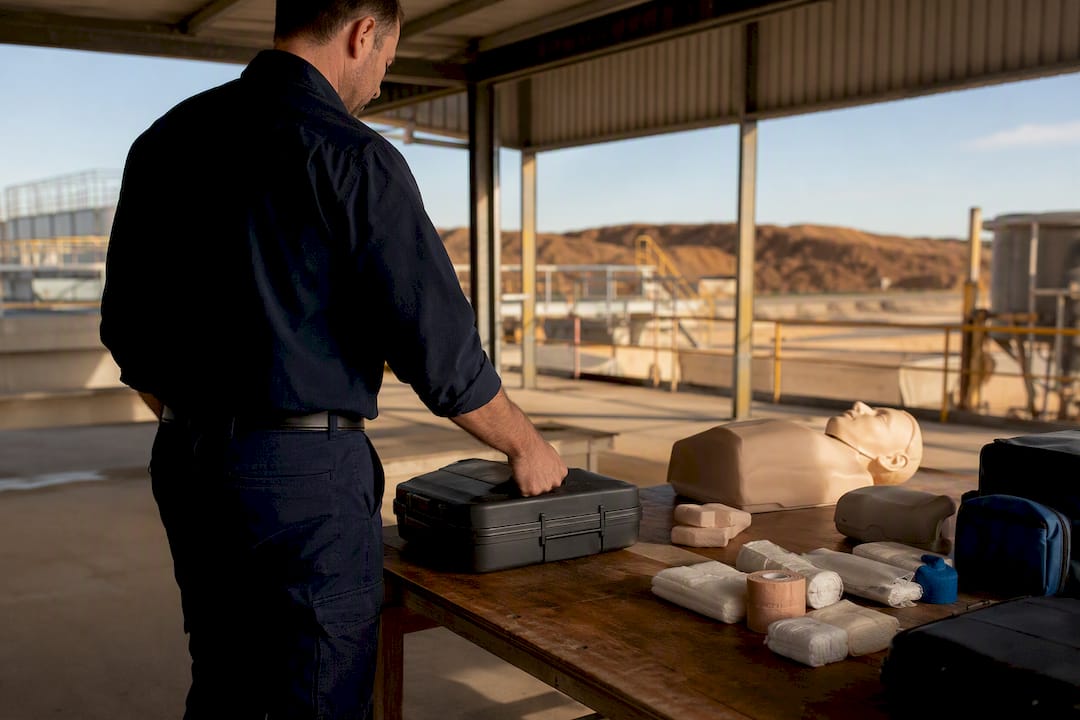
Selecting delivery that matches your environment matters more than most people realise. A childcare centre needs HLTAID012 content around infant airway obstruction. A construction site needs scenario training around falls, crush injuries, and dust exposure. A mine site or remote operation needs a provider who can physically get a trainer and equipment to location.
Designing realistic drills that actually build muscle memory
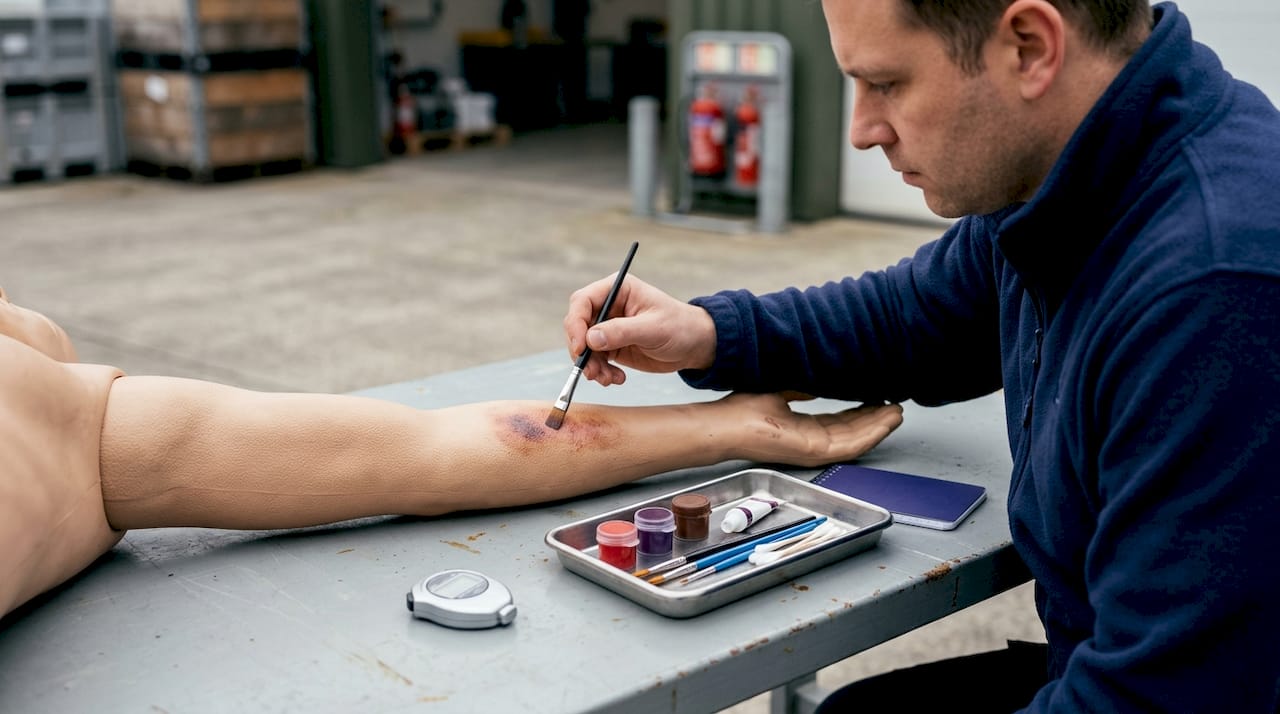
Classroom-only training creates a dangerous gap: people who can recite steps but freeze when the situation is loud, messy, or unfamiliar. High-fidelity drills close that gap by adding the environmental chaos a real emergency brings. Practitioner guidance on running effective first aid drills points to moulage, background noise, imposed time pressure, and assigned roles as the elements that force genuine muscle memory rather than rehearsed recall.
Location matters too. Running a drill in the actual work area, rather than a training room, tends to expose obstacles and communication breakdowns a classroom setting simply can’t replicate, according to practical drill design guidance.
The metrics that separate a useful drill from a box-ticking exercise:
Time from incident recognition to first intervention
AED retrieval and application time
CPR compression rate and depth against the 100 to 120 per minute standard
Clarity and speed of communication between responders and emergency services
What’s measured | Why it matters |
Response time | Delays of even a minute reduce survival odds in cardiac events |
AED retrieval time | Reveals whether equipment location is actually known and accessible |
Compression rate/depth | Confirms the physical skill has been retained, not just understood |
Communication clarity | Exposes gaps in role assignment during real chaos |
An honours thesis on experiential training backs a “no verbal walkthrough” rule: if a participant starts explaining what they’d do instead of doing it, the trainer should stop them and demand an immediate physical demonstration. Debriefs work best when they’re built around the numbers a stopwatch and checklist actually captured, not general impressions, so corrective actions target the specific step that slowed things down.
The legal and ethical side of giving first aid
Good Samaritan protections exist in every Australian state and territory, generally shielding a person who gives first aid in good faith and without recklessness from civil liability. That protection is one reason workplaces train staff rather than leaving emergencies to chance, but it isn’t a licence to act beyond your training.
Consent matters ethically even in an emergency. A conscious, competent adult can refuse treatment, and a responder has to respect that, however difficult it feels. For unconscious patients, implied consent generally applies, on the basis that a reasonable person would want help.
Scope of practice is where trained responders sometimes overstep. A HLTAID011 certificate qualifies you for first aid, not for administering medication beyond what a workplace policy explicitly authorises, and not for procedures reserved for paramedics or clinicians. Acting outside that scope, even with good intentions, can create both legal and ethical problems.
Duty of care sits differently for workplaces than for individuals. Employers have obligations under work health and safety law to provide adequate first aid arrangements, which is why certification, refresher timing, and equipment maintenance aren’t optional extras. Documentation matters here too. Recording who attended training, which competencies they demonstrated, and when refreshers are due protects both the worker and the business if an incident is ever reviewed.
Why hands-on practice frequency decides how ready you actually are
Skills fade faster than most people expect. CPR technique, in particular, degrades within months without repetition, which is exactly why HLTAID009 refreshers are typically pitched at a 12-month cycle even though the full HLTAID011 certificate runs for three years.
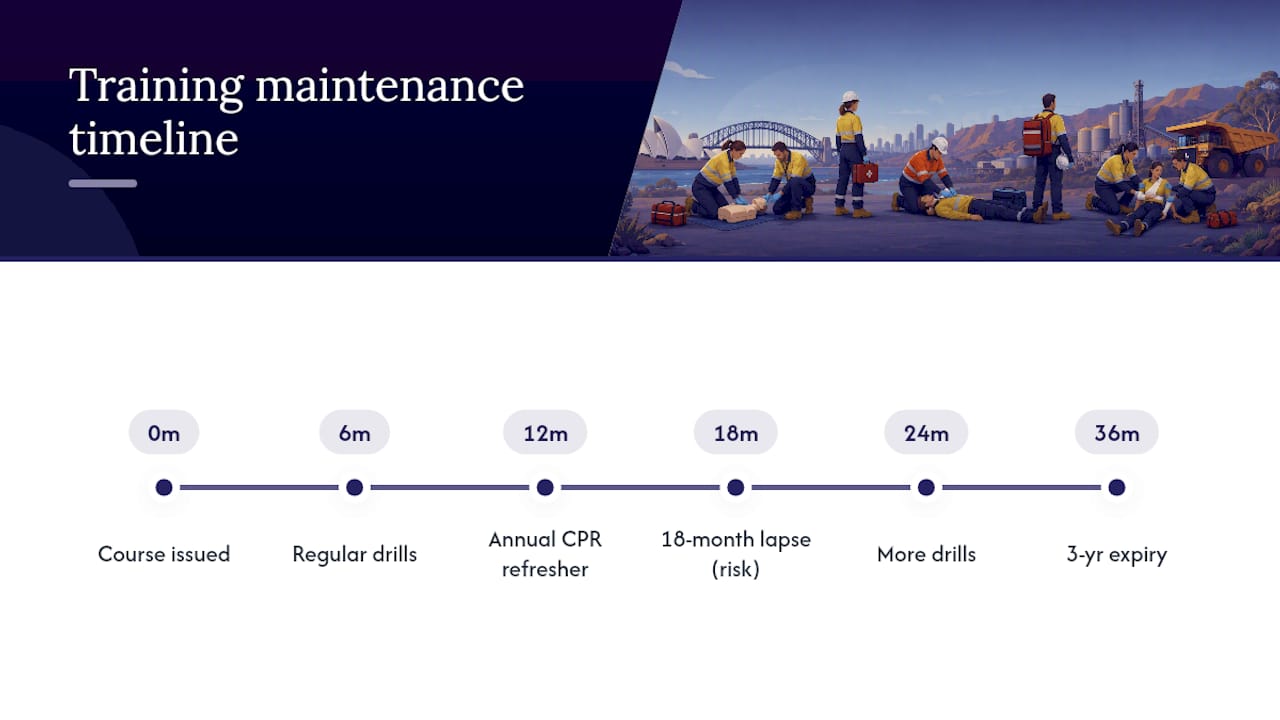
The gap between “certified” and “capable” widens every month a skill goes unpractised. A worker who completed training eighteen months ago and hasn’t touched a manikin since is statistically less reliable in a real emergency than someone six months into their first certificate, regardless of what the paperwork says.
This is where workplace drills earn their place alongside formal refreshers. A short, realistic scenario run every few months, even without a full course, keeps compression technique, AED confidence, and decision-making sharp between renewal dates. Workplaces with genuinely high-risk profiles, mine sites, construction, remote operations, benefit from drilling more often than the certificate cycle technically requires.
Refresher training isn’t a compliance formality to tolerate. It’s the mechanism that keeps a certificate meaning something six months after the course finished.
Equipment handling during practical training
The gear used in a practical session isn’t incidental to the learning. Manikins with feedback sensors let trainers show a participant, in real time, when compressions are too shallow or too fast, which is a correction no amount of verbal instruction achieves as effectively.
AED trainers are deliberately built to mimic the real device’s voice prompts and pad placement, so muscle memory transfers directly to an actual emergency unit. Participants should also handle real bandaging materials, triangular bandages, gauze, and pressure dressings, because tension and technique feel completely different in practice than in a diagram.
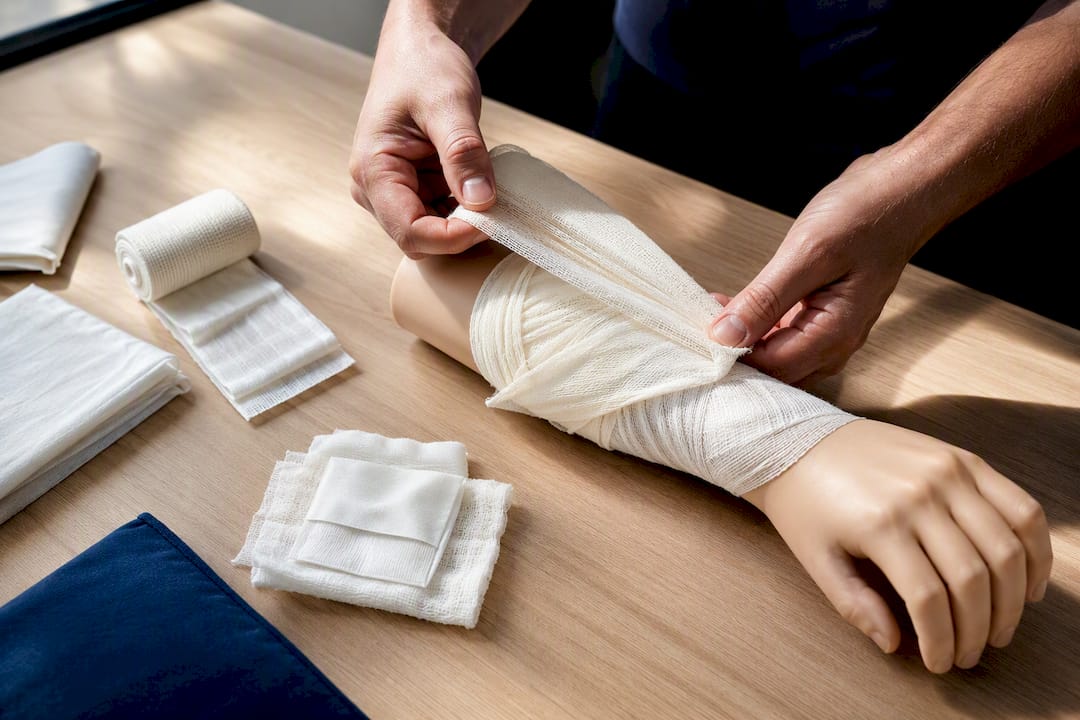
Providers have a maintenance responsibility that’s easy to overlook: manikin lungs and faces need regular hygiene replacement, AED trainer batteries need checking, and any workplace’s actual first aid kit needs periodic auditing against expiry dates and stock levels. A course that spends time explaining how to check kit contents and rotate expired supplies is doing more for long-term readiness than one that skips straight to the drama of the scenario.
Common scenarios and the decisions responders face
Cardiac arrest scenarios test more than compression technique. They test whether a responder will act in the first ten seconds instead of hesitating, and whether they’ll delegate someone to call emergency services and retrieve the AED rather than trying to do everything alone.
Choking scenarios split into two distinct decision paths: back blows and abdominal thrusts for a conscious patient, versus CPR for one who becomes unconscious. The decision point, recognising when to switch, is exactly what a practical assessment is designed to test, because it’s the step people freeze on most.
Severe bleeding scenarios force a judgement call around direct pressure versus a tourniquet, and workplace training increasingly covers both given how common crush and laceration injuries are on industrial sites. Anaphylaxis and asthma scenarios test whether a responder can recognise escalating symptoms early enough to act before a full airway crisis develops.
What separates confident responders from hesitant ones isn’t intelligence or memory. It’s exposure to enough realistic scenarios that decision-making becomes automatic rather than something they have to consciously work through under pressure.
Publisher perspective: what real-world delivery actually requires
Training that holds up under audit and under pressure needs tailored, on-site delivery and trainers who’ve worked the industries they teach. That’s the standard Prime First Aid and Training was built around, particularly for remote and industrial workplaces where a generic classroom course simply doesn’t reflect the job.
— Vapour
Booking practical first aid training for your team
Getting your workforce certified shouldn’t mean weeks of back-and-forth or a course that ignores the hazards your site actually has. Primetraining runs face-to-face and blended courses built around the competency code your workplace actually needs, with mobile delivery available for remote and industrial sites, including operations across the Pilbara, where flying a trainer to you beats flying your whole team out.
Before you request a quote, have three things ready: the number of participants, the competency code you need, and any specific hazards your site presents, such as confined spaces, remote access, or industry-specific risks. This information helps the provider tailor the scenario content before the trainer arrives.
Public courses can be booked directly through the online booking form, while workplaces needing group sessions or on-site delivery can request a tailored quote the same way. Certificates are issued promptly once competencies are signed off, so your team isn’t left waiting on paperwork to get back to work. Browse the current course catalogue to check duration, format, and pricing for your team’s exact requirement.
Sources
Recommended
Comments