
Respirator and Facial Hair: 4 Compliant Options for Employers

Tight-fitting respirators cannot reliably seal over facial hair, full stop. Any beard growth crossing the sealing surface breaks the seal and lets contaminated air bypass the filter, regardless of the respirator’s rating. If shaving isn’t possible, a loose-fitting powered air-purifying respirator (PAPR) or another approved alternative is the compliant path forward. Talk to your respiratory protection programme manager about fit testing or documented accommodation before you assume you’re covered.
TL;DR:
Facial hair that crosses the sealing surface completely invalidates the fit of tight-fitting respirators, increasing leakage and reducing protection significantly.
For workers unable to shave daily, loose-fitting PAPRs and supplied-air hoods provide reliable protection regardless of facial hair because they do not depend on a face seal.
Fit testing cannot be valid if facial hair interferes with the seal, requiring employers to provide accommodations like alternative equipment or task reassignment.
Temporary fixes such as beard bands or the Singh Thattha technique are not validated or certified for compliance and should only be tested through controlled fit tests.
On-site fit testing optimizes detection of issues caused by facial hair or other factors, ensuring proper respirator pairing and maintaining compliance standards.
Table of Contents
Why facial hair and respirator seals don’t mix
A tight-fitting respirator only works because the edge of the facepiece presses evenly against skin, forming an airtight boundary between the filter and the atmosphere outside. Hair follicles create tiny channels under that edge. Air, and whatever’s suspended in it, finds the path of least resistance and slips straight through those channels instead of passing through the filter media. It doesn’t take a full beard to cause this. NIOSH’s own science bulletin on beards and respirators makes clear that even stubble sitting under the sealing surface undermines a fit that would otherwise pass.
Statistic Callout: NIOSH and CDC summaries point to studies showing leakage can significantly increase when facial hair sits under the seal, compared with a clean-shaven fit.
The evidence behind this rule comes from a mix of sources safety professionals should know:
NIOSH’s Conformity Assessment Interpretation Notice, which defines the sealing surface and states plainly that fit testing must not proceed when hair interferes with it.
3M’s technical bulletin on facial hair and fit testing, which reinforces the same position from a manufacturer’s standpoint.
A 2025 brief report examining how longer facial hair lengths may interfere with N95 efficacy, flagging that more research is still needed.
Which respirators actually work with facial hair
If shaving daily isn’t realistic for your workforce, the fix isn’t a workaround for the seal. It’s switching to equipment that doesn’t need one.
Loose-fitting PAPRs, built with hoods or helmets rather than a tight facepiece, push filtered air into a space around your head and face instead of relying on skin contact. NIOSH’s guidance lists these as a genuine alternative for workers who can’t achieve a seal. They carry assigned protection factors that hold up even with a full beard, because the protection mechanism doesn’t depend on facial contact at all.
Supplied-air hoods work on the same principle, feeding breathing air from a remote source through a hose into a loose hood or helmet. These suit tasks like abrasive blasting or confined-space work where airflow and cooling both matter. Escape-only respirators, kept for emergency egress rather than daily wear, follow different rules again and generally aren’t fit tested at all.
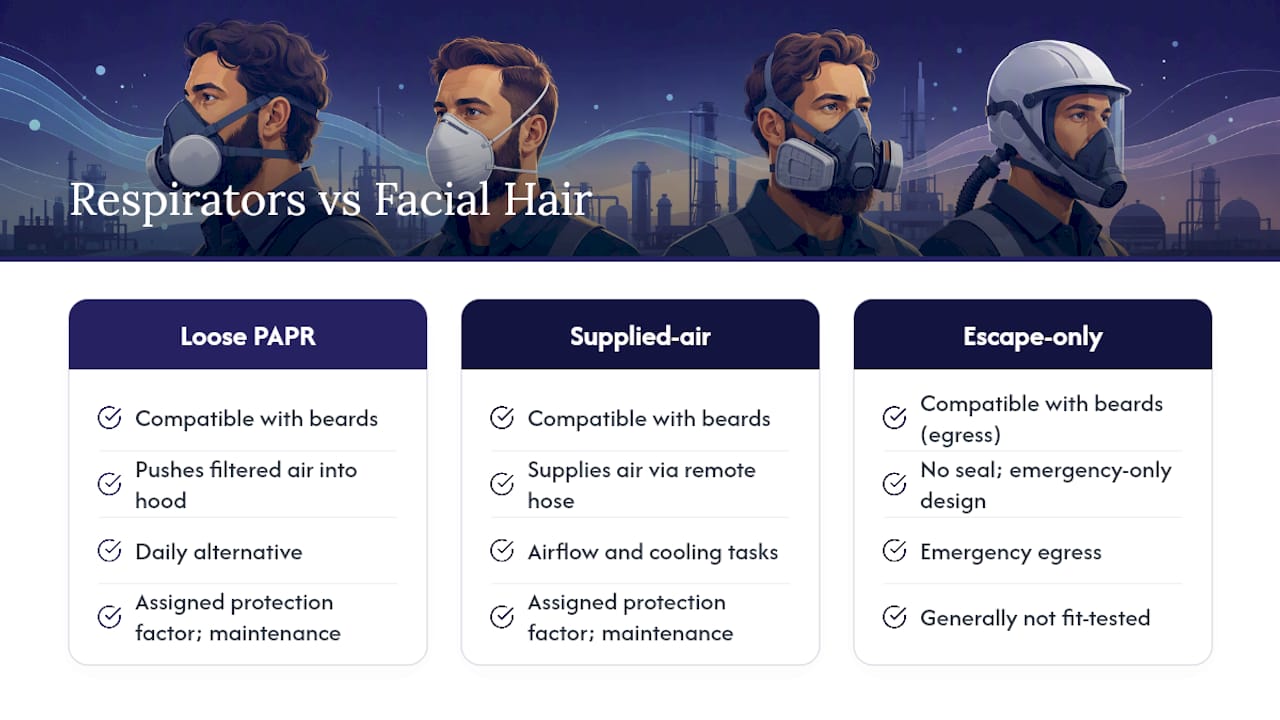
What doesn’t work: filtering facepieces (the disposable N95 style), half-masks, and full-face elastomeric respirators. Every one of these depends on that skin-to-facepiece contact, and every one fails the moment hair crosses the seal line.
Pro Tip: When budgeting for PAPRs, factor in more than the unit price. Battery charging routines, filter and hose replacement schedules, and hygiene protocols between shifts all add ongoing cost that a half-mask never carries.
Fit testing rules and what employers need to do
Fit testing exists to confirm a respirator actually seals against an individual’s face, and that test is only meaningful if nothing interferes with the seal on the day. NIOSH, OSHA, and ANSI guidance all converge on the same point: a fit test should never be conducted on someone with facial hair crossing the sealing area, because the result is meaningless if the seal itself is compromised. International standards bodies including OSHA under 29 CFR 1910.134 apply this consistently, and 3M’s guidance treats anything beyond a day’s stubble growth as facial hair for enforcement purposes.
When a worker can’t or won’t shave, employers have a short list of legitimate responses:
Offer a loose-fitting PAPR or supplied-air alternative that doesn’t require a tight seal.
Reassign the worker to tasks that don’t require respiratory protection with a face seal.
Arrange a medical evaluation if the facial hair relates to a skin condition or other health issue.
Document any accommodation, including the reason, the alternative provided, and the date it was arranged.
Daily user seal checks still matter for anyone using a tight-fitting device, and records of fit tests, accommodations, and seal check failures should sit in the same file. If an incident review ever asks why someone was wearing a half-mask with a moustache, that paperwork is what protects the business.
Beard bands and the Singh Thattha technique: promising, not proven
A handful of experimental fixes have circulated in industrial hygiene circles for years. Beard bands compress facial hair flat against the jawline in an attempt to create a smoother sealing surface. The Singh Thattha technique, named after its developers, uses a specific taping and compression method aimed at the same goal.
Statistic Callout: NIOSH’s current position treats these methods as promising but not validated, meaning no agency currently accepts them as a substitute for a documented passing fit test.
Points worth weighing before an employer considers trialling either method:
Neither has cleared the bar that would let a safety professional rely on it for compliance purposes.
3M’s guidance advises against depending on facial hair management techniques for fit assurance, on the same seal-integrity grounds covered earlier.
Facial hair changes daily. Even a genuinely effective technique today doesn’t guarantee tomorrow’s fit, which is part of why regulators stay cautious.
If a workplace does want to experiment, treat it as a controlled trial rather than a policy. Quantitative fit testing with proper documentation, repeated across multiple days, is the only way to know whether it’s holding up. Even then, keep a loose-fitting alternative on hand as the fallback.
What on-site fit testing actually reveals
Running fit tests across a real workforce surfaces problems no policy document predicts. Facial hair is consistently one of the top reasons a scheduled test can’t proceed on the day, alongside workers arriving mid-shift with two days’ stubble because they didn’t realise the rule applied to them.
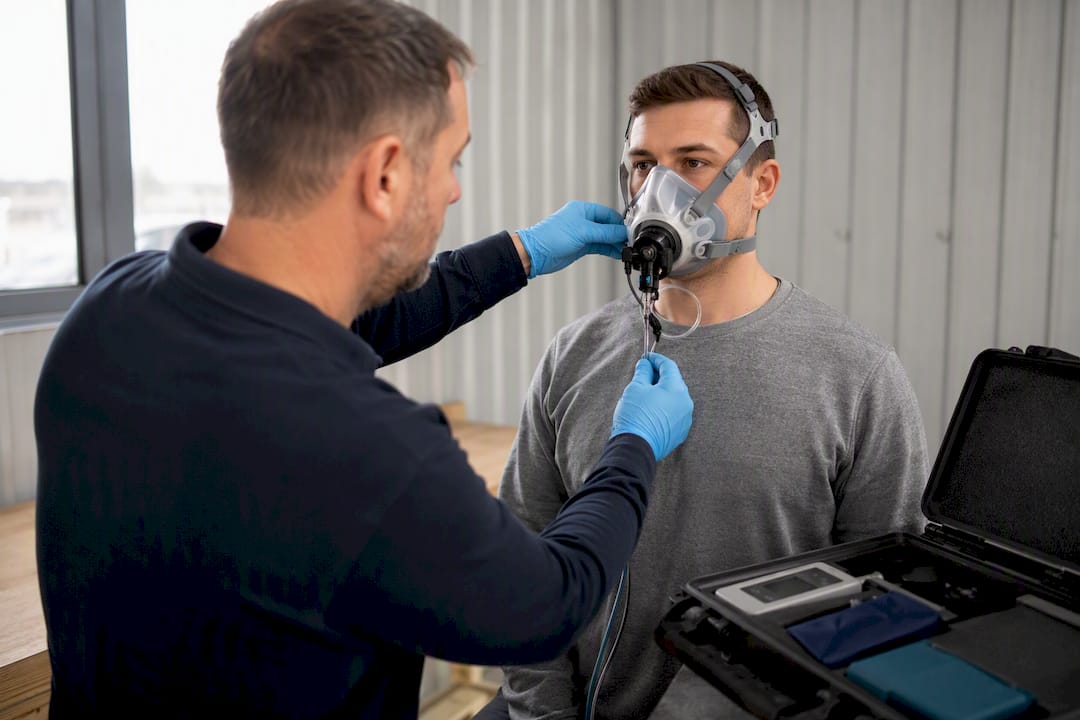
Mobile, on-site testing removes a lot of the friction that causes this. Workers get tested where they already are, on rosters that suit remote sites and shift patterns, rather than losing a day travelling to a clinic. What usually comes out of a tailored session is a clear picture of who needs a different respirator category altogether, not just a different mask size, plus documentation that stands up if WorkSafe or an internal audit comes asking.
Pro Tip: Book fit testing on the same day new starters are inducted. Sorting facial hair policy before day one on site avoids losing shift hours later.
Book fit testing and training with Primetraining
Getting this right on paper is one thing. Getting it right across a whole crew, on a mine site or in a workshop, is another. Primetraining runs Respirator Protective Equipment fit testing on-site and mobile, so you’re not pulling workers off a remote job to chase a clinic appointment in town.
A booked session provides clear pass or fail results for each worker and a compliance record for auditing, with certificates issued upon testing completion. For crews working in confined spaces, our confined space and gas test atmosphere course covers fit-for-purpose respirator selection alongside the fit-testing requirements that apply. Trainers bring industry-relevant experience, which matters when half your crew has genuine reasons for keeping a beard and needs a real alternative, not a lecture about shaving. Book online to lock in a date, or check our full course list to bundle fit testing with other compliance training your site needs.
The bottom line on facial hair and respiratory protection
The rule hasn’t changed in decades and it isn’t going to bend for convenience: if the protective equipment depends on a seal, facial hair in that seal defeats the purpose of wearing it at all. Stay clean-shaven where a tight-fitting respirator is the only option, or move the worker to an approved loose-fitting system instead of hoping stubble won’t matter that day. Document every accommodation properly and treat fit testing as a genuine checkpoint, not paperwork. Get in touch with Primetraining if your site needs on-site fit testing done properly.
— Vapour
Sources
Recommended
Comments