
Employers: Verify First Aid Certificates via USI Transcripts, Not PDFs

The fastest authoritative way to verify a first aid certificate is to view the holder’s USI VET transcript or confirm the Statement of Attainment directly with the issuing RTO. Both routes rely on national systems, not the certificate itself. If a holder can’t share a transcript straight away, ask them to request their Statement of Attainment and quote the RTO code, unit codes (like HLTAID011), and enrolment number so you can check it against training.gov.au.
TL;DR:
Verifying a first aid certificate requires checking the USI VET transcript or Statement of Attainment via the issuing RTO, not the certificate itself.
USI transcripts take time to update after completion, so a recent course may not appear immediately, which is normal.
Confirm the RTO registration and scope on training.gov.au to ensure the unit codes and dates are valid and current.
Examine the physical certificate for correct unit codes, the RTO details, and verification features like QR codes or online links.
Restrict safety-critical duties if a record is missing or suspicious until the RTO confirms or authorities review the case.
Table of Contents
Step-by-step checklist to verify first aid certification
Employers and individuals can confirm most first aid credentials quickly using these steps. Each one builds on the last, so work through them in order rather than jumping straight to the certificate itself.
Request the holder’s USI transcript. Ask them to log into the USI Student Portal and grant your organisation ‘view’ access to their VET transcript. This takes the holder a short time and gives you a government-authenticated record.
If no transcript is available yet, request the Statement of Attainment. Ask for the RTO name, RTO code, and the specific unit codes completed. This is your fallback when transcript access isn’t practical or the record hasn’t updated.
Confirm the RTO on training.gov.au. Search by name or code to check the provider is currently registered and that HLTAID011 or HLTAID009 sit within its scope.
Use any QR code or verification link printed on the certificate, then save copies of everything you’ve checked.
A few things worth remembering along the way:
The USI number alone shows nothing. Without shared access, third parties can’t see any training history attached to it.
Recent course completions can lag behind in national systems, so a missing transcript entry doesn’t automatically mean a fake certificate.
Using the USI VET transcript: permissions, contents, and timing
A USI VET transcript lists every unit of nationally recognised training a person has completed since 1 January 2015, and it’s government authenticated, which makes it the strongest single piece of evidence you can ask for. It’s not something you can pull up yourself. The holder has to grant access through their USI account, selecting your organisation by name or code and choosing how long that permission stays active, anywhere from three months to two years.
Build this step into onboarding rather than treating it as an afterthought, because chasing transcript access after someone’s already on-site working solo is the wrong time to discover a gap.
Here’s the catch employers routinely miss:
RTOs submit completion data to national collections on their own schedules, not the moment training finishes.
Recent completions can take several weeks to months to appear in a transcript, depending on the RTO’s reporting cycle.
If someone finished their course last week and their transcript looks empty, that’s not necessarily a red flag. It’s usually just the system catching up.
Checking the issuing RTO on training.gov.au
Every registered training organisation in Australia has a public profile on Training, and reading it properly takes about two minutes.
Search the RTO by name or its unique RTO code, which appears on most certificates and Statements of Attainment.
Confirm the registration is current and check the start and end dates listed against the training period in question.
Scroll to the scope of registration and look for the specific unit codes, such as HLTAID011 or HLTAID009, listed with their own start and end dates.
A scope entry with an end date in the past, or a unit that simply isn’t listed, is worth a direct call to the RTO before you draw any conclusions. Scope details change, RTOs add and drop units, and an organisation’s registration profile will show you exactly when that happened. Ambiguity here isn’t proof of fraud, but it’s a reason to pick up the phone rather than assume.
What to check on the physical certificate
The certificate or Statement of Attainment itself carries several markers worth a close look before you accept it at face value.
Confirm it names the correct unit codes, HLTAID011 or HLTAID009, alongside the RTO’s full name and RTO code.
Check for the nationally recognised training logo, a certificate identifier or booking number, the issue date, and the assessor’s name.
Look for a QR code or online verification link the RTO has embedded for exactly this purpose.
Red flags include mismatched names between the certificate and photo ID, blurry or low-resolution printing, missing identifiers altogether, a sender email address that doesn’t match the RTO’s actual domain, or a QR code that leads nowhere.
Pro Tip: Keep a screenshot of any QR verification result alongside the certificate. Links can expire or break later, and you’ll want proof you checked it at the time.
How long first aid certificates stay valid
HLTAID011, the current unit for Provide First Aid, is commonly treated as a three-year credential before refresher training is expected. The CPR-specific unit, HLTAID009, typically needs annual renewal because CPR technique and guidelines shift more often than broader first aid content.
Those intervals aren’t set in stone across every industry. Childcare, mining, and construction workplaces often layer their own conditions on top of the national minimums, so check your specific employer policy or industry code before assuming a three-year window applies unchanged.
If a record is missing or you suspect a fake certificate
Missing records don’t always mean fraud, but they need a proper process rather than a shrug.
Contact the issuing RTO directly and quote the certificate identifier or enrolment number from the Statement of Attainment.
Keep a written log of every request you send and every response you get back.
If the RTO can’t confirm the record, or appears to be deregistered, escalate to ASQA or the relevant state VET regulator, along with USI support, and bring your evidence with you.
While that’s underway, restrict the person from safety-critical duties until you’ve got a confirmed answer. It’s a precaution, not an accusation, and it protects everyone on site while the paperwork catches up.
How Prime First Aid and Training issues and verifies certificates
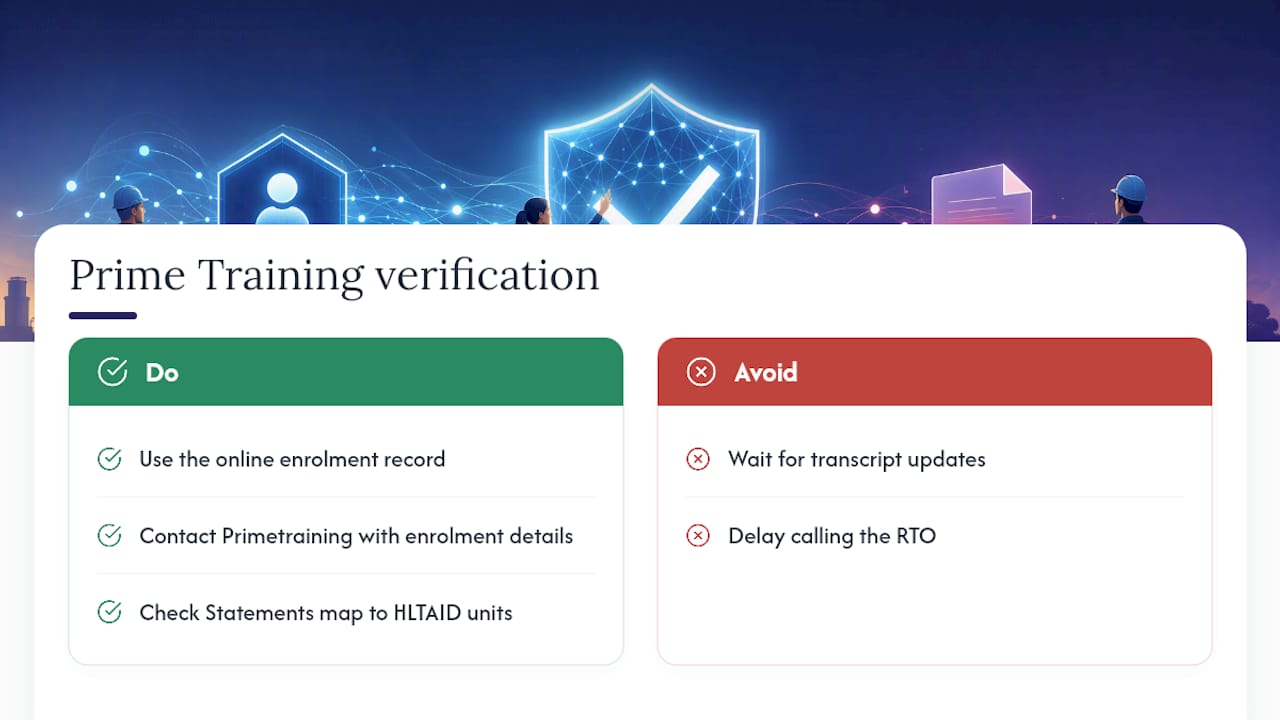
Statements of Attainment are issued mapped directly to the relevant HLTAID units, and certificates are sent to participants promptly after course completion. Bookings run through an online system, which gives employers a clear enrolment record to point to if verification is ever needed down the track.
If you’re an employer chasing a fast confirmation, or a participant who’s misplaced a certificate, contact Primetraining directly with your enrolment details or booking reference. Because course records sit with the RTO that delivered the training, a quick call is often faster than waiting on a transcript update, particularly in the weeks right after a course finishes.
Book verified first aid training with Prime First Aid and Training
This provider offers a practical option for businesses that need timely certification, whether at remote sites or construction crews requiring staff certification before shifts. On-site, mobile, and online delivery of HLTAID011 and HLTAID009 means training happens where your team already is, and certificates go out fast enough that you’re not chasing records weeks later just to prove someone’s covered.

Group bookings are straightforward through the online booking system, and if you’ve got a mixed team needing different units, from confined spaces to construction site safety, the full course range covers it in one place. If you need a replacement certificate or want to confirm a booking reference before an audit, it’s best to get in touch directly rather than waiting on a transcript to update. Book your next course today and skip the paperwork chase later.
What employers usually get wrong about verifying credentials
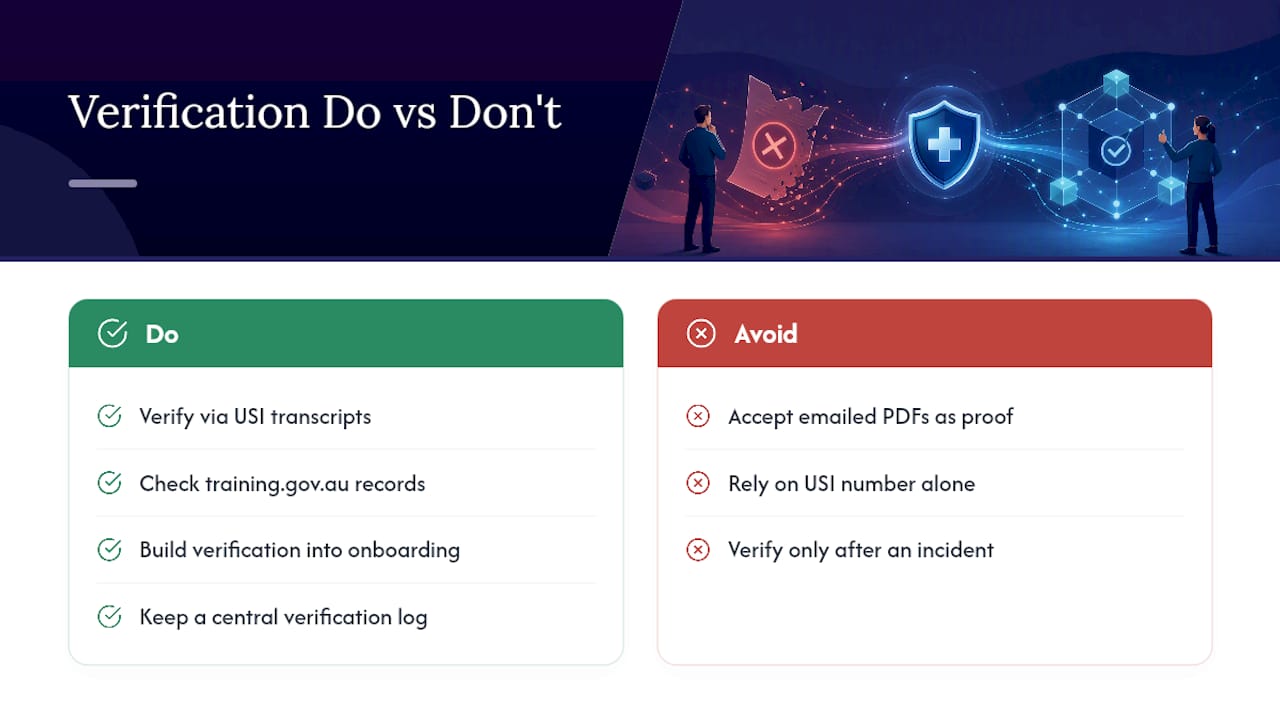
The biggest mistake employers make is treating an emailed PDF as proof. A certificate is only as good as the record behind it, and that record lives on training.gov.au and in the USI system, not in someone’s inbox. The second mistake is assuming a USI number alone tells you anything. It doesn’t, not without the holder actively granting access.
Build verification into onboarding, not into a crisis after an incident. Keep a central log of every check you’ve run, every transcript you’ve viewed, and every RTO confirmation you’ve received. It’s the difference between a five-minute audit response and a scramble.
— Vapour
Sources
Recommended
Comments